

Blog Body
An AI model can perform well in a demonstration and produce encouraging results on a selected dataset, yet encounter problems when connected to business systems and real users. That does not make the proof of concept worthless. It means the experiment answered a limited question, while production requires additional evidence.
After a successful proof of concept, ask whether the organization can operate the service, detect errors, and restore a safe process when something fails. This article proposes a practical readiness review for business, technology, and data teams in Saudi Arabia. The tables and examples are editorial decision aids to adapt to the use case, not an official certification or a prescribed approval checklist.
State what the experiment actually proved
Prepare a short account of what was tested and what was not. Which data was used? Who participated? Were records historical or live? Did an expert review the outputs? Were business systems connected, or were files used in their place?
Success on clean documents does not establish performance on incomplete records or poor-quality scans. Success under an account with unrestricted access does not establish safe behavior for employees with different permissions. Preserve the positive result, but record the boundaries of the evidence alongside it.
RMG’s earlier article on proofs of concept in government organizations discusses experiment design and documentation in Arabic. This article moves to the next question: preparing a service for everyday work. It does not assume that a successful model satisfies any government assessment requirement. [6]
Test the complete work journey
Trace a request from its data source through identity checks, model invocation, output presentation, human review, and the final action or saved record. At each transition, specify what happens when data is missing, a response is late, access is denied, or a request is repeated.
Include deliberate failures as well as successful cases. For example, disconnect the source system in a test environment. Does the employee see a clear data-unavailable message, or a plausible answer based on an outdated copy? Then submit the same request again. Does the application create a duplicate transaction? Test these behaviors before giving the system authority to change operational records.
Google Cloud’s MLOps guidance distinguishes building a capable model from operating an integrated system and describes testing that covers data and models as well as software [1]. It is a technical reference, not a requirement to adopt a particular cloud platform.
Assemble evidence for the operating decision
| Readiness area | Decisive question | Inspectable evidence |
| Integration | Does the complete journey work, including failures? | End-to-end results covering permissions and retries |
| Task quality | Are acceptance criteria met in consequential cases? | A preserved test set and results by case and error category |
| Monitoring | Will deterioration be detected and acted upon? | Indicators, alert thresholds, and a tested notification route |
| Recovery | Is there a safe alternative if the service fails? | A rollback or manual-fallback exercise and its outcome |
| Operating ownership | Are responsibilities and resources in place? | A service owner, support roles, procedures, and cost estimates |
Mark each area as evidenced, needing remediation, or out of scope with a reason. Avoid turning the review into a percentage that hides a critical issue. A monitoring dashboard cannot compensate for a failed permissions test.

Conceptual illustration of testing the full service, including documents, integration and failure cases.
Test the cases that matter to users
Include cases that could change an employee’s decision, rather than selecting only convenient examples. Examine results by meaningful groups: document type, language, input quality, or transaction category. A strong overall average can conceal poor performance in an infrequent but consequential group.
Keep acceptance examples separate from material used to tune the solution. Preserve a record linking each result to the model, instructions, configuration, and knowledge-source versions. That record helps explain a difference after something changes. For a generative assistant, include unsupported answers, inappropriate source citations, and attempts to push the system beyond its permitted scope alongside ordinary response-quality tests.
There is no single accuracy threshold appropriate for every use case. Agree with the process owner which errors can be tolerated, which outputs need human review, and which findings prevent release. Preparing a draft for an employee is a different operating arrangement from executing a consequential action without review.
Make monitoring lead to an action
Monitoring should establish more than whether a server is running. Organize it around three questions: Is the service available within the required response time? Are outputs still suitable for the task? Is the practical benefit acceptable in relation to effort and cost?
For each indicator, record its source, review frequency, owner, and the action to take when a boundary is crossed. A temporary increase in human referrals may be manageable. Exposing a document to an unauthorized user may require the affected route to be stopped immediately. Define the response according to risk before an incident occurs.
NIST’s AI RMF includes post-deployment monitoring, response, recovery, change management, and responsibilities for disengaging or overriding systems when necessary [2]. It is voluntary risk-management guidance, not Saudi legislation [3].
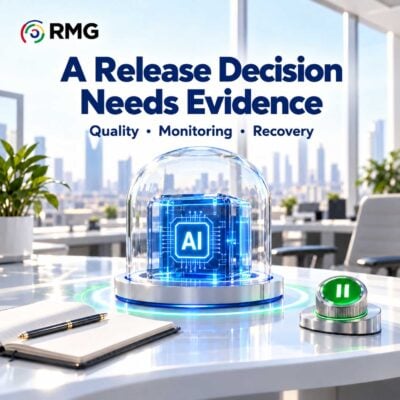
Conceptual illustration of monitoring and the ability to pause or recover the service.
Name the operating owner before launch
The project manager coordinating delivery is not automatically the service owner after handover. Identify who is accountable for continuity, who investigates quality deterioration, who maintains knowledge sources, and who approves changes. Users should also know where to report an error and how to track its resolution.
Provide a short operating guide that can be used during an outage. How is the current state checked? When is a problem escalated? How is a known acceptable version restored? How does work continue without the AI component? Test the guide with the people expected to use it. A document that is clear to its author is not necessarily executable when that person is unavailable.
Assign data responsibility before production
In a Saudi organisation, document the service data, purpose and access permissions before release. If personal data is involved, have the responsible specialist review the applicable Personal Data Protection Law and regulations. Technical success does not establish compliance [5].
For the operating review, attach a list of data sources, receiving parties and source owners. Separate test data from live records, define what may be logged for diagnosis and remove unnecessary details. These are proposed organisational steps to support review, not a complete legal checklist.
A hypothetical example: document extraction
Suppose a proof of concept successfully extracts fields from a collection of documents. Before production, an end-to-end test reveals that a connection failure triggers a repeated request and creates a duplicate record. A second test shows that poor-quality scans can produce apparently complete fields whose correctness is uncertain.
The remaining work is to prevent duplicates, route unresolved cases to a reviewer, and test corrections before a record is saved. Initial use might be limited to suggestions that an employee must review. The service owner can then decide whether to expand on the basis of evidence. This hypothetical example does not describe an RMG customer project or claim a measured performance result.
Record one of three release decisions
A readiness review can conclude with release within a documented scope, a limited operational trial with controls and human review, or postponement until specific blockers are resolved. In every case, record the decision owner, version, limitations, and criteria for expansion or rollback. A restricted trial is not unrestricted permission for new uses.
This decision record turns a successful experiment into an operating responsibility that can be followed through. Organizations can discuss the remaining work with RMG through its innovative AI solution development offering [4], using the experiment results and the required readiness evidence to define the scope. The linked service page is in Arabic. Technical delivery should be evaluated against the agreed operating conditions before launch.