

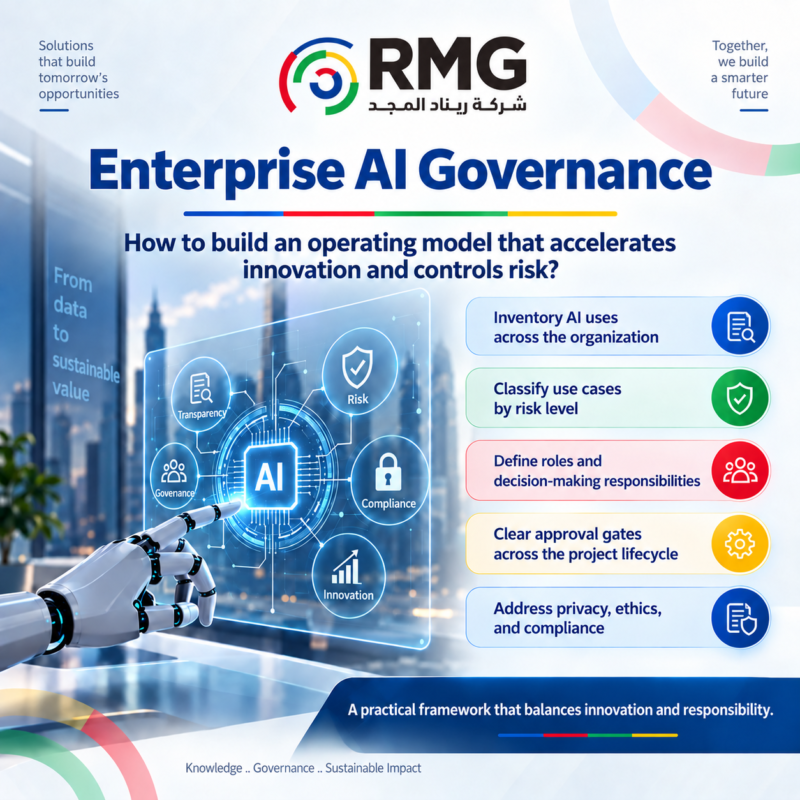
Successful AI adoption depends not only on selecting the right use cases or ensuring data availability, but also on establishing governance that defines who makes decisions, who conducts reviews, what may be used, when a solution can be deployed, and how it is monitored once operational.
Once an organization begins identifying AI use cases and preparing the data they require, a new challenge emerges: different departments start experimenting with AI tools, vendors propose multiple solutions, and employees use external tools to accelerate their work, while technology, data, security, and legal teams each approach the subject from their own perspective.
At this stage, the organization may have a growing number of initiatives without necessarily having an enterprise-wide system for managing AI.
This is where AI governance comes in.
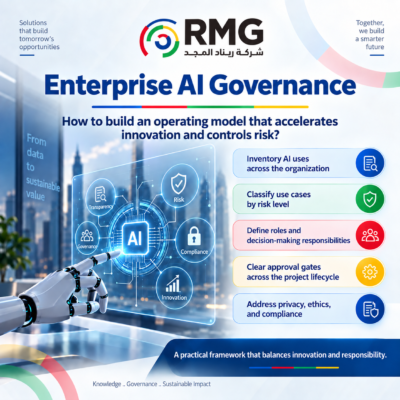
Governance is not about stopping experimentation or adding lengthy layers of approval. It is about establishing clear rules that enable the organization to use AI in a structured and accountable manner, so that management knows which systems are in use, their associated risks, who is responsible for each decision, and which conditions must be met before moving from an idea to operational deployment.
In its published service offerings, Renad Al Majd defines AI governance as a system of policies, procedures, and standards designed to support the responsible use of AI, with a focus on transparency, fairness, accountability, privacy, and risk management. [1]
Why Is a Single AI Policy Not Enough?
Some organizations begin by issuing a general policy stating, for example, that AI must be used responsibly, sensitive data must not be entered into publicly available tools, and management approval must be obtained before implementing any solution.
This is a good starting point, but it is not sufficient on its own.
The challenge emerges during practical implementation. What happens when the human resources department wants to use a model to analyze résumés? Who determines whether the use case is high-risk? What happens when the beneficiary services department wants to use a generative language model? Who reviews the knowledge sources? Who approves the instructions provided to the model? Can the model take action within a system, or is it limited to making recommendations?
Effective governance turns these questions from discussions repeated in every project into a clearly defined, organization-wide operating process.
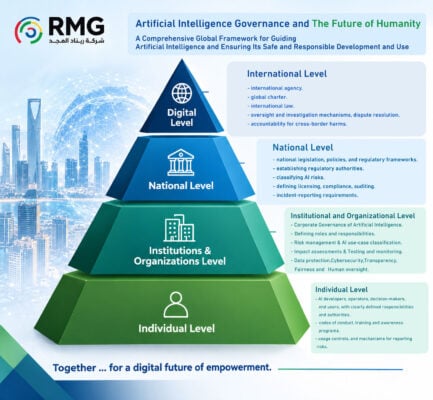
This is why the international standard ISO/IEC 42001:2023 does not treat AI as a standalone technology project. Instead, it specifies requirements for establishing, operating, maintaining, and improving an AI management system within an organization. It is an international management system standard—not, in itself, binding Saudi legislation. [2]
Similarly, the NIST AI Risk Management Framework and its supporting implementation tool provide a voluntary approach to managing AI risks through interconnected functions encompassing governance, understanding the context, measurement, and risk management. NIST emphasizes that the framework is intended for voluntary use and can be adapted to an organization’s needs. [3]
Start by Taking an Inventory of AI Across the Organization
It is difficult to govern something the organization does not know exists.
One of the first practical activities proposed, therefore, is to establish an enterprise-wide register of AI systems and use cases.
The register should not be limited to large projects managed by the IT department. It may also need to include tools used individually by employees, AI capabilities embedded in previously purchased systems, or third-party services that use AI models without this being apparent to the end user.
At a minimum, the register should answer questions such as: What is the system called? What is its purpose? Who is its organizational owner? Who is the vendor or developer? What data does it use? Does it generate recommendations or take action? Who is affected by its outputs? Does it handle personal data or sensitive information?
The intended outcome of this stage is more than a technical list. It is a map that enables leadership to understand where AI is being used and why.
Classify Use Cases by Risk Instead of Treating Them All Alike
One mistake that can turn governance into a burden is applying the same approval procedures to every use case.
Using a tool to help rephrase internal text is not equivalent to using a model that makes a recommendation about a beneficiary’s eligibility. Likewise, a tool that summarizes a published report differs from a system that processes personal data or takes action within a financial system.
The organization can therefore develop an internal risk classification that links the level of review to the nature and impact of each use case.
The following table presents a proposed practical model, not an official regulatory classification:
| Risk Level | Illustrative Example | Proposed Governance Approach |
| Low risk | Summarizing public content or supporting internal drafting that does not involve restricted information | Basic usage controls and user awareness |
| Medium risk | An internal knowledge assistant that provides information to employees | Assessment of data and sources, access permissions, testing, and monitoring |
| High risk | A model that influences a decision concerning a beneficiary, employee, or vendor | Expanded risk assessment, multidisciplinary review, human oversight, and approval before deployment |
| Critical or unacceptable in its current state | A use case whose risks cannot be explained, or for which the necessary controls cannot be established | Redesign or suspension until the blocking issues are resolved |
The key advantage of this approach is that it allows low-risk innovation to move quickly while increasing scrutiny as the impact of a decision grows.
Define Decision Ownership: Technology Teams Cannot Govern AI Alone
AI is multidisciplinary, making it difficult for a single function to manage it independently.
Business teams understand the need and the expected value; data teams understand data quality and sources; cybersecurity teams review technical risks; legal and compliance teams review legal and regulatory requirements; and technology teams know how to build and operate the solution.
The organization therefore needs an accountability and decision-making model.
An AI governance committee may be appropriate for some organizations, while those with a large portfolio may need an AI office or a permanent central function. Other organizations may distribute responsibilities across existing departments, provided that authority is clearly defined.
The organizational title matters less than clarity of responsibility.
Every project must identify the use case owner accountable for value, the technical lead, who reviews the data, who accepts residual risk, and who has the authority to approve deployment or suspend the solution’s operation.
Establish Clear Decision Gates Across the Project Lifecycle
Governance becomes practical when it is linked to actual decision points.
For example, an organization can require a use case to have a defined owner, value, data sources, and risk level before moving from ideation to proof of concept. It can require specific tests to be passed before progressing from proof of concept to pilot operation. Moving from pilot to production can then depend on demonstrating that acceptance criteria have been met and that a monitoring and support plan is in place.
In this way, governance moves from being a document to a set of decision gates.
It is useful to link each gate to specific evidence: a use case profile, a data assessment, a risk assessment, test results, a list of known limitations, a human oversight plan, an approval log, and a post-deployment monitoring plan.
This practice also helps prevent a common problem: moving directly from a successful, limited demonstration to enterprise deployment without assessing what changes when the solution interacts with real users, data, and integrations.
Do Not Separate AI Ethics from the Approval Process
The Saudi Data and Artificial Intelligence Authority (SDAIA) provides AI principles, as well as generative AI principles for government entities and the general public, addressing considerations and practices related to the responsible use of these technologies. [4]
The National Data Governance Platform also provides an AI Ethics Self-Assessment tool, which enables entities to compare their practices against defined standards and demonstrate a model’s level of ethical compliance. [5]
In practice, ethics should not remain a general topic in an awareness document. It can be translated into questions embedded in the approval process for each use case: Can users recognize that they are interacting with an AI system when appropriate? Is there a possibility of bias? Can the basis for a recommendation be explained to the degree required by the use case? Can a human review or challenge the decision when the situation requires it?
In this way, the principles become part of design and testing rather than a statement detached from the project.
Privacy Is Not an Item at the End of a Checklist
When AI systems process personal data, the requirements of the Personal Data Protection Law (PDPL) and its Implementing Regulations become part of the legal and regulatory considerations that the entity must identify and apply according to the nature of the processing.
The National Data Governance Platform explains that SDAIA oversees the implementation of the PDPL and its Implementing Regulations. The law also sets out the obligations of data controllers and processors and the rights of data subjects. [6]
Privacy should therefore not become a consideration only after the model has been completed. From the use case design stage, the organization must define the purpose of processing, which personal data the solution actually needs, who can access it, where it is processed, how it is retained or destroyed, and which other controls apply.
A distinction must be made between binding legal and regulatory requirements and voluntary international frameworks and standards that can support the design of the governance system. Implementing ISO/IEC 42001 or drawing on NIST does not automatically establish compliance with Saudi laws and regulations.
Establish Clear Rules for Employees’ Use of Generative AI
An important aspect of governance now takes place outside formal AI projects.
An employee may use a generative AI tool to draft an email, analyze a document, summarize a meeting, or write code. Enterprise AI governance must therefore cover employees’ day-to-day use, not just formally developed applications.
Suggested practices include defining approved tools, the types of information that may be entered, what requires human review, how to handle unverified outputs, and which uses are prohibited or require prior approval.
Awareness is essential because a significant share of the risks arises not only from poor system design, but also from using the right tools in inappropriate ways.
Hypothetical Example: An Intelligent Assistant for Policies and Procedures
Suppose a government entity plans to launch an intelligent assistant that answers employees’ questions about internal policies and procedures.
From a technical perspective, the project may appear straightforward: upload the documents and connect them to a language model.
Governance, however, reveals a deeper set of questions.
Who determines which document is the authoritative version? What happens when a recent circular conflicts with an older policy? Can all employees see the same content? How does the system handle a question for which no answer is available? Can it provide an answer without citing its source? Is it allowed to execute a request within a system, or is its role limited to providing information?
The governance model can then be designed so that the policy owner is responsible for approving the content, the technology department is responsible for operations, and the data and security functions define access levels. The system can also be required to display its sources and avoid giving definitive answers when reliable information is unavailable.
Before deployment, the solution is tested against a set of routine questions and edge cases, then introduced within a limited scope. If unsupported answers or access-permission issues emerge, they should not be viewed simply as “model errors,” but as signals to improve governance, content, and design.
This example demonstrates that good governance does not obstruct the solution; it helps the organization understand what is required to use it with greater confidence.
Which Metrics Can Be Used to Measure AI Governance Maturity?
Governance should not be measured solely by the number of policies an organization has issued.
An entity can track the proportion of identified use cases recorded in the register, the percentage of use cases classified by risk, the percentage assessed before deployment, the average approval time by risk level, the number of open risks, the percentage of systems with a clearly identified business owner, and the percentage of systems subject to periodic monitoring.
It can also track the number of incidents or unapproved uses, the percentage of employees who have completed awareness programs, and the number of systems suspended or redesigned as a result of review findings.
A good metric does not merely demonstrate that governance exists. It shows whether governance is actually helping the organization identify risks and make decisions at the right time.
How Can Renad Al Majd (RMG) Support AI Governance?
Renad Al Majd (RMG) offers specialized AI governance consulting services, including AI strategy development, the design of tailored governance frameworks, compliance and performance assessment, training and capacity building, AI ethics consulting, and the management of risks associated with AI applications. [1]
RMG also provides services for developing AI solutions and use cases, enabling governance to be connected to the practical realities of the solutions that will operate within the organization rather than being developed separately from implementation. [7]
The governance journey can begin with a current-state assessment, an inventory of AI uses, and the identification of roles and risks. This can be followed by the development of policies, procedures, approval gates, and monitoring metrics tailored to the organization’s nature and the regulations and requirements that apply to it.
If your organization has already started using AI or is preparing to expand its portfolio of use cases, the Renad Al Majd team can help you build a governance framework that transforms fragmented uses into a clear, manageable enterprise-wide system.
Conclusion
As AI adoption expands, the need for governance grows.
The goal, however, is not to build a complex approval system. It is to create an environment in which everyone understands the rules: Which use cases exist? Who owns them? What are their risk levels? Who approves them? What testing is required? How are they monitored once operational?
A mature organization does not ask only, “Can we build this solution?” It also asks a more important question: “Can we operate it responsibly, accountably, and sustainably across the organization?”