

Introduction
The world is witnessing unprecedented advances in Artificial Intelligence (AI), opening enormous opportunities for development, innovation, and improved quality of life. At the same time, AI presents risks that extend beyond the boundaries of individual countries and organizations.
Therefore, treating AI as merely a technological issue is no longer sufficient. There is a growing need to establish a comprehensive global framework that ensures AI development and use remain focused on serving humanity while protecting societies from harmful or uncontrolled applications.
- The Need for a Global AI Governance Framework
AI technologies have the ability to operate across borders and influence economies, security, information ecosystems, privacy, labor markets, and decision-making processes.
Future AI governance should therefore be based on the principles of safety, accountability, transparency, fairness, protection of rights, human oversight, and international cooperation, while adopting a risk-based approach that imposes stricter requirements as the level of risk or the scope of impact of an AI system increases.
- Establishing an International Artificial Intelligence Agency
It is proposed that a specialized International Artificial Intelligence Agency be established to serve as a global reference point for coordination, oversight, and cooperation.
Its responsibilities could include:
- Developing international AI standards.
- Classifying high-risk AI systems.
- Establishing safety and testing requirements.
- Sharing information on AI-related risks and incidents.
- Supporting countries in developing regulatory and governance capabilities.
- Establishing an international registry for high-impact AI systems.
- Strengthening cooperation in responding to cross-border AI risks.
- Developing a Global AI Charter
A global AI charter should be developed to establish the fundamental principles governing the development and use of AI.
These principles should include:
- Human primacy and human-centered AI.
- Do no harm.
- Respect for human dignity and fundamental rights.
- Fairness and non-discrimination.
- Privacy and data protection.
- Transparency and explainability, where appropriate.
- Security and safety.
- Accountability.
- Sustainability.
- Effective human oversight of high-impact and sensitive decisions.
- Adopting an International AI Law
Alongside ethical principles, there is a need for an international legal framework defining obligations, responsibilities, and prohibited practices.
Such a framework could regulate:
- The development and deployment of high-risk AI systems.
- Pre-deployment testing and assessments.
- Reporting of serious AI-related incidents.
- Liability for damages caused by AI systems.
- The use of AI in critical and sensitive domains.
- Controls over autonomous AI systems.
- Cooperation in cross-border investigations.
At the same time, the framework should allow individual countries to develop more detailed national legislation in accordance with their specific circumstances and sovereignty.
- An International Court or Specialized Mechanism for AI Disputes
As AI adoption expands, new disputes and cross-border harms may emerge that cannot be adequately addressed through traditional legal frameworks alone.
Therefore, the establishment of a specialized international AI court, or an international judicial and arbitration mechanism, could be considered to address major disputes related to AI, determine liability, resolve disputes between relevant parties and states, and develop international judicial principles that contribute to a consistent understanding of liability for damages caused by high-risk AI systems.
- A Global Risk Classification and Oversight Framework
AI applications should be classified according to their level of risk.
Low-risk applications could be subject to simplified requirements, while high-risk AI systems should be subject to stringent requirements, including:
- Impact assessments
- Safety and security testing
- Data quality controls
- Independent validation
- Documentation and traceability
- Continuous monitoring
- Incident response plans
- Safe shutdown and intervention mechanisms when necessary
- Integrated Hierarchical Governance: From the International Level to the Individual
Effective AI governance cannot be achieved through international laws alone, nor through the internal controls of organizations operating independently.
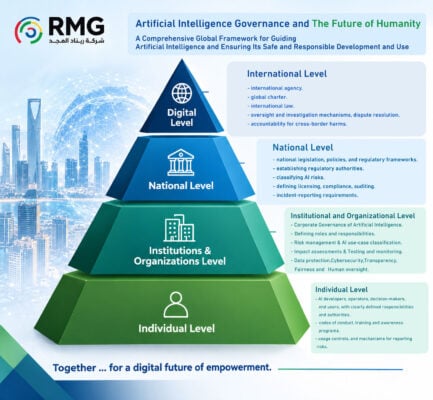
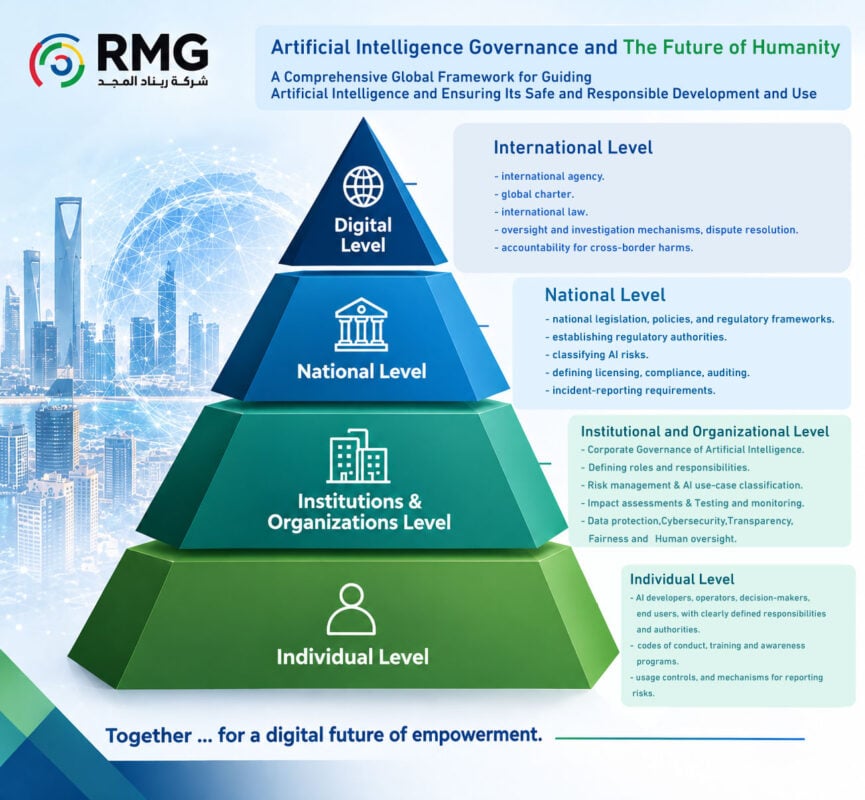
Instead, an integrated, hierarchical AI governance model should be established, through which principles, responsibilities, and controls flow from the international level to the national level, then to organizations and institutions, and ultimately to the individual AI user or developer.
This model ensures that there are no gaps between global regulation and practical implementation, and that ethical and legal principles are translated into measurable and accountable practices.
International Level
This represents the top of the governance hierarchy and includes the international agency, global charter, international law, oversight and investigation mechanisms, dispute resolution, and accountability for cross-border harms.
National Level
Countries would translate international principles and obligations into national legislation, policies, and regulatory frameworks. This level would also include establishing regulatory authorities, classifying AI risks, and defining licensing, compliance, auditing, and incident-reporting requirements.
Institutional and Organizational Level
At this level, legislation is transformed into practical operational controls through institutional AI governance, including:
- Defining roles and responsibilities.
- Risk management.
- AI use-case classification.
- Impact assessments.
- Testing and monitoring.
- Data protection.
- Cybersecurity.
- Transparency.
- Fairness.
- Human oversight.
Individual Level
This level includes AI developers, operators, decision-makers, and end users, with clearly defined responsibilities and authorities, codes of conduct, training and awareness programs, usage controls, and mechanisms for reporting risks.
It should also reinforce the principle that the use of AI does not eliminate human responsibility.
Two-Way Governance Flow
The model operates in two directions:
Top-down: Principles, laws, standards, and controls flow from the international level down to the individual user.
Bottom-up: Performance data, risks, incidents, and lessons learned flow from individuals and organizations to national authorities and ultimately to the international level, enabling continuous improvement of regulations and controls.
International Governance → National Governance → Institutional Governance → Individual Responsibility
Use, Incidents & Risks → Institutional Oversight → National Oversight → International Learning & Development
- Required Technical and Operational Controls
The global AI governance framework should include practical controls throughout the AI lifecycle, including:
- Data governance.
- Model and infrastructure security.
- Bias, robustness, and safety testing.
- Third-party risk management.
- Documentation of data and model sources.
- Post-deployment monitoring.
- Independent auditing.
- Change management.
- Effective human intervention mechanisms.
- Safe system shutdown mechanisms for critical situations.
- International Cooperation and Capacity Building
The success of global AI governance requires ensuring that regulatory controls do not become barriers for countries with limited technological capabilities.
International programs should therefore be established to support:
- Knowledge transfer.
- Capacity building.
- Joint research centers.
- International risk-alert and information-sharing mechanisms.
- Funding for AI safety and reliability research.
At the same time, countries should retain the right to leverage AI technologies to support their economic and social development.
- The Role of Renad Al Majd (RMG) in Developing AI Governance and Controls
Renad Al Majd (RMG) has accumulated expertise in areas including digital transformation, data governance, risk management and compliance, cybersecurity, and the development of institutional policies and frameworks.
This expertise enables RMG to support organizations seeking to establish practical AI governance frameworks.
RMG’s areas of support include:
- Developing AI governance frameworks and controls.
- AI risk and use-case classification.
- AI impact assessments.
- Privacy, transparency, and human oversight controls.
- AI model lifecycle security.
- AI testing and continuous monitoring.
- Third-party AI risk management.
- Auditing and compliance measurement.
- Integrating AI governance into broader Enterprise Governance, Risk, and Compliance (GRC) frameworks.
- A Call for Collaboration
Renad Al Majd (RMG) invites government entities, institutions, companies, regulatory bodies, and research organizations interested in AI governance to engage with RMG and benefit from its expertise in designing, developing, and implementing institutional AI governance frameworks, policies, and controls.
RMG supports organizations in building governance models aligned with the nature of their operations and the risk levels associated with their AI use cases, contributing to greater trust and the safe and responsible adoption of AI technologies.
Conclusion
Protecting humanity from the risks of AI does not mean stopping innovation; rather, it means guiding innovation within a fair, practical, and globally coordinated governance framework.
The proposed approach is based on integrating an international AI agency, global charter, international law, and specialized judicial or dispute-resolution mechanisms with national legislation, institutional governance, and individual responsibility.
Through this approach, AI governance can evolve from a collection of fragmented principles into a connected global governance ecosystem that balances innovation, sovereignty, and development on one side with safety, rights, and accountability on the other.