

Blog Body
When digital transformation initiatives compete for the same budget, every proposal can sound urgent: a service that users need to complete faster, data integration that several teams are waiting for, or an AI assistant intended to improve productivity. Funding each proposal separately, however, does not establish whether the initiatives will work together or whether the organization can deliver them at the same time.
Prioritizing digital transformation initiatives starts with the outcomes the organization needs. It then requires comparing alternatives and choosing a connected set of initiatives that fits both the budget and delivery capacity. The decision should specify what starts now, what needs preparation, what is deferred, and what evidence would justify reconsideration.
Set a realistic funding and delivery boundary
Before comparing proposals, establish the funding available after existing commitments, the period it covers, and the capacity of business, technology and procurement teams. Funding two initiatives does not necessarily provide two delivery teams. Even a small project can stall when it depends on a shared specialist who is already committed elsewhere.
Identify applicable mandatory obligations and critical service continuity needs separately from discretionary proposals. Record the reason for each obligation, its deadline and the minimum response required, then compare efficient ways to meet it. Other initiatives can be considered within the remaining budget and capacity, with the cost and risk of deferral made explicit.
Give every initiative a consistent decision brief
Ask initiative owners to explain the problem, the users affected, the intended outcome and the baseline against which improvement will be measured. Assign a business owner accountable for realizing the benefit, and identify the evidence needed to demonstrate it and when that evidence will be reviewed.
Include delivery, integration, operations, licensing, change management and transition costs. Record the assumptions and uncertainty behind the estimate. Compare alternatives over a common time horizon: improving an existing process or reusing an available platform may be more suitable than purchasing a new solution. The UK Green Book provides guidance for comparing options and assessing costs and benefits over a project’s life [2].
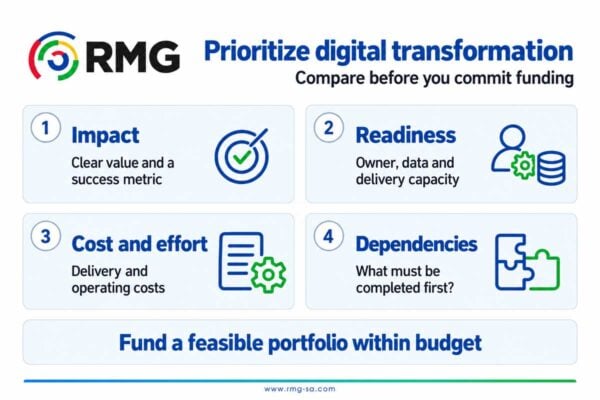
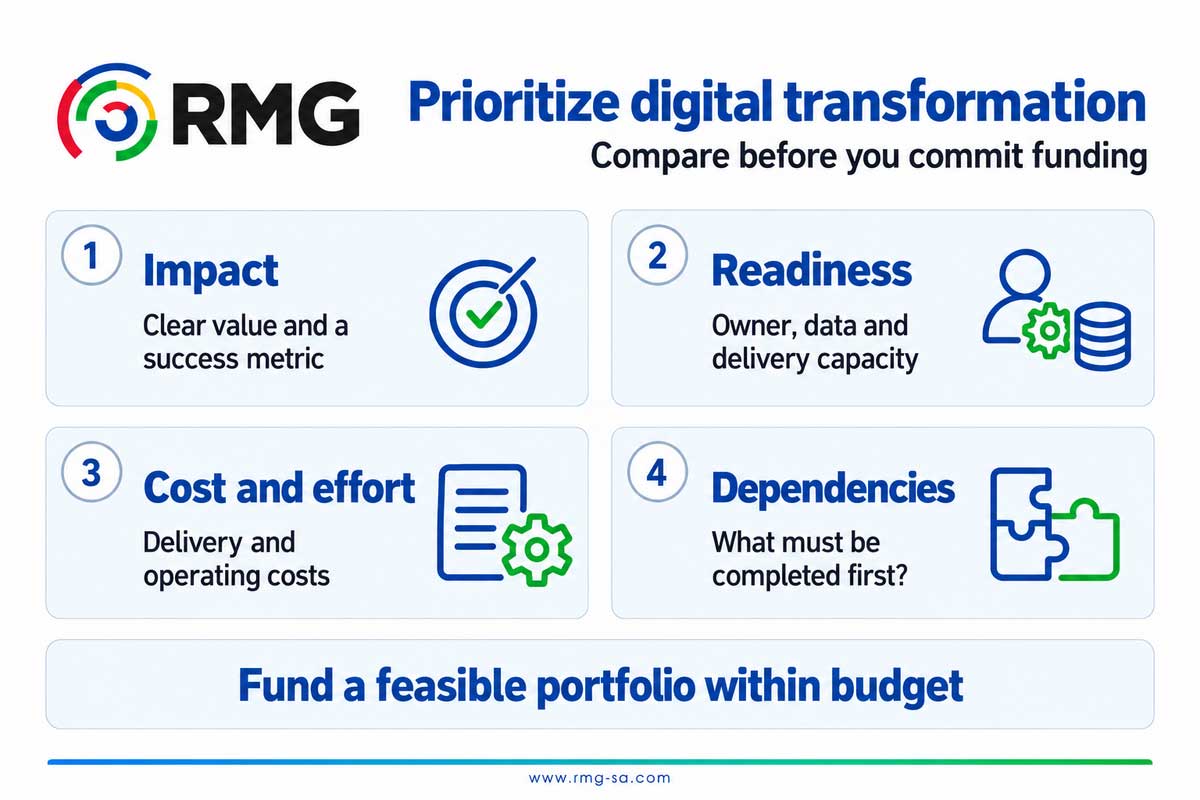
| Comparison area | Evidence needed before funding |
| Impact | A defined outcome, baseline, success measure and benefit owner. |
| Readiness | A clear scope, available data and skills, and operational responsibilities. |
| Cost and effort | Delivery and operating costs, capacity needs, assumptions and risks. |
| Dependencies | Prerequisites, shared systems and the required delivery sequence. |
Use this matrix to expose the strength of the evidence and any gaps. Explain the trade-offs between proposals: is the expected value greater, is the evidence weaker, or does delivery depend on an unavailable resource? These questions help the funding committee assess the decision without allowing one aggregate score to conceal a critical delivery constraint.
Four areas to compare before choosing a funded portfolio.
Compare combinations that can actually be delivered
A high-impact digital service may depend on data integration whose immediate value appears less visible. Funding the service while deferring its integration prerequisite can leave the service unable to launch. Map dependencies first, identify capabilities that initiatives can share, and then compare feasible combinations within the funding and delivery limits.
Enterprise architecture helps make the relationships between business capabilities, data, applications and technology visible, including opportunities for reuse. The OECD’s framework for managing digital government investment addresses strategic alignment, portfolio management and oversight of benefits during delivery [1].
An illustrative decision: allocating SAR 1 million
Assume an organization has SAR 1 million available for this group of initiatives in the first year, after meeting its other commitments. The figures below are fictional teaching examples, not RMG prices, client projects or reported results. The comparison assumes that improving the service is the most pressing need and that the organization can deliver the shared foundation followed by the service launch.
| Initiative | Year-one funding | Decision-critical information |
| B: Shared data and integration foundation | SAR 300,000 | Enables service A and addresses part of C’s requirements. |
| A: Digital service redesign | SAR 500,000 | Has a measurable outcome; launch depends on completion of the relevant elements of B. |
| C: Enterprise AI assistant | SAR 450,000 | Knowledge and data readiness are incomplete; also depends on B. |
The combined funding request is SAR 1,250,000, exceeding the available budget by SAR 250,000. Under these assumptions, the organization could allocate SAR 800,000 to B + A, retain SAR 200,000 as an unallocated contingency reserve, and defer C until its readiness and expected value are clearer. The reserve is illustrative: its actual size should reflect risks and estimates, and is not a recommended standard percentage.
Approving funding for B and A does not mean starting every activity simultaneously. The relevant elements of B must be completed before the dependent parts of A go live. Other work can proceed in parallel where team capacity allows. If B’s cost or readiness date changes, reassess the combined investment before committing to the next stage.
The table shows first-year funding envelopes. Before approval, the organization must also assess whether it can afford ongoing operations, transition and, where relevant, decommissioning of existing systems over the same appraisal horizon. That review may require a smaller scope or a different combination of initiatives.
Count each benefit once and distinguish capacity from cash savings
If integration helps reduce service completion time, do not record the full improvement under B and again under A, then add the two values together. Maintain one benefit record showing the contributing initiatives, the accountable owner and the measurement method. A shared foundation may create other independent benefits, but those require separate evidence.
Reducing staff hours per transaction releases capacity. It becomes a cash saving only when spending actually falls. RMG’s article on calculating return on investment in digital transformation projects provides background on different forms of value. Each benefit and its assumptions should then be documented before it is used to compare investment combinations.
Make continued funding depend on evidence
Delivery can be divided into stages suited to the initiative. An initial stage confirms the problem and critical assumptions, followed by a limited implementation and then expansion once agreed criteria are met. At each transition, review forecast costs, readiness, service quality and evidence of benefit. Money already spent is not, by itself, a reason to keep investing.
For initiative C, record why it has been deferred and what would support reconsideration: prepared knowledge sources, defined access permissions and tested output quality, for example. Any limited discovery work should have its own scope, funding and approval. The contingency reserve should not be treated as automatically available for it.
For organizations operating in Saudi Arabia, readiness reviews should identify applicable Saudi requirements according to the organization and initiative: Digital Government Authority requirements for entities within scope; the Personal Data Protection Law and relevant SDAIA requirements when processing personal data; and National Cybersecurity Authority controls and sector regulator requirements where applicable. Check current official sources before approval. The international references used here offer methodological guidance and do not replace Saudi requirements.
Turn the funding decision into a roadmap
The final decision record should identify the funded combination, delivery sequence, stage budgets, benefit owners and evidence required for further funding. It should also capture deferred initiatives, reasons for deferral and conditions for reconsideration. Set an appropriate review date and revisit the decision whenever a material assumption changes.
RMG’s digital transformation roadmap service connects current-state assessment and initiative prioritization with budgets, resources, performance indicators and implementation planning. Bringing these elements together helps an organization present a funding decision that leadership can review and translate into delivery steps measured by their outcomes.