


Blog Body
An analyst joins a project management office just before the steering committee meets. The last monthly pack is easy to find. The schedule, however, gives three dates for one milestone: an approved date, a later forecast and the actual completion date. The departing analyst knows which date the committee uses to measure slippage, but the report gives neither the reason nor the approval reference. A successful handover lets the new analyst explain the figure and show where it came from.
Start with the work that must continue
Ask the current role holder what decision their successor will face first. What mistake might a capable colleague make after reading the files alone? Prioritise knowledge needed for an imminent decision, held by one person or hard to reconstruct once that person leaves. In the reporting example, explaining a date variance matters more than teaching a familiar slide layout.
Watch the outgoing colleague perform one real task. At each choice, ask which evidence they trust, why they pick one source over another and when they consult someone with decision authority. Capture exceptions that the written steps miss. Where nobody can explain a practice reliably, record the question and who can settle it.
Give the handover clear owners
The project manager prioritises the risks and names an owner after the transition. The outgoing colleague demonstrates the work. The successor tries it and records what got in the way. The PMO maintains the reference templates and approved versions. HR helps the manager arrange overlap, while the knowledge management team maintains the handover method and helps other teams reuse relevant lessons.
Use one form for each critical item of knowledge
Capture enough to start the task and check the output. For the steering pack, the critical knowledge is how to choose the comparison date and explain a variance. The project controls lead maintains the form and verifies its source. The approved schedule and change decision log live in the project repository. The analyst uses both with completion evidence when preparing the pack. Review the form after an approved change, a transfer of ownership or relocation of the source.
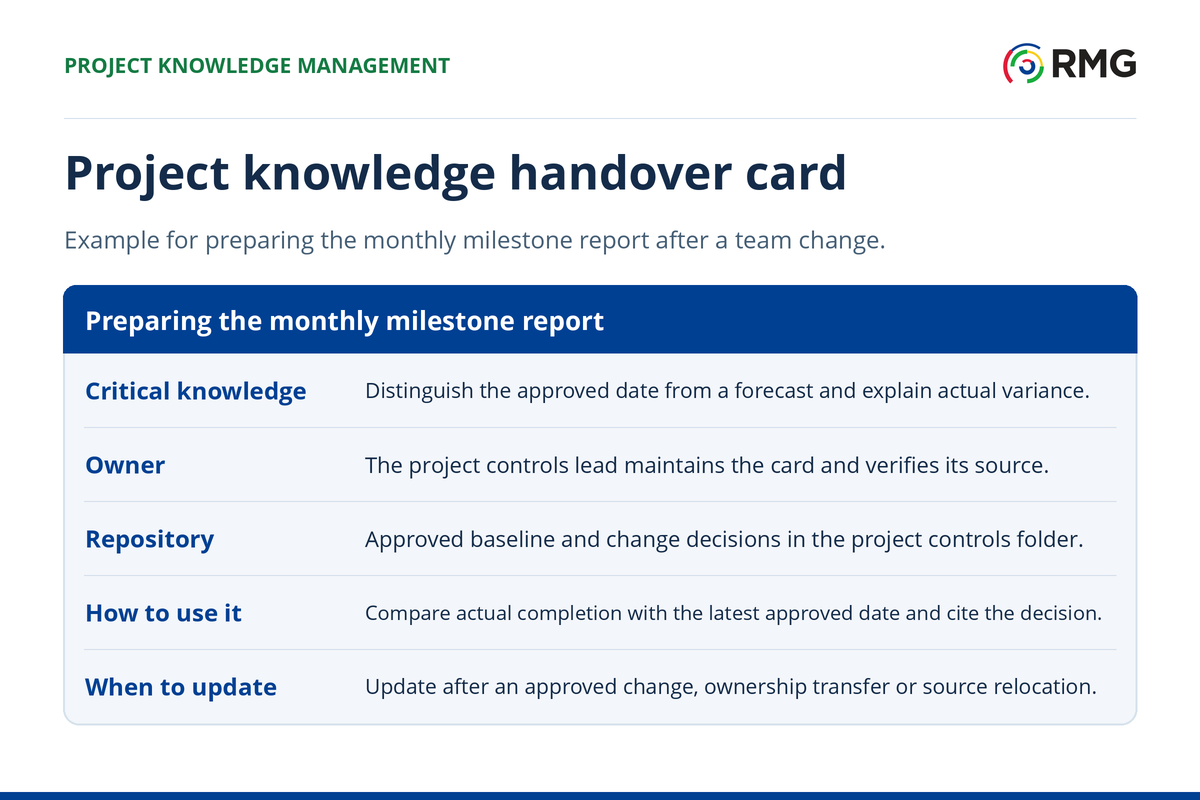
A handover form links critical knowledge to its owner, source, use and update trigger.
Reusable entry: critical knowledge or decision [ ], owner after transition [ ], approved source and version [ ], when and how to use it [ ], update trigger and reviewer [ ]. Add the successor, trial date and result. Test access using the successor’s own account, and link to restricted material under the repository’s existing permissions.
Ask the successor to explain the result
In an illustrative exercise, the approved baseline gives a milestone date of 10 November. Completion evidence gives 14 November. An email between the two dates also forecast completion on 14 November. Ask the successor to write one line for the committee stating the variance, the source of the comparison and whether a change to the baseline was formally approved.
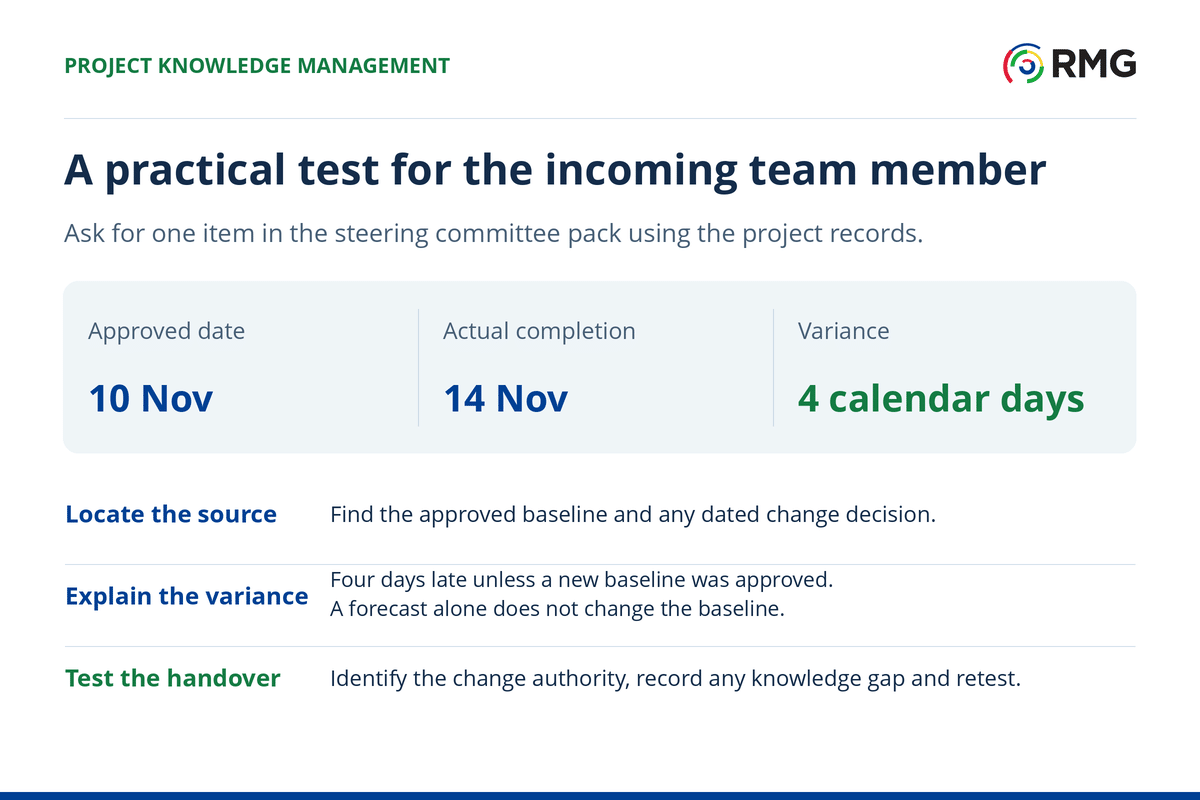
A practical test for the incoming colleague using illustrative dates from a steering committee report.
If 10 November remains the approved date, the work finished four calendar days late. If the successor finds an approved change, they must establish its effective date and scope before using the revised baseline. If the decision log is inaccessible, they report only what they can substantiate, assign the access gap an owner and due date, and repeat the exercise once it is resolved without help from the outgoing analyst.
Keep the context where the team will use it
Place the guidance next to the document the team uses, with references to the decision log and change history. Maintain one approved source with an owner and review date. Label older worked examples as training material so that a colleague can tell which record governs current work.
NASA’s report on knowledge continuity during employee transitions includes prompts to identify tasks and resources, check that successors can access the source documents and hold follow-up discussions. After the first reporting cycle, ask the successor for one decision they could make using the handover and one question that still needs a reliable answer.
NASA report on knowledge continuity during employee transitions
Reconstruct sudden departures from evidence
If the role holder has already left, start with approved outputs, decision records and the people involved in creating them. Distinguish what the records establish from what colleagues recall, and ask the process owner to resolve discrepancies. Record each gap, its owner and due date. Once the successor can perform the task, retrieve the evidence independently and identify when a decision is required, the manager can acknowledge the transfer of that item while keeping unresolved questions visible.
Try the form on the next role change
Pick a task that will soon change hands. Ask the successor to repeat it using one handover form. If ownership, access or maintenance gaps recur, discuss the results with RMG’s knowledge management consulting team. The exercise helps identify what belongs in an organisation-wide management system and what should stay specific to the project.