



Blog Body
After a committee meeting, a member asks, “Did we vote to extend the pilot for four weeks or eight?” The results report gives the count but leaves out the motion. The secretary has to reconstruct it from slides, the invitation and messages sent during the discussion. A better starting point is to tie each voting round to one motion, its eligible voters and a decision rule before anyone casts a ballot.
Write the decision voters will see
Give members a proposition they can accept or reject without guessing its effect. “Extend the current service pilot by four weeks with its scope unchanged” is more precise than “Should we continue the pilot?” Assign the item an identifier and version. Link any supporting paper to that version. If a member could support an extension but oppose a wider rollout, put those questions to separate decisions.
Record the decision rule in advance. What quorum is required to hold the meeting or decide the item? Which majority applies, how are abstentions treated and what happens in a tie? Use the charter or other rules governing this session. Keep the rule’s reference and date in the voting record so a reviewer can later apply it to the same count.
Establish who may vote on each item
An invited specialist may attend as an observer. A member may be entitled to vote on one item and excluded from another. Record the role for that item, any authorised proxy and any applicable restriction. If votes are weighted, confirm the source and date of the weights. Compare the invitation list with the eligibility roster and test that an observer can attend without casting a ballot.
Assign responsibilities before opening the vote
The secretariat prepares the motion, roster and supporting documents. The authorised supervisor checks the version on screen and directs when voting opens and closes. A designated reviewer reconciles the count to the round and its decision rule. The secretary records the authorised outcome in the minutes. Agree who can rule on a challenge to eligibility and who can postpone the vote if eligible members cannot participate.
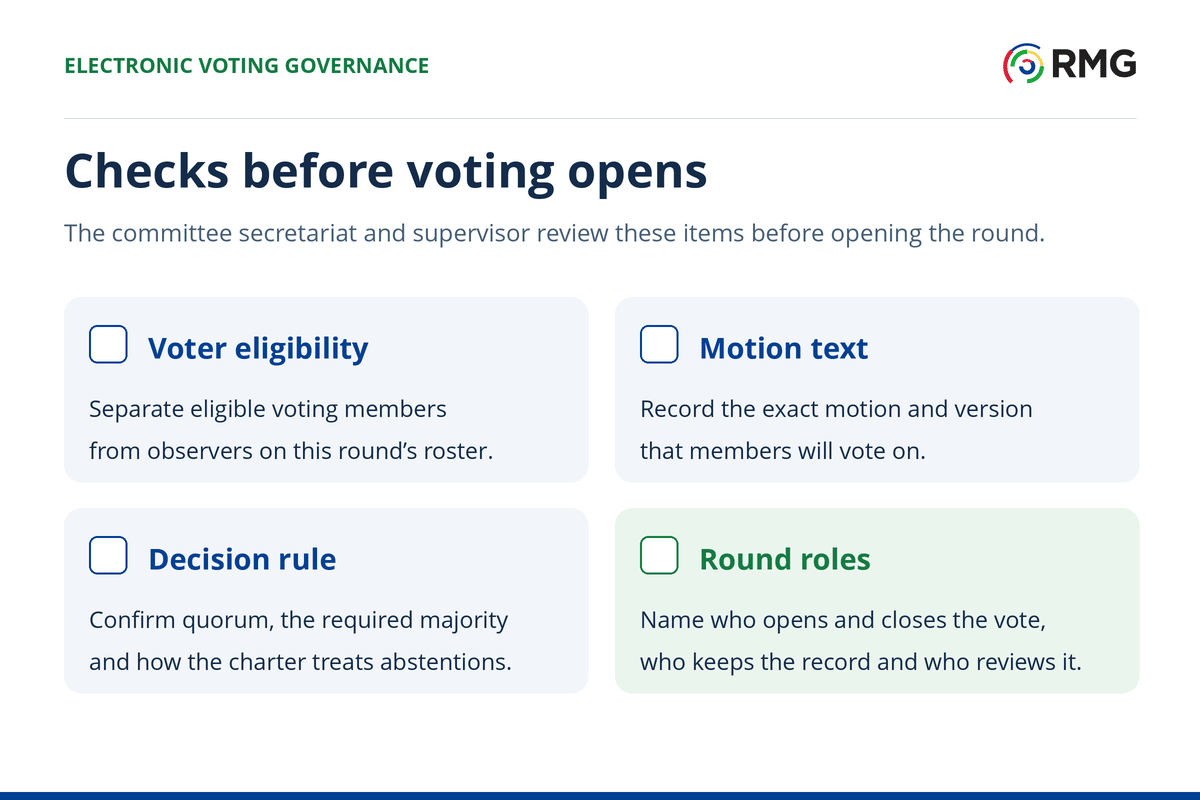
Four checks cover voter eligibility, the motion, the decision rule and assigned roles.
Rehearse these arrangements in a separate test round. Check the member and observer views, wording, options, opening and closing times and time zone. Rehearse what happens if a member cannot get in. Give the live round its own identifier so that practice ballots never enter the live count.
Reconcile the tally before declaring the outcome
Suppose a committee invites seven people to discuss extending a service pilot for four weeks. Five members may vote on this item, with one vote each. Two attendees are observers. The system records five accepted ballots: three in favour, one against and one abstention. The figures reconcile for this example and explain why the number of invitees can be higher than the ballot count.
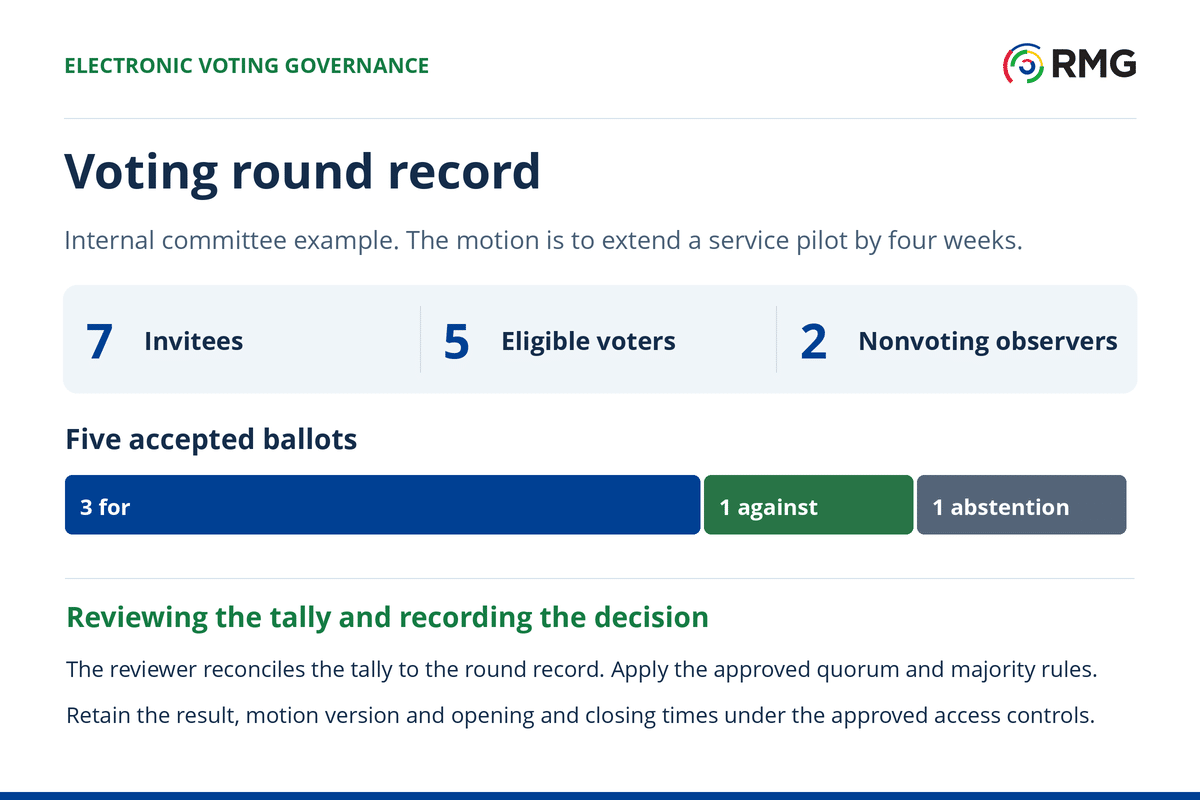
An illustrative vote on a four-week pilot extension, with an aggregate tally and checks before a decision is declared.
Apply the quorum and majority rules, including the treatment of abstentions, before declaring an outcome. If the report shows six accepted ballots, hold the announcement until the discrepancy is explained. If the discussion instead produces an eight-week proposal, retain the original motion and round status and record the amendment under the agreed procedure. If a fresh vote is required, give the revised motion its own round. Each ballot then stays with the question the member actually saw.
Assemble a record another reviewer can use
Keep the meeting and item references, motion version, restricted eligibility roster, opening and closing times, aggregate results and any exception, its impact and how it was resolved. Add the reviewer’s name and the approved minutes reference. For a secret ballot, separate checks on participation rights from ballot choices, and apply the organisation’s access and retention rules to each record. Give readers of the circulated report the detail they need to understand the decision.
Ask an authorised colleague to retrieve the wording and apply the decision rule using the record alone. If they cannot explain a difference between attendee and ballot counts or identify which proposal was on screen, improve the record before the next vote.
Use the rules for the meeting you are holding
In Saudi Arabia, Article 14 of the Capital Market Authority’s Implementing Regulation of the Companies Law for Listed Joint Stock Companies addresses shareholder identity and eligibility for individual agenda items when technology is used in general or special assemblies. Article 15 addresses quorum. Those provisions concern the shareholder assemblies within their scope. In the internal committee example, use the committee charter, delegations and other rules that apply to it.
Capital Market Authority | Implementing Regulation, Articles 14 and 15
Test the system with one of your agenda items
RMG’s E-voting management system supports agenda-item voting, controls over which items are open and results that can be reviewed. When assessing a system, take a motion with sensitive details removed and ask to try the voter and observer journeys. Then retrieve the results report and link it to the minutes. The exercise shows which needs the system meets and which responsibilities belong in your own procedures.