


Blog Body
Announcing winners does not establish who will receive a solution or what will test its usefulness after the event. When prototypes remain on participants’ devices and presentations remain in an organizer’s inbox, challenge owners cannot readily assess what is usable and what needs rebuilding. A practical closure process starts with a documented handover for each solution selected for follow-up, while recording the disposition of the other submissions.
Define the handover and the remaining uncertainty
A solution record should describe the problem, intended user, demonstrated functionality and untested assumptions. Include a specific version of the presentation and prototype, operating instructions, dependencies and known limitations. Do not label a demonstration as a production-ready service. GOV.UK’s prototyping guidance distinguishes testing an idea from meeting production requirements. This is a useful design distinction, not a Saudi legal requirement. [2]
Store the files where the organization can access them under clear permissions, and identify a reference version whose changes are recorded. Add an owner for questions and an agreed contact route. Test presentation links, dependencies and demo accounts during the session. Keep passwords and access keys out of presentations and follow-up registers.
Before transferring code or designs, document what the participation terms, agreements and relevant licenses permit. Delivery of files alone does not establish a transfer of rights or unrestricted use; refer unresolved questions to the appropriate specialist before experimentation. This is a proposed verification step, not a general finding about ownership of participants’ work.

Involve the challenge owner in acceptance
Bring a team representative, the challenge owner and the follow-up coordinator together to run the prototype and review its limitations. Record the next decision: a bounded experiment, additional work, a reasoned pause or closure. Competition ranking does not replace this decision. Judging assesses an entry against event criteria; follow-up examines practical fit, resources and responsibility.
Receiving the package means its contents and limitations are understood and recorded. It does not constitute production acceptance or approval to purchase additional services. For a bounded experiment, define scope, resources and who can stop it. For further work, identify a verifiable gap, such as missing operating instructions or an inability to reproduce the demonstration, instead of a general request to improve the solution.
Connect each next action to evidence
Replace an open-ended promise to follow up with a defined action, such as testing one user journey or completing the operating instructions. Give each action an owner, an agreed date and evidence of completion. These dates are agreements among the parties, not standard deadlines imposed by this article. Revisit the plan when a contributor leaves or a resource becomes unavailable; further voluntary participation requires a renewed commitment.
The Community and Code guide notes that follow-up has no fixed recipe and participants return to their usual work. Apply this insight by naming a coordinator, confirming the team’s availability, and choosing a review rhythm that suits the action and its dependencies. If progress stalls, record a reason and decision owner, or close follow-up explicitly rather than leaving the solution indefinitely pending.
Test before scaling
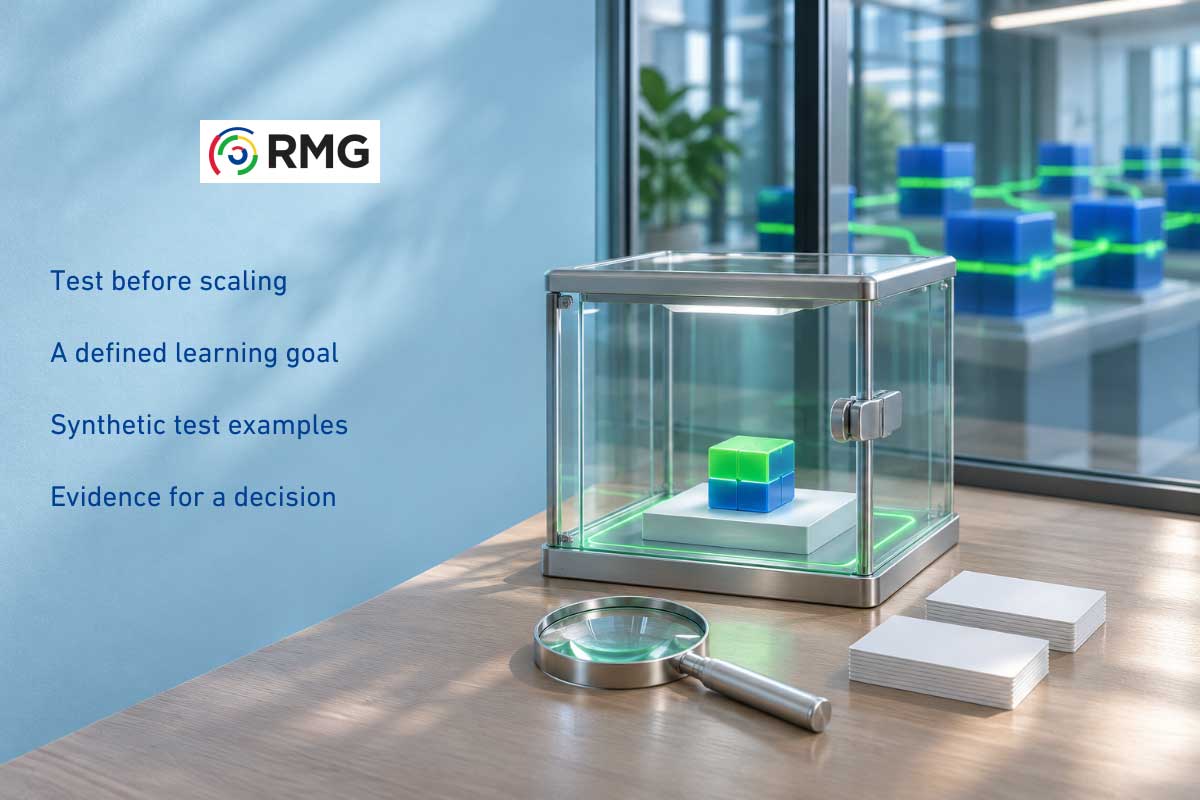
In an illustrative scenario, not a customer case, a team proposes a prototype to categorize beneficiary requests. The next step could be a small test with synthetic examples and manual review before system integration or use of real records. The challenge owner defines the learning objective and suitable acceptance criteria. Before moving to real personal data, review the purpose, lawful basis, minimum data needed, access rights and protective measures with the relevant specialists under the Saudi Personal Data Protection Law and its regulations. Check whether the National Cybersecurity Authority controls apply to the entity and solution. A small test does not remove applicable obligations. This compliance review precedes implementation; using synthetic examples here is a proposed testing practice, not a universal legal requirement.
In this example, reviewers may find that one category of request is not classified in a useful way. A useful outcome is a specific decision: revise and retest definitions, narrow the intended use, or end the experiment if the need no longer exists. A polished demonstration or team agreement does not establish suitability for every request.
Review decisions and outcomes
A follow-up register can include the solution ID, challenge owner, received version, limitations, decision, next action, accountable person, agreed date and completion evidence. Review what has changed in the solution’s viability and which decision is now needed. Meeting counts and uploaded files do not establish operational impact.
Design follow-up into the program
Actionable follow-up starts by defining who receives the work, what is handed over and which decision needs new evidence. If your organization is planning a hackathon, discuss a suitable handover and follow-up process with RMG within an agreed scope of hackathon organization and management services. The aim is to make event outputs understandable and assessable; it does not guarantee that every prototype becomes a product.