

Blog Body
A customer’s appointment has been cancelled twice. The customer care agent can book the next available slot. The customer needs an earlier one, and the diary is full. Who can grant priority, and who will call the customer back if the decision is delayed? When each team forwards the ticket to the next, the customer can end up telling the story again while the decision is still outstanding.
Classify complaints by the action they need
At intake, record what happened, the impact in the customer’s own terms and the outcome they want. “Two appointments were cancelled. I need a replacement before I travel” tells the handler more than “appointment complaint”. Confirm the booking reference and contact channel. Link any earlier contact about the same appointment so that the next handler can distinguish an information request, a routine correction and an exception.
Priority depends on the impact, the time available and whether the customer has a workable alternative. Repeated cancellations warrant investigation, but frequency alone does not establish who may make an exception. Give each category a question that changes the next action. Can the handler resolve it within their delegation? Does another team hold a missing fact? Is the customer challenging an existing decision?
Separate a referral from an escalation
A referral obtains information or action within existing authority. The case owner might ask scheduling to confirm the next free slot. An escalation puts a decision to someone with different authority, such as the person who can release a priority appointment. Give the customer one contact and an agreed update time even when someone else has to decide.
Map each condition to a decision-maker
For each row of the matrix, specify an observable trigger, who may decide and what evidence would justify closure. A routine complaint can be remedied and documented within the frontline delegation. An exception goes to the authorised decision-maker with the available options. If a customer contests closure, route the case to an authorised reviewer independent of the original decision, in line with the organisation’s policy.
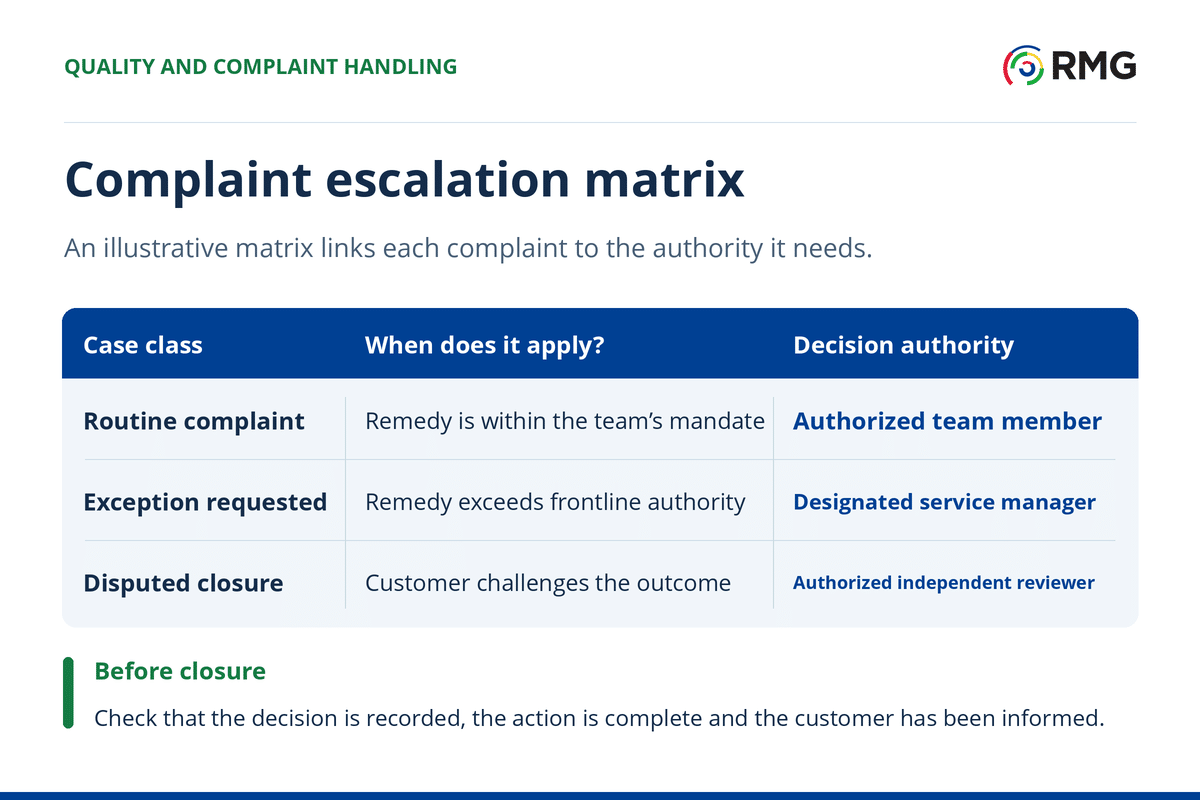
Three scenarios show who handles the complaint, who decides an exception and who reviews a disputed closure.
Specify when to escalate and who can deputise if the decision-maker is unavailable. If the promised update is due before the manager decides, tell the customer which decision is outstanding and when they will hear from you again. ISO 10002 provides guidance on designing, reviewing and improving complaints handling. The roles and matrix shown here are examples to adapt to local delegations.
ISO 10002:2018 guidelines for complaints handling
Test the route on a cancelled appointment
In our hypothetical case, the booking record confirms that the organisation cancelled both appointments. The case owner includes the two cancellation references, the next regular slot and the impact reported by the customer. They ask the service manager a question they can decide: may scheduling offer a priority replacement under the exception policy? The case owner agrees and records the next update time without promising an outcome.
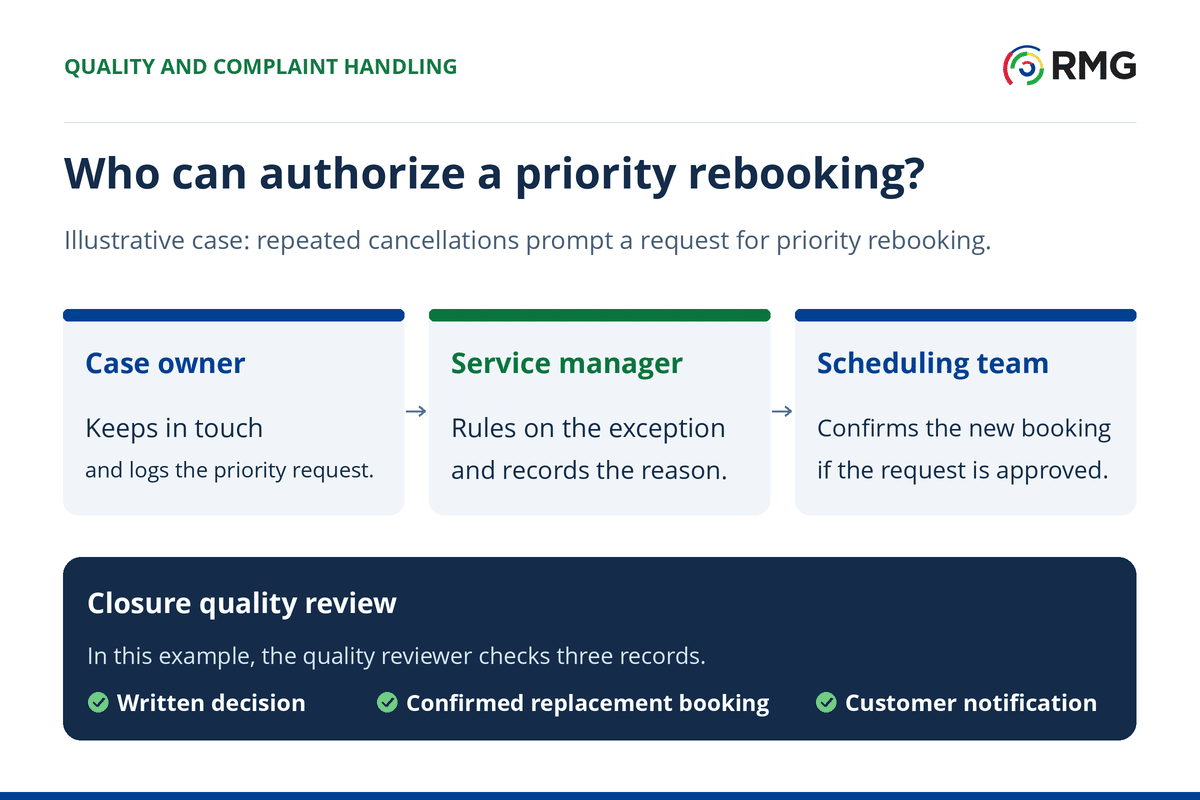
An example separating customer contact, exception authority, implementation and closure review.
If the manager authorises the exception, they record the reason and instruct scheduling. Scheduling confirms the booking and returns its reference so the case owner can notify the customer of the date through the agreed channel. If a priority slot cannot be offered, the manager records the reason and available alternatives. The case owner explains the options and how the customer can request a review.
Check closure from the customer’s point of view
Open a sample of closed cases. Was the decision recorded by someone authorised to make it? Is there evidence that the promised action happened? Was the customer told the outcome and what they could do next? For an approved exception, look for the decision, confirmed booking reference and notification record. Without the booking reference, implementation is still outstanding. If the customer challenges the outcome, record the grounds, the designated reviewer and the next update time.
One quality check is the share of sampled closed cases reopened because implementation evidence was missing. Use cases inspected in the same period as the denominator and state the sample size and reasons for reopening. This can reveal a workflow that closes the complaint when the manager approves the remedy, before scheduling confirms a booking.
Identify the external route for the sector
In Saudi Arabia, the Communications, Space and Technology Commission describes an escalation route for telecom complaints after the customer has complained to the provider. Its published conditions cover cases closed without a remedy. For another sector, establish which authority and time limits apply, and explain to customers how to find the appropriate channel when needed.
CST | Telecom complaints escalation
Try the matrix on a case your team closed
Remove identifying details from a recent complaint. Ask two colleagues where escalation was needed, who could decide and what supported closure. If their answers differ, start with that row in the matrix. RMG’s quality and complaint-management consultants can discuss the example with you when reviewing your complaints process and its decision rights.