
Blog Body
A successful backup starts the evidence
A backup job may finish without errors while service recovery remains untested. A valid copy may exist, but the team may lack access or the application may need missing configuration. Start with a business question: can a defined service return to acceptable operation within its requirements? Opening one file does not demonstrate recovery of the whole environment, and one successful sample does not guarantee every backup. This article proposes a practical record linking scope, steps, evidence and corrective action without assuming a result or a recovery time.
Define the service and acceptance criteria
Choose a service, backup, date and test environment, recording inclusions and exclusions. Agree with the service owner on the functions to demonstrate: signing in, reading data, completing a test transaction or generating a valid report as appropriate. Distinguish the recovery time objective, RTO, from the recovery point objective, RPO. The first concerns returning to operation; the second concerns acceptable data loss and required data currency. Values should follow business impact and organizational requirements. Record when the measured interval starts and ends so that file transfer time is not confused with complete service recovery.
Prepare a safe executable exercise
Approve the plan and access before starting. Use an isolated environment that prevents unintended production effects or real transactions. Confirm the availability of encryption keys, accounts, licences, configuration and dependencies required by the plan, and name an owner for each step. Use appropriate test data and protect restored information with approved access and retention. If a cyber incident may have contaminated the backup, specialists should assess its integrity and recovery path rather than automatically moving it into a clean environment. Define stop conditions and cleanup after evidence collection.
Test the path from copy to function
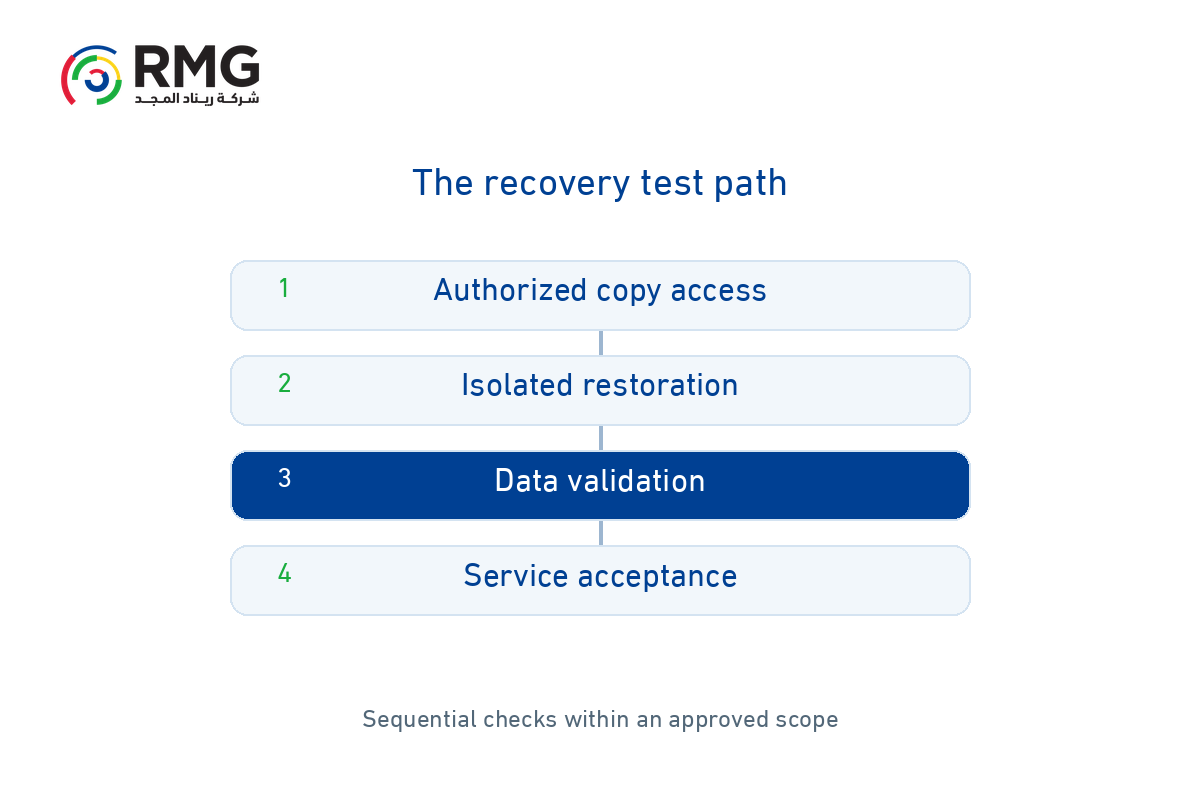
Begin at the actual backup location and establish that the team can find and access the selected copy through the authorized process. Restore it and record timing, errors and decisions. Validate data integrity and consistency using methods appropriate to the application, then exercise the agreed service functions and dependencies within scope. Microsoft distinguishes backup from replication and emphasizes testing restoration alongside other recovery steps [2]. Replication alone does not replace a point-in-time copy, and technical restoration completion does not establish user acceptance of the service.
Record outcomes at the level of evidence
For each step, capture expected and actual behavior, evidence, owner and decision. If a database opens but a service transaction fails, classify the result as partial and identify the blocker rather than declaring complete success. The following table organizes hypothetical examples; it is not a customer test or an official measurement. Reference logs or appropriately redacted screenshots when useful, excluding passwords and unnecessary personal information. State whether measured durations include environment preparation and application validation, and identify dependencies, locations or copies left untested.
| Illustrative step | Required evidence | Outcome interpretation |
| Access the copy | Copy reference and valid authorization | Access failure blocks restoration |
| Validate data | Application-appropriate integrity result | Record any consistency failure |
| Exercise a service function | Test transaction accepted by owner | Acceptance within tested scope only |
Connect gaps with a retest
Turn each blocker into an action with an owner, agreed due date and closure evidence. Retest the changed part and affected dependencies. Remediation may involve access lists, missing configuration or the order in which dependencies are restored. Closing a support ticket is insufficient without evidence that the path now works. Retain the plan version, results and service-owner acceptance decision. Reconsider testing after material changes. Frequency should follow risks, applicable requirements and approved policy rather than one interval applied to all services.
Separate guidance from obligations
NCA publishes backup policy and standard templates. Their introductions explicitly describe them as illustrative examples that require adaptation to the entity’s business and relevant requirements and internal approval [3, 4]. Individual clauses or frequencies should therefore not be copied as universal obligations for every organization. Specialists should establish binding controls, applicability, sector requirements, data obligations and contracts before approving the plan. The proposed test record organizes operational evidence; it is neither a compliance certificate nor a substitute for specialist review.
Start with a scope that demonstrates recoverability
A clearly defined service is a useful starting point for discovering actual blockers and building a repeatable record. Bring service ownership, operations and security together to agree scope, acceptance and evidence responsibilities before the exercise. RMG offers backup and data recovery services including business-needs assessment and selection of data, backup approaches and locations [1]. Discuss an appropriate recovery-test and readiness-improvement scope with RMG. Actual results and durations require verification in the relevant environment.