
Blog Body
Start with a question that evidence can confirm or reject
An emerging technology trial can end with an impressive demonstration without answering a defined question. Before starting, connect the question to a specific task and known beneficiary: can this technology support a particular step under the organisation’s conditions? Avoid asking whether the technology is good; that allows the goal to shift after every result. Identify the decision owner, the existing alternative for comparison and what remains outside the trial. The proposed trial card is an internal working tool, not an official form or a promise of results. Its purpose is agreement between the team and provider before time, data and resources are committed.
Freeze acceptance criteria before seeing results
Separate a measure from the threshold that would make the result acceptable. Document retrieval is a broad measure; a criterion specifies the test set, how reviewers judge a correct reference and which cases prevent acceptance even if an average improves. The team chooses thresholds suited to risk and the existing alternative rather than borrowing a percentage from an article or sales presentation. If a baseline is missing, measure it before comparison. For AI trials, NIST MAP supports recording purpose, context, limitations and risks. It is voluntary guidance rather than a Saudi requirement for every technology. [2] The card’s criteria are an independent practical proposal.
Draw boundaries that prevent scope expansion
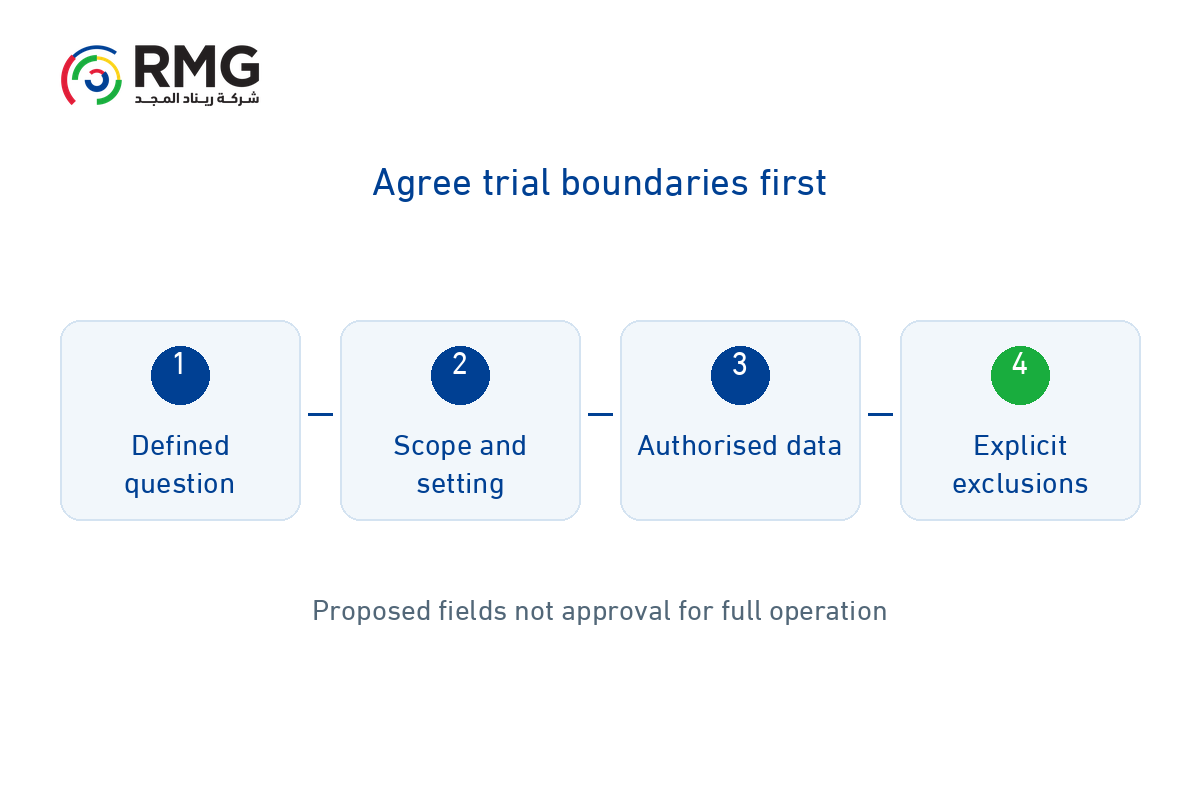
Define one process or a small set of uses, the permitted environment, participants and interfaces actually being tested. Record exclusions too: no production connection, no automated decision execution or no unauthorised data, according to the organisation’s needs. Boundaries should be verifiable rather than simply described as a limited test. Record the technology version, configuration and data sources so reviewers understand the result’s conditions. When an additional use is proposed, document its effect on the question, timebox, data and acceptance criteria before approving or deferring it. Do not combine results from different scopes into one judgement without explaining the difference.
Treat data and time as parts of the test
Identify each dataset’s source, authorised use and relevance to the target situation. Where needed, separate preparation material from evaluation cases. Include difficult, incomplete and conflicting cases instead of relying on examples selected for a successful demonstration. Set a timebox, review steps and a stop point suited to the question and resources. This article prescribes no universal duration or mandatory sample count. Name the person who may stop the test after an incident or loss of data control, and define evidence preservation and rollback. A changed data source or technology version needs documentation and may require reassessment rather than comparison of unlike results.
Design evidence that shows failure as well as success
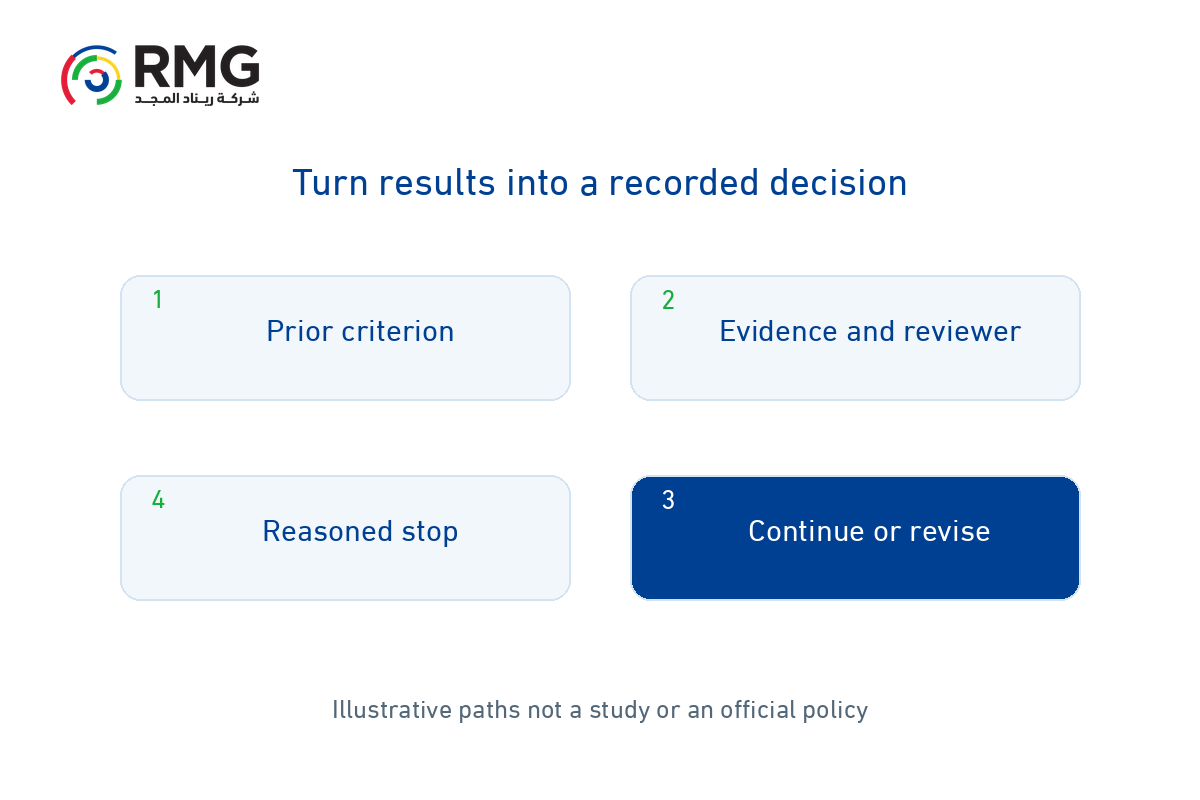
For each criterion, assign an evidence collection method, reviewer and result format. Preserve failures, incomplete cases and untested conditions, explaining their effect on the decision. Distinguish evidence supporting a next evaluation step, a bounded revision or stopping because the hypothesis is unsuitable or risk is too high. These are proposed paths rather than an official acceptance policy. A successful narrow proof of concept does not establish full operational readiness or contractual acceptance; those need separate later assessments. Keep the trial question focused while preventing a successful demonstration from being interpreted as approval to scale.
Use a short trial card before starting
The example collects fields the team can complete during preparation. Its cases are hypothetical rather than a study, customer results or approved acceptance thresholds. Replace broad statements with judgeable criteria and define the comparison reference before testing. Add the decision owner, specialist reviewer, card version and authority for scope changes. Every technology need not pass; ruling out an unsuitable use before a larger commitment can be valuable. Avoid announcing success without prior criteria, omitting difficult cases from the report or extending a trial indefinitely without a new question that can be resolved.
| Card field | Hypothetical example | Agree before starting |
| Question and scope | Find references in an authorised trial library | Defined set; no automated decision or production link |
| Criterion and evidence | Review reference correctness and no-result cases | Judgement method baseline and blocking cases |
| Timebox and decision | Testing window agreed by the team | Decision owner stopping and result retention |
Review Saudi applicability before introducing data
Calling work a trial does not remove applicable requirements. When personal data is processed, specialists should review the Saudi PDPL and regulations, purpose, access, processing parties, retention and any transfer outside the Kingdom as applicable. SDAIA guidance explains that protection does not depend on data volume and that storage is processing; it also states that the guidance is not itself a binding legal instrument. [3] Small or pseudonymised datasets are not automatically unrestricted. Security, compliance and sector specialists should review relevant constraints before the environment opens. The proposed card, criteria and decision path are organisational practices rather than compliance certification or substitutes for required approvals.
Start the RMG conversation with the trial question
RMG’s current emerging technology services page describes proof of concept and prototype design and development, with documentation of objectives, success indicators, outcomes and lessons learned. [1] This service description does not establish a universal project result, duration or scope. Prepare the trial question, use case, existing alternative, data and environment boundaries and draft acceptance criteria. Discuss with RMG a test suited to organisational readiness that produces reviewable evidence and an accountable decision. A clear meaning of acceptance before starting makes the result easier to interpret honestly, whether it supports continuation, revision or stopping.