
Blog Body
Begin with what the employee must learn
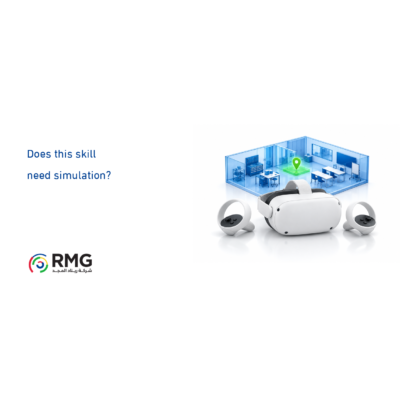
An appealing headset does not by itself justify a virtual training project. First ask what decision or skill is difficult to learn through the current method. An organisation may need staff to interpret a spatial situation and make a scenario based decision, while a video or interactive guide may adequately teach fixed information. Write an observable behaviour before selecting technology, such as identifying a layout conflict in a training workspace. This is hypothetical rather than an assessment of a particular organisation. Simulation becomes a candidate when it adds meaningful practice and suitable feedback, with an acceptable content production, operation and update effort, rather than simply offering employees a new experience.
Distinguish a demonstration from skills practice
A three dimensional tour may introduce a location, but it becomes skills training only when the learner has an action, consequence and assessment criterion. Distinguish viewing a scene, interacting with objects and making a decision that changes the case. CDC describes laboratory VR training that supplements existing eLearning and uses defined learning objectives and assessable performance. [2] This is a specific context rather than proof that simulation is superior for every sector or skill. Apply the idea of linking design to purpose without transferring evaluation percentages or generalising findings to your employees. Ask what the learner will do and how they will recognise an appropriate response.
Compare simulation with simpler alternatives
Compare the scenario with a case workshop, interactive screen, classroom session or guided practice in a suitable setting. Spatial judgement, rare practice opportunities or difficulty repeating a situation can justify simulation. Memorising a definition or understanding a short policy may not need immersion. State the expected added value as a hypothesis to test, alongside what might be lost, such as direct conversation or physical equipment feedback. Do not assume that a virtual model automatically transfers fine manual skills or replaces an approved practical assessment. Training remains a learning pathway, and the organisation decides where simulation contributes and where another method is needed.
Complete a scenario card before development
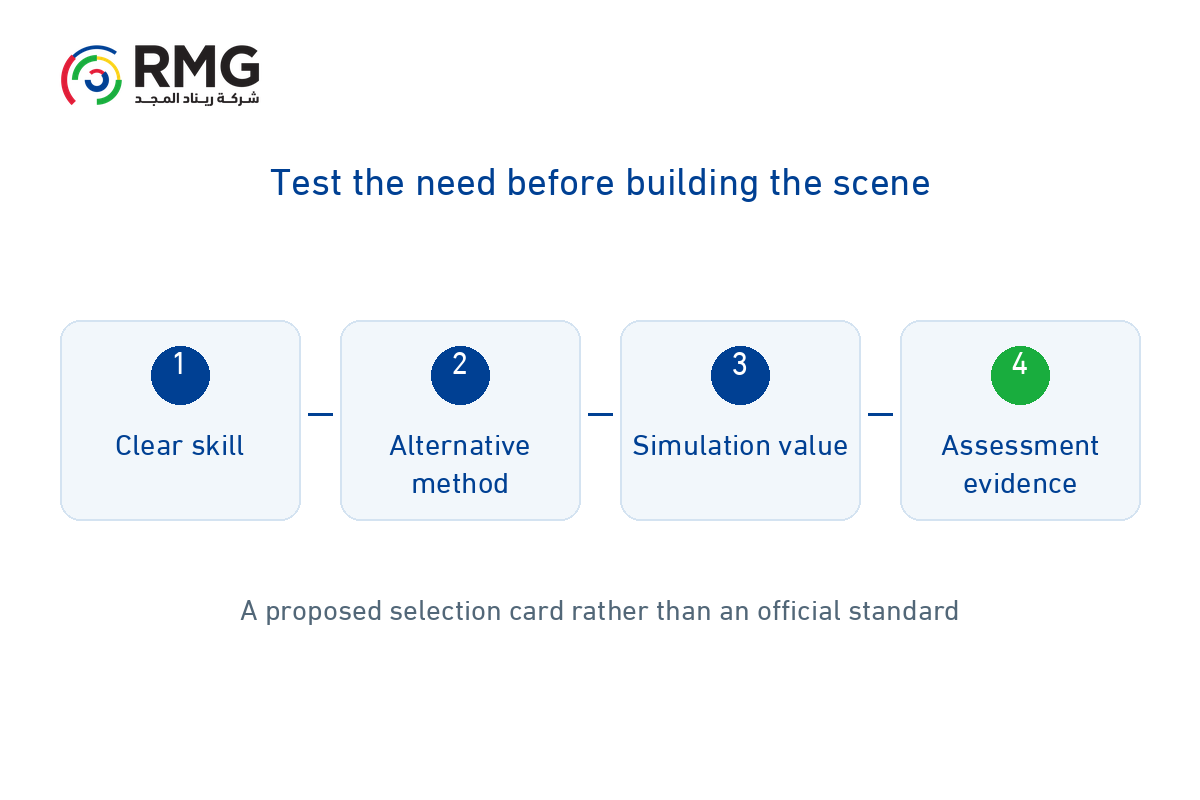
The proposed card includes audience and skill, situation boundaries, learner decision, expected response, assessment method and the approved content reference. Add the instructor’s role, feedback approach and what follows an inappropriate choice. Define stopping and help seeking conditions within the case and retain an alternative if headset use is unsuitable. Review the card with a domain expert and learning designer before building scenes: a beautiful model cannot correct a flawed scenario. Label fictional data and locations clearly. Use employee information or real site details only after checking authority and the minimum content actually needed for the learning objective.
Check operational and user suitability
Test language clarity, controls, available space and instructor preparation before wider use. Consider alternative access, comfort, equipment cleaning, shared device scheduling and support, with a clear stop process if a user is uncomfortable. These are proposed design and operational considerations rather than medical advice or a guarantee of suitability for everyone. A NIOSH study published in 2026, in a mine rescue context, reports preference for VR as a supplement and barriers involving support, acceptance and compliance fit. [3] Avoid generalising that context, but use its questions to examine organisational readiness. Assign responsibility for updating scenarios when the represented policy or environment changes.
Choose a scenario with a clear assessment
The table compares hypothetical examples rather than experimental results or an official technology ranking. Do not award learning credit simply for scene complexity or time spent in a headset. Before the trial, specify whether the objective is to spot an issue, explain a decision or choose an appropriate communication path, and what evidence the assessor will review. A less complex case may be a better starting point if learning can be observed and content updated easily. Record why a scenario does not require simulation so that it does not return to scope merely because someone requests another scene. Use weights or improvement percentages only when the organisation approves a method and collects suitable evidence.
| Hypothetical scenario | Potential simulation rationale | Proposed learning evidence |
| Spot a spatial conflict | Inspect object relationships from different views | Identify the conflict and explain why. |
| Decide in a branching case | Repeat safe alternatives with feedback | Justify the decision and escalation path. |
| Recall a policy definition | Consider a simpler method before VR | Comprehension question and short case. |
Evaluate learning and protect assessment data
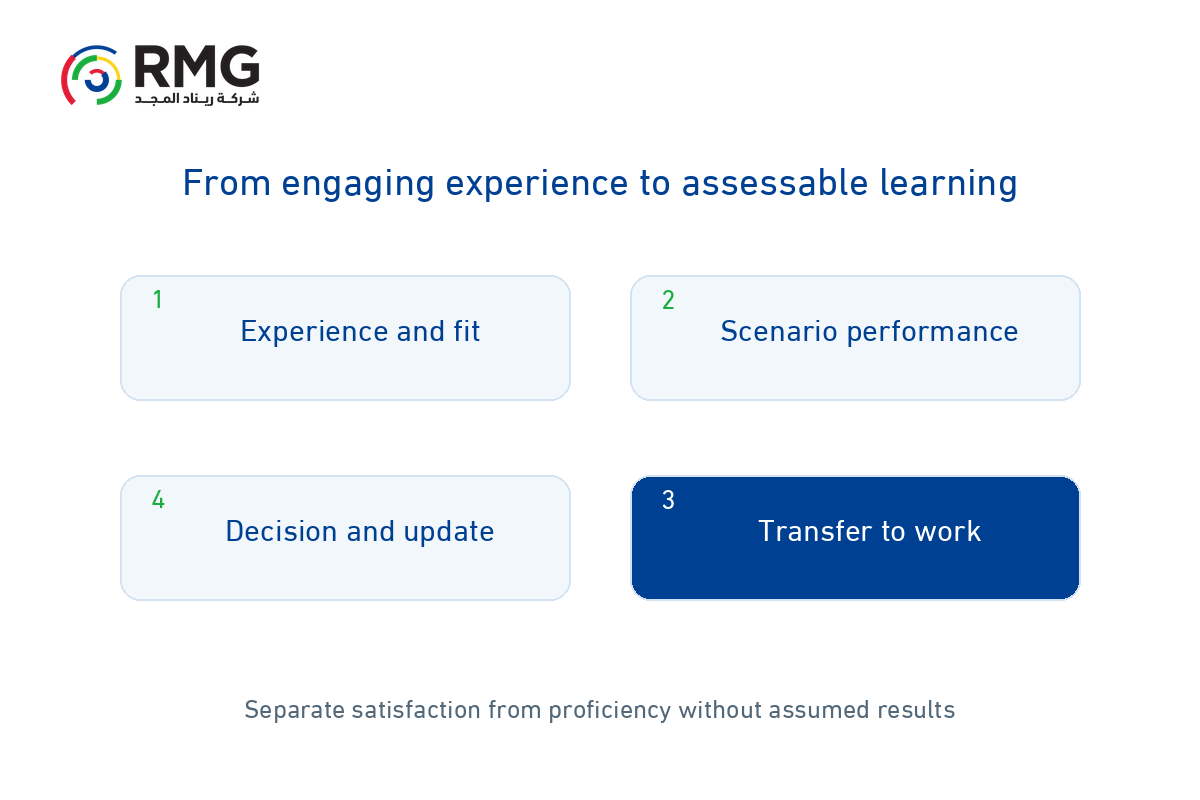
Separate satisfaction, task performance inside the simulation and transfer to work. A proposed approach compares performance on equivalent cases before and after learning and reviews later application with the instructor. Speed alone is not quality, and this approach is not a report of achieved results. When recording identity, movement or assessment, specialists should review what constitutes personal data and the applicable Saudi PDPL requirements, access, retention and service provider arrangements. SDAIA guidance explains that storage is processing. [4] Avoid treating automated scoring as a final employment decision without organisational controls and specialist review. Simulation is not a compliance certificate or authority to practise a profession.
Start with a scope that produces useful learning
RMG’s VR services include vocational training and interactive simulation. [1] Bring one scenario card, assessment criterion, target users and operational needs to the discussion, then confirm implementation, integration, support and update scope. Do not transfer claims about cost or error reduction to your project without testing them. A trial may justify expansion, a design change or a simpler learning method. Each is useful when supported by evidence. Contact RMG to discuss a simulation experience that begins with a clear skill and gives instructors and learners reviewable evidence before broader deployment.