
Blog Body
A risk register may be full while decision-makers still cannot see which objective is affected, whether a control operates or who owns the next step. The problem is not always too few recorded risks. It is the missing connection between a risk and the work it should protect. A broad phrase such as project delays does not identify an actionable response or accountability.
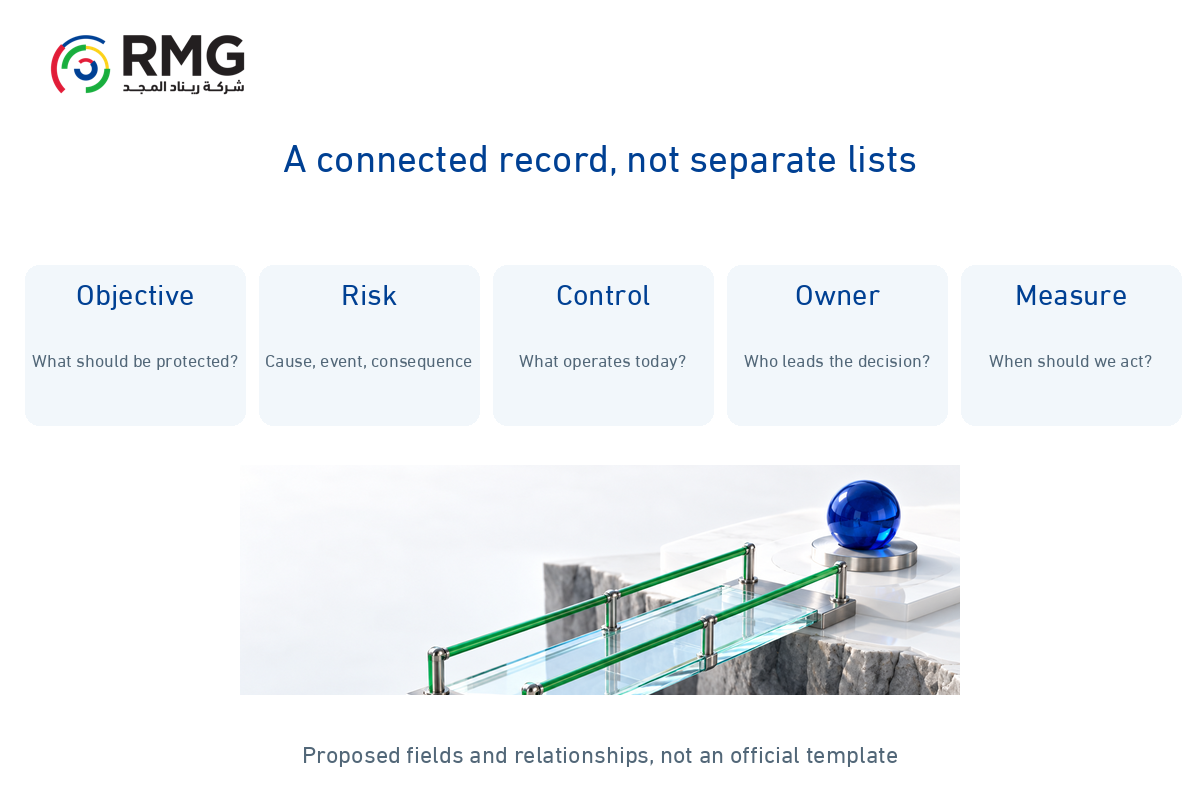
This article proposes a practical record for governance, risk and compliance teams and committee secretaries: a clear objective, a cause–event–consequence statement, an evidenced control, an accountable owner and a decision-triggering measure. The record and example are illustrative, not an official template or universal rating method. The article focuses on potential adverse effects without defining all risk as loss.
Identify the objective that could be affected
Start with an approved organizational or operating outcome rather than a department name. What should be achieved, for whom and within which scope? The objective may concern service continuity, output quality or a process commitment. Record its reference, owner and performance monitoring. Without a clear objective, explaining the significance of a risk is difficult even when its description sounds plausible.
ISO 31000 offers risk-management guidance supporting objectives; it is not a certifiable standard. [1] In the proposed approach, one risk may affect several objectives and one objective may face several risks. Record meaningful links rather than duplicating rows in ways that suggest independent risks or inflate the count.
Separate the cause, event and consequence
A cause describes what could create the conditions; an event is what might happen; and a consequence explains the effect on the objective. Separating them helps locate the response. The UK Orange Book presents cause–event–consequence statements and warns against merely restating the opposite of an objective as a risk. [2] It is used here as a practice reference, not a Saudi requirement.
In a hypothetical example, the objective is to keep an internal service operating against its approved commitments. Weak follow-up of approval for a supplier deliverable could leave it unready when needed, delaying a dependent activity and affecting service. Weak follow-up is a possible cause, unavailability is the event and disruption to the dependent step is a consequence. This is not a reported customer problem or a claim that one cause explains every delay.
Write a record that can be reviewed and acted on
| Proposed field | What the record should establish |
| Objective and scope | Objective reference, owner and affected process or service, including other objective links when relevant. |
| Risk statement | Possible cause, uncertain event and effect on the objective, with evidence, assumptions and information sources. |
| Assessment and basis | Judgment against approved criteria, confidence limits and review date, without invented numerical precision. |
| Existing control | What operates today, by whom and when, with operating evidence and effectiveness checks. |
| Treatment and ownership | Additional action, action owner and approved due date, distinguished from risk ownership. |
| Monitoring and decision | Measure, data source and approved action trigger, with a decision or escalation, owner and next review. |
Do not label a future action as an existing control
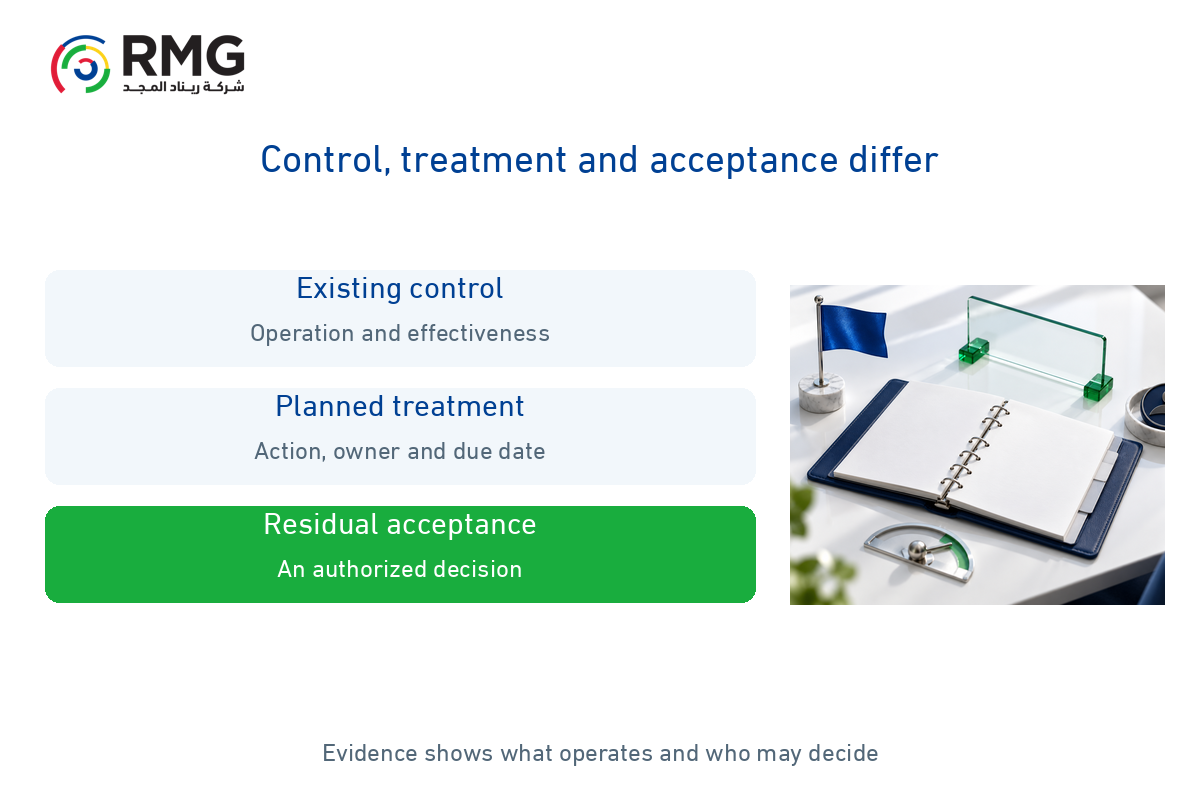
A register may list introducing regular supplier reviews as a control when those reviews have not started. That is a planned treatment, not an operating control whose effectiveness can be relied on. Describe what operates now and keep improvement in a separate action with an owner, approved due date and verifiable status.
In the example, an existing control might review outstanding approvals before the deliverable is needed, record findings and escalate to the authorized person. Operating evidence could be a review record or a particular tracking entry. A policy file alone does not prove that a review occurred, and meeting counts alone do not show whether it identified or addressed deviation.
Assess residual risk using evidence about control operation and effectiveness, not simply because a control name has been added or an administrative task closed. The assessment may stay unchanged, or confidence may improve without risk decreasing. Show missing evidence instead of making the record look more precise than the information supports.
Distinguish the risk owner from the control operator
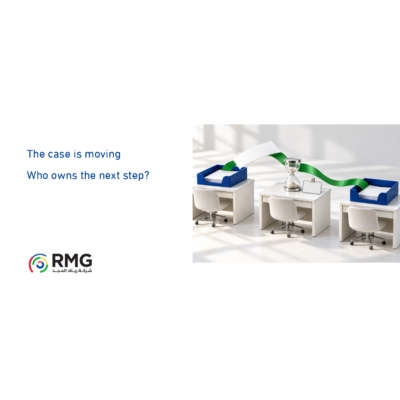
The risk owner monitors the effect on the objective and leads requests for decisions within their authority. The control operator performs a defined activity, while a treatment-action owner delivers an agreed improvement. One person may hold these roles in a simple case, but they are not inherently identical. A risk team should not automatically own every business risk merely because it administers the register.
State who can accept residual risk and approve resources or priority changes. If a decision exceeds the owner’s authority, document escalation rather than treating a record update as acceptance. When responsibility changes, transfer evidence, open actions and review dates as well as the name. Renaming the owner without a knowledge handover leaves an operating gap.
Choose a measure that changes the response when needed
The example could monitor dependent deliverables lacking required approval before their recorded need date. Define valid approval, the date source, who updates the data and how date changes are handled. No universal threshold, weights or five-level matrix is presented as official. The organization adopts criteria suited to its objective, risk appetite and authorities.
Connect the measure to an action: investigate the delay, seek an alternative plan or escalate a decision to the relevant committee. The measure alone does not establish that the risk occurred or disappeared; data quality and scope may have changed. Retain the change history, reassessment reasons and decisions, and revisit links when objectives, suppliers or controls change, not only at reporting time.
Separate a general register from scoped requirements
For cybersecurity risk, NCA’s ECC 2-2024 includes requirements for a risk-management methodology and procedures, implementation and review. The document also defines entity scope and control applicability. [3] It should not be applied indiscriminately to every organization or every business risk. This proposed record does not replace applicable controls or sector requirements; specialists confirm applicability and relevant versions.
A governance discussion with RMG can begin with one evidenced risk record and its links to objectives, roles, policies and evidence. The company describes governance and operating-model services covering responsibilities, policies and performance monitoring. [4] Value lies not in the number of rows, but in seeing what threatens an objective, what operates to address it and who makes the next decision.