

Blog Body
An idea campaign ends with a full submission board. Yet the challenge owner needs a simpler answer than the participation count: which idea needs my attention, what decision must I make, and what evidence will reach its contributor? If those answers are scattered across messages and meetings, an intake platform can become a queue whose destination nobody understands.
The aim is not to implement every idea. Each needs a clear route: clarification, evaluation, a bounded experiment, a reasoned deferral or a documented closure. This article proposes an operating approach for innovation offices and challenge owners to discuss when configuring Mubtaker. The statuses, fields and controls below are editorial recommendations, not representations of product screens or default settings.
Distinguish submission from authorization
Mubtaker’s page describes customizable forms, adjustable evaluation criteria, idea lifecycle tracking and converting approved ideas into initiatives and projects. [1] The organization determines responsibilities, transition criteria and permitted resources. Recording an idea does not authorize spending, data use or an experiment. Popularity among participants is not equivalent to operational feasibility.
ISO 56007:2023 addresses managing opportunities and ideas toward development decisions, and explains that no single method or toolset fits every situation. [2] The route below is therefore not presented as mandatory standard stages or evidence of conformity. It helps each organization identify what it needs to learn before committing further resources.
Give each transition a reviewable output
| Proposed status | Output needed before moving on |
| Received | Stable identifier, a specific problem, contributor and the supported challenge or process. |
| Needs clarification | A specific question, a named respondent and what is missing for evaluation. |
| Under evaluation | Published criteria, preliminary evidence, reviewers’ reasoning and a recorded decision. |
| Ready for a bounded test | Business owner, hypothesis, authorized scope and resources, measurement method and stop condition. |
| Being followed up or closed | Test findings, lessons and a reasoned decision to continue, change or close. |
Do not add a status merely because it sounds professional. If nobody knows who can change it or what demonstrates completion, it creates overhead. A clarification request should specify what is needed rather than saying that information is insufficient. For a deferral, record the reason and the trigger for reconsideration. Deferred must not mean abandoned without an owner.
An idea campaign ends with a full submission board. Yet the challenge owner needs a simpler answer than the participation count: which idea needs my attention, what decision must I make, and what evidence will reach its contributor? If those answers are scattered across messages and meetings, an intake platform can become a queue whose destination nobody understands.
The aim is not to implement every idea. Each needs a clear route: clarification, evaluation, a bounded experiment, a reasoned deferral or a documented closure. This article proposes an operating approach for innovation offices and challenge owners to discuss when configuring Mubtaker. The statuses, fields and controls below are editorial recommendations, not representations of product screens or default settings.
Distinguish submission from authorization
Mubtaker’s page describes customizable forms, adjustable evaluation criteria, idea lifecycle tracking and converting approved ideas into initiatives and projects. [1] The organization determines responsibilities, transition criteria and permitted resources. Recording an idea does not authorize spending, data use or an experiment. Popularity among participants is not equivalent to operational feasibility.
ISO 56007:2023 addresses managing opportunities and ideas toward development decisions, and explains that no single method or toolset fits every situation. [2] The route below is therefore not presented as mandatory standard stages or evidence of conformity. It helps each organization identify what it needs to learn before committing further resources.
Give each transition a reviewable output
| Proposed status | Output needed before moving on |
| Received | Stable identifier, a specific problem, contributor and the supported challenge or process. |
| Needs clarification | A specific question, a named respondent and what is missing for evaluation. |
| Under evaluation | Published criteria, preliminary evidence, reviewers’ reasoning and a recorded decision. |
| Ready for a bounded test | Business owner, hypothesis, authorized scope and resources, measurement method and stop condition. |
| Being followed up or closed | Test findings, lessons and a reasoned decision to continue, change or close. |
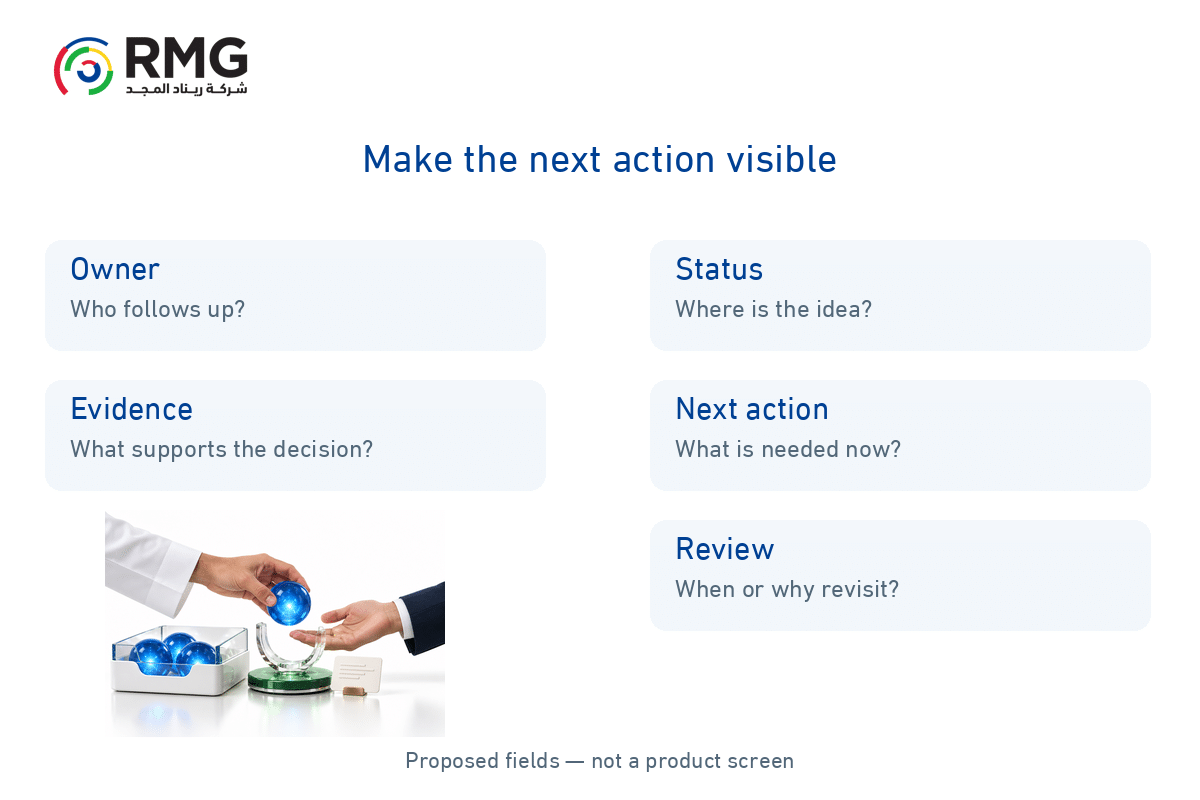
Five recommended tracking fields make the next action visible; this is not a product screenshot.
Separate the contributor from the challenge owner
The contributor explains the problem, proposal and available evidence. The innovation office organizes intake, triage and coordination, including whether an existing initiative is related. The challenge owner clarifies priority, process boundaries and resources that may be requested. Specialists assess matters within their remit. The authorized decision-maker acts within organizational authorities, not simply because they have a platform account.
When an idea becomes an experiment, the business owner should explicitly accept follow-up responsibility. Record who will produce the next evidence, who will review it and who decides afterwards. A small team may combine roles, but preparing a recommendation must remain distinguishable from authorizing resources. Address conflicts of interest under organizational governance, including when a reviewer contributed the idea, and document an appropriate alternative.
Evaluate knowledge and what remains to be tested
Use common questions before an overall score: what does available evidence show about the problem, who benefits, which assumption is uncertain, and what is the smallest test that could answer it? What costs, risks and dependencies are involved? Ask reviewers to connect their judgment to evidence or identify it as an estimate requiring a test. Missing data need not automatically mean rejection, while optimism is not evidence of success.
If the organization uses weights or scores, define and explain them before evaluation and examine how they affect different idea types. This article sets no universal acceptance score or official weights. A small service improvement may warrant a limited test even if its potential impact is smaller than a strategic concept. Portfolio choices involve resources, learning and risk, not only a numerical ranking.
Test the route with one idea before scaling it
In a hypothetical example, not a customer case or reported outcome, an employee proposes simplifying an internal request form because some requests are returned for clarification. The team records the problem, available baseline and the definition of a returned request. The process owner asks whether reordering fields would reduce ambiguity. A specialist checks whether removing a field would affect an approved requirement. The authorized decision-maker then permits a limited test scope before implementation.
Record what changed and what did not, how findings will be compared and possible side effects, such as additional review time. At the end, a contributor’s preference is insufficient. Present evidence and limitations so that the authorized person can choose to continue, modify or stop. If findings do not support the hypothesis, retain the lesson instead of deleting the idea as though it never existed. The example promises no improvement percentage or delivery duration.
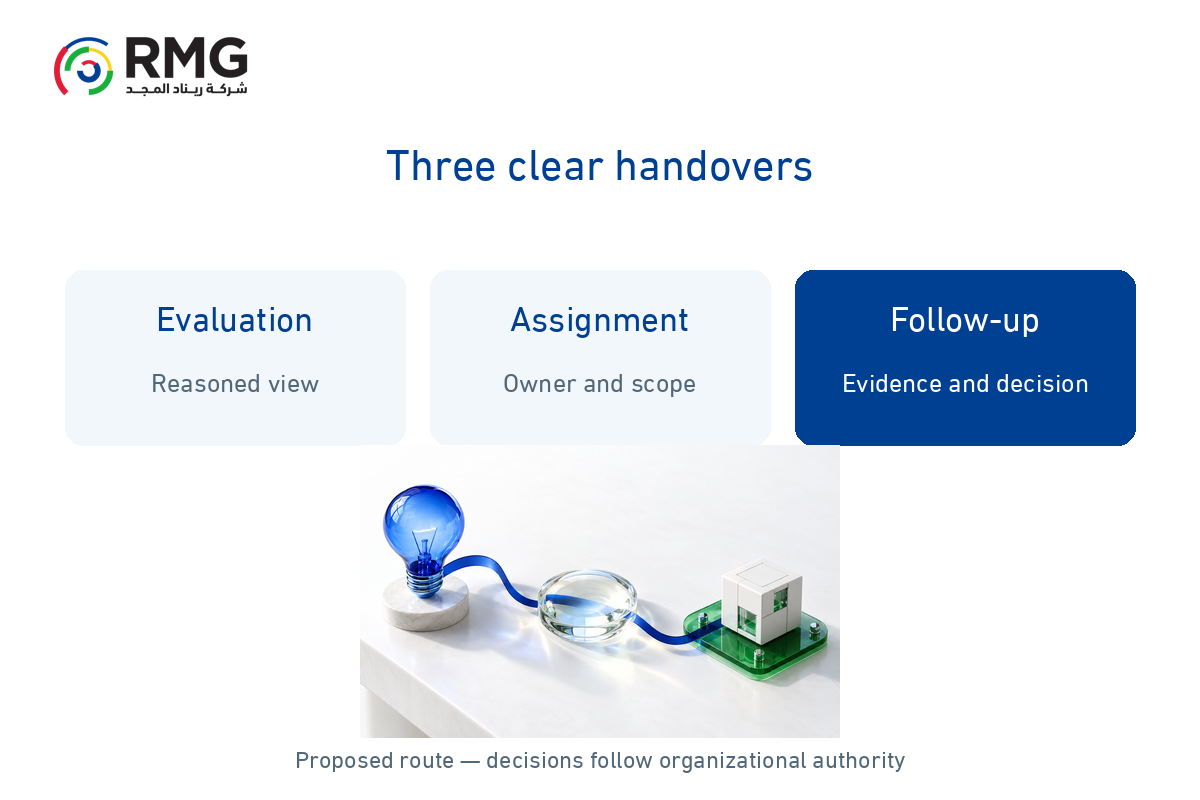
Three proposed handovers connect evaluation with a test decision; each needs an owner and evidence.
Monitor waiting without making speed the only goal
At follow-up meetings, examine ideas with no next action or those waiting on an unnamed party. Resolve the cause. Possible internal measures include elapsed time from complete information to an evaluation decision, the share of ideas assigned to an owner, and the share of tests ending in a documented decision. Define each measure’s start, end, period and denominator. Separate waiting for the contributor from waiting within the organization.
These are proposed measures, not official thresholds or product results. Fast closure is not success if it encourages rejection before understanding. Read flow alongside decision quality and lessons, then change the process causing congestion rather than adding another alert with no accountable respondent.
Protect participant data and idea content
Attachments may include employee or beneficiary information and restricted business material. Where personal data is processed, Article 19 of the PDPL Implementing Regulation requires collection and retention of the minimum data necessary for the purpose. [3] This legal obligation is separate from the proposed workflow. Use examples without personal data where possible and have specialists assess access, legal basis and retention for the case.
A comment or vote is not permission to publish a participant’s data or transfer ownership of their idea. Review participation terms, confidentiality, intellectual property and authorities before launching an open campaign. A platform alone does not establish that these requirements are met. Integration, hosting, access and configuration details belong in an agreed project scope, not assumptions drawn from this article.
Use the demonstration to test your actual need
Bring three sanitized organizational cases to an RMG discussion: an incomplete idea, one ready for evaluation and one awaiting an experiment owner. Ask how the proposed configuration records the reason, responsible person and evidence and how feedback reaches the contributor. Clarify what is available and what needs configuration or agreement. This tests the route against a specific need instead of relying on a generic demonstration or a promise that every idea becomes a project.