


Blog Body
Initiative reports arrive on time and completion percentages are updated, yet the meeting ends with “continue monitoring.” The same blocker returns the following week: an integration awaits approval, a shared specialist is unavailable, or scope remains disputed. The issue may not be a shortage of reports. The report may simply fail to identify the decision required, who can approve it and what must happen next.
A digital transformation office adds value when it helps teams turn that monitoring into actionable, verifiable decisions. This article proposes a meeting and decision-record model for initiatives already under way. The model grants no automatic authority: the organization defines the office’s remit, delegation limits and relationships with service owners, the project management office and relevant committees.
Clarify what the office can decide and what it must escalate
Start with a short operating charter covering the office’s responsibilities: consolidate the picture, check information consistency, surface dependencies, prepare options and follow decisions through. Map decision types to approved authority. Changing a task date within delegation differs from increasing a financial commitment or changing service scope. The office may recommend and coordinate a solution while approval remains with the authorized decision maker.
GOV.UK’s agile governance guidance stresses decisions at the right level, with teams understanding their authority boundaries and who can help beyond them. [1] Do not send every detail to the senior committee, or use delivery speed to bypass approval. Record escalation routes and arrangements for an absent decision maker within the organization’s agreed governance.
Turn status updates into decision questions
Before the meeting, classify items as information, a blocker the team can resolve, or a decision beyond its authority. Ask the initiative owner: what stopped, when, which outcome is affected and what decision would unlock progress? “Integration is delayed” is insufficient. The real need may be an agreed data definition, a named approver or allocated delivery capacity.
Request an evidence link and an update date, distinguishing confirmed facts from estimates. A high completion percentage does not remove a critical blocker, and a demonstration does not establish operational acceptance. Where information is incomplete, assign an evidence-gathering action, owner and date. Do not turn uncertainty into open-ended approval or defer an item without a clear question.
Northern Ireland’s Department of Finance links issue management to assessing effects on delivery, resources, costs and timescales and referring matters to an appropriate decision level. [2] Use that logic to identify decision-ready agenda items: a meaningful effect, feasible options and known authority. Keep potential future risks distinguishable from problems that have already occurred.
Prepare options that can be compared
Describe feasible alternatives and their boundaries, including continuing unchanged when that is a valid option. Explain effects on scope, time, resources, service quality and dependencies. Do not present only the preferred option and ask vaguely for direction. State why it is recommended and what assumption could change that recommendation. A bounded investigation may be the appropriate decision before a larger commitment.
Show cross-initiative effects. Moving a specialist to a blocked project may delay another service; review capacity with the resource owner rather than presenting the remedy as cost-free. State when the decision is needed and what delay would affect, without manufacturing urgency to advance an immature option.
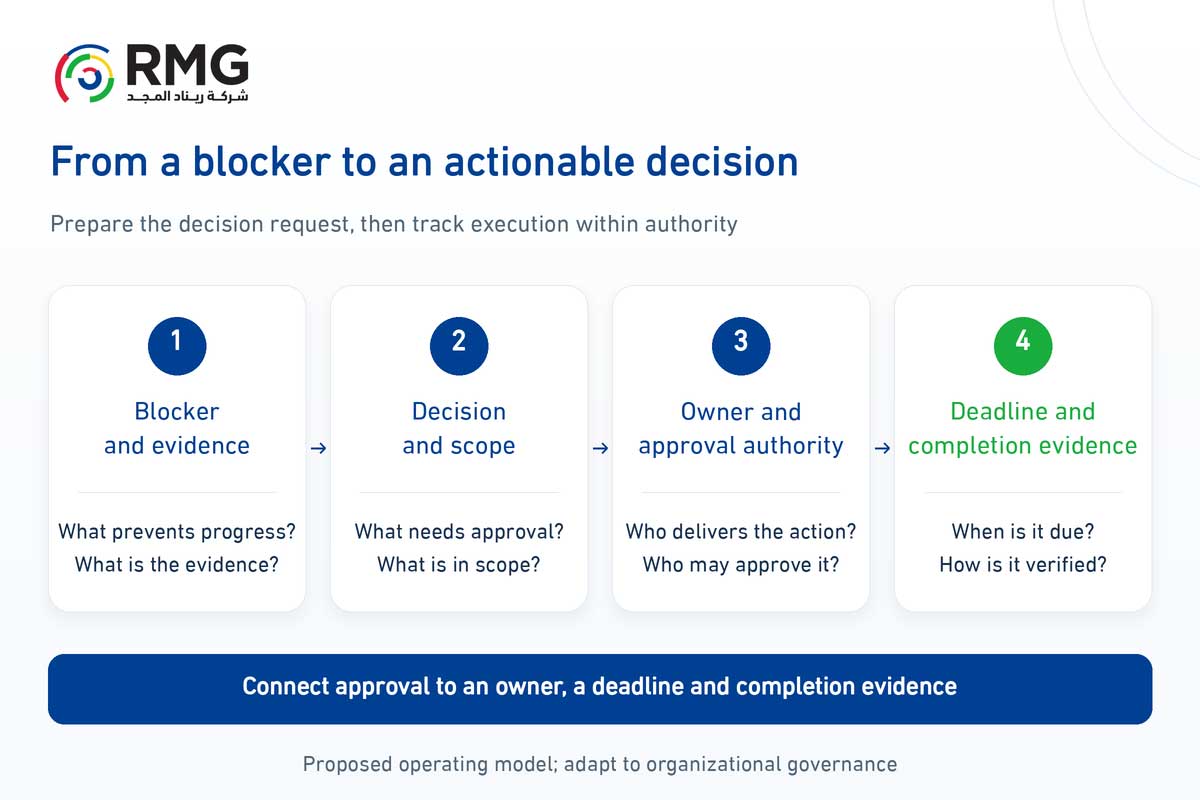
Present the blocker with a specific decision request, then connect approval to an owner, deadline and evidence.
Run a meeting that produces an unambiguous record
A meeting can begin with previous decisions that have reached their due dates, consider complete decision requests and finish by confirming actions and escalations. Circulate information-only updates beforehand where practicable. Adapt the following proposed record so that someone who missed the meeting can understand what was decided and what remains unresolved.
| Record field | Required question or statement |
| Blocker and evidence | What is blocked and what is affected? Evidence link and date: ___ |
| Decision required | What choice is needed? Options, scope boundaries and assumptions: ___ |
| Approval and status | Who has authority? Recommended, approved or deferred? Approval reference and conditions: ___ |
| Execution and deadline | Execution owner: ___ | Specific action: ___ | Due date: ___ | Dependencies: ___ |
| Verification and escalation | Acceptance criterion and evidence: ___ | Verifier: ___ | When and to whom is delay escalated? ___ |
Write the decision in operational terms: what changes, within which scope and under which conditions? “Coordinate with stakeholders” needs a defined outcome. An unapproved option remains a recommendation or a deferred decision, with a reason and the information needed next. Silence or inclusion in minutes does not itself establish approval; retain the reference that evidences the decision under organizational procedures.
The Project Routemap governance guide addresses delegation, escalation routes and triggers for intervention by a higher authority. [3] In practice, a trigger might be a critical missed date or a changed condition underlying approval. Agree triggers in advance and update the record when scope changes; an earlier approval should not silently cover a different action.
A hypothetical example: an integration needs a shared decision
Suppose a digital-service initiative cannot complete integration testing because business and technology teams use different definitions of an application status. This is a hypothetical example, not a client project or outcome. The office frames the blocker as: “Status acceptance testing is blocked until its definition and approving owner are agreed.” It gathers evidence of the difference and its effect on the test date, rather than repeating “coordination is ongoing.”
Options include agreeing the definition first or running a bounded test using a documented temporary mapping, with the implications of each made explicit. After specialist input, the office recommends the first option. The record remains a recommendation until the authorized person approves it. Approval then assigns the process owner to settle the definition and the integration lead to update the mapping, with clear dates and an agreed acceptance criterion.
Sending the definition or updating a file does not close the blocker. The acceptance owner checks the specified test, attaches evidence and updates the effect on the initiative plan. If approval is delayed, the item follows its escalation route with options and the consequences of waiting. The office cannot presume consent or authorize operational launch merely to preserve a date.
Recommendation, approval and verified execution are distinct stages, each requiring its own evidence.
Measure the office’s effect on execution
Track decision waiting time from a complete request, the number and age of open requests, and due decisions whose execution has been evidenced. For execution rates, define the denominator as decisions due within the reporting period, showing approved changes and previous dates. Moving deadlines or dividing one decision into smaller actions should not create an artificial improvement.
Review reopened decisions and whether a blocker was removed or merely transferred to another team. Completing an action does not itself demonstrate the initiative’s benefit; the benefit owner tracks the outcome separately. RMG supports establishing and operating digital transformation offices, addressing strategy, capabilities and roles. [4] Contact RMG’s experts to build a follow-up approach that connects each blocker with a clear decision, owner, deadline and completion evidence.