

Blog Body
Maintenance requests accumulate quickly. Sorting them only by report date can place a cosmetic repair ahead of an asset that supports an essential service. Calling every asset “critical” creates a different problem: the classification stops helping anyone decide. A useful priority must explain which service depends on the asset, what is known about its condition, and which action addresses the exposure within available resources.
This article proposes an administrative framework for facilities, asset and maintenance teams. It connects condition, criticality and service interruption in a record that can be followed through. The examples are hypothetical, not client results or an official classification standard. The framework does not replace competent technical assessment, manufacturer instructions, or the safety and regulatory requirements applicable to the facility.
Start with the service the asset supports
Before rating a pump or an air handling unit, identify its service, location and users. Similar equipment can support areas with very different consequences of interruption. Ask the service owner about acceptable downtime, the operations affected and dependencies on other assets. Record the answer, its source and review date. “Important to operations” does not provide enough support for a deferral decision.
ISO 55001:2024 addresses an asset management system aligned with organizational objectives, connecting performance, risk and expenditure across the lifecycle [1]. A practical question for a maintenance meeting follows: which service does this work protect, and what evidence supports its priority?
Separate the asset owner, service owner and maintenance delivery owner in the record. Facilities may own the equipment while another department depends on it. Outsourcing the work does not remove the asset owner’s responsibility to follow the decision and accept the result within their authority.
Distinguish criticality, condition and urgency
Criticality describes the consequences of losing the asset’s function in its operating context. Condition describes evidence from inspection, measurements, failures and tests, assessed by competent personnel. Urgency determines when action is needed in light of that evidence and applicable obligations. An important asset in stable condition may require planned maintenance; new evidence of deterioration may change the intervention date.
Do not infer failure probability from age alone. Few complaints do not demonstrate that an uninspected asset is sound. Mark missing information as “unverified” and assign an owner and due date to obtain it. Do not translate missing data into a low rating that automatically permits delay. The next action may be a specialist assessment that resolves uncertainty, rather than an undefined repair order.
Verify the alternative before treating it as mitigation. Can it carry the required service? Has readiness been tested through the approved procedure? Does it share a power source, supplier or failure point with the primary asset? A standby device listed in the register does not itself prove continuity. The technical assessor documents its limitations; the service owner approves appropriate continuity arrangements.
Apply mandatory gates before comparing work
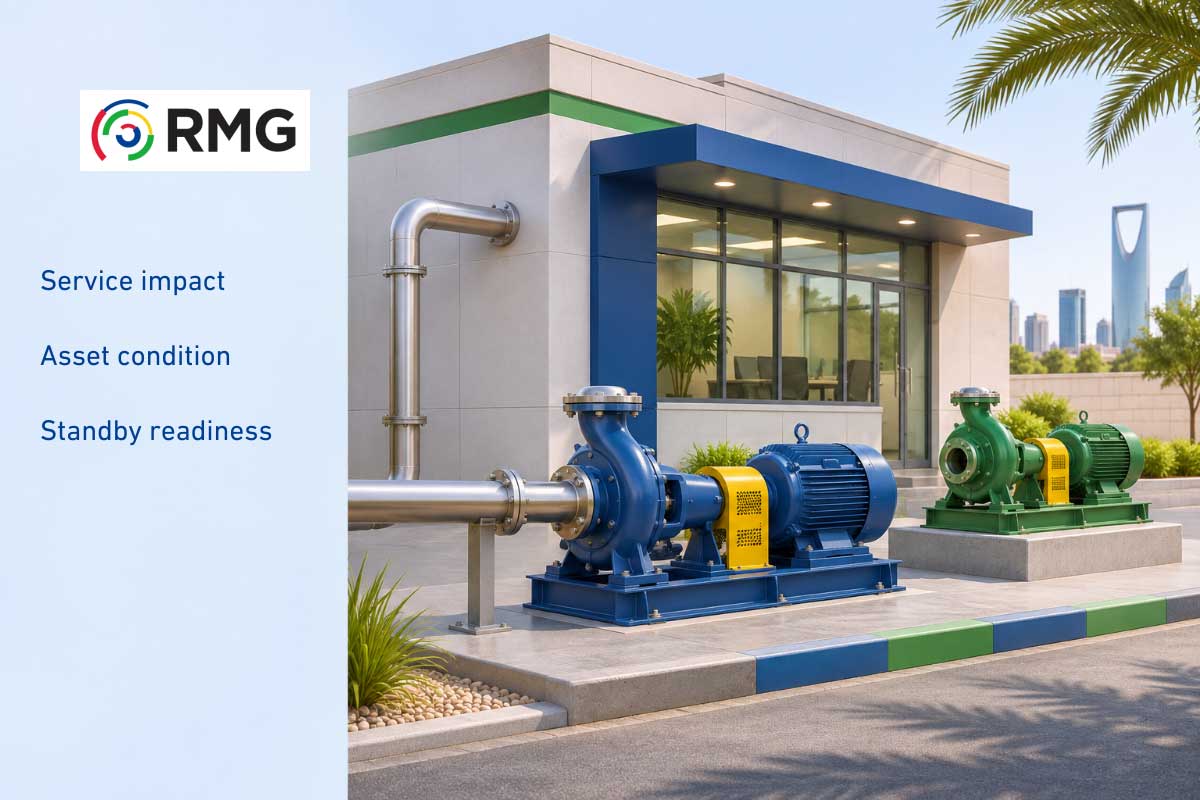
Route safety concerns and binding obligations to the responsible specialists under facility procedures. A scoring table must not delay a required safety action or mandatory inspection date. Then compare discretionary work using service consequences, condition evidence, confidence in alternatives, resource lead times and the opportunity for safe execution.
Clearly defined descriptive categories may be more useful than an opaque combined score. For example, define “high impact” against the service disruption the organization can tolerate, and specify the evidence each category needs. If numerical weights are later adopted, approve them internally and examine how sensitive the result is to those choices. Do not describe them as ISO or Expro weights without an explicit source.
For otherwise similar cases, the maintenance and service owners should consider continuity options, spare-part availability and the work window. Record why the decision was made and who approved it, not just the category. Escalate resource shortages with the consequences of delay and temporary controls; do not downgrade criticality simply because funding is unavailable.
Use a matrix that leads to action
The following compact matrix is educational, not equipment-specific technical advice. The operational record should also include the asset identifier, location, date of condition evidence, service owner and next decision date. Actual deadlines must follow the organization’s assessment, not this example.
| Asset and service | Condition, criticality and impact | Action and follow-up owner |
| Building supply pump | Deterioration documented; interruption affects supply; standby readiness unverified | Specialist assessment of condition and standby, then decide intervention; facilities maintenance lead |
| Meeting-room cooling | Underperformance confirmed; meetings can move to an available room | Coordinate planned maintenance and service relocation; operations supervisor |
| Staff access gate | Repeated faults; alternative route exists but suitability needs verification | Specialist inspection and confirmation of a safe approved access route; facilities manager |
The comparison explains why “repeated fault” or “old equipment” is insufficient. The decision can change when the alternative fails, service dependency increases or a new inspection result arrives. Retain the reason and date of any priority change so that the decision remains understandable, rather than overwriting the previous assessment without a history.
Turn priority into executable work
A priority does not reserve a team or a spare part. Connect the decision to a scope reviewed by competent personnel, a delivery owner, required resources, applicable approvals and permits, and a work window agreed with the service owner. Identify who informs users, the conditions for restoring service and the evidence needed to accept the result.
US Department of Energy guidance describes maintenance approaches including preventive, predictive and reliability-centered maintenance [2]. This is general practice guidance, not a Saudi obligation. Selecting an approach is a technical and management decision based on the asset and its evidence. Criticality does not automatically justify sensors or a predictive maintenance contract for every asset.
When work is complete, attach the delivery report, appropriate test result and acceptance by the authorized party. Update the asset record, condition assessment and maintenance plan where the work warrants it. Closing a work order in software does not alone demonstrate restored service or removal of the fault’s cause. Acceptance evidence is required, with a later review if the assessment calls for one.

Review the list against service evidence
Agree a review frequency suited to the facility, and reassess after a failure, inspection or material change. Track overdue important work with its reason and decision owner, repeat faults after closure, requests lacking condition evidence, and whether the agreed service restoration time was achieved. Separate waiting for resources from execution time to understand the delay.
Do not rely solely on the number of closed work orders. That count may rise while a consequential asset remains untreated. Sample deferral decisions: does the justification still hold, and has the temporary control been verified? If circumstances change, return the decision to the authorized owner. The aim is a maintained decision record, not a ranking that remains fixed as reality changes.
Connect the framework to the organization’s reference material
In Saudi Arabia, Expro presents the National Manual of Assets and Facilities Management for government entities, covering subjects including asset management, condition assessment, maintenance and risk [3]. Its asset management volume also lists material on the asset register, policy, planning and improvement [4]. These references are useful to the relevant entities. They do not make this proposed matrix an official template or establish that every manual procedure applies identically to all private facilities.
Start with a limited set of assets linked to a clear service. Complete their records with the responsible owners and test whether the decisions are executable before expanding. RMG’s asset management consulting service provides a related route for discussing the management system [5]; the verified English contact page is available for enquiries. The practical outcome is a priority with a stated reason, an action with an owner and a result that can be checked.