
Blog Body
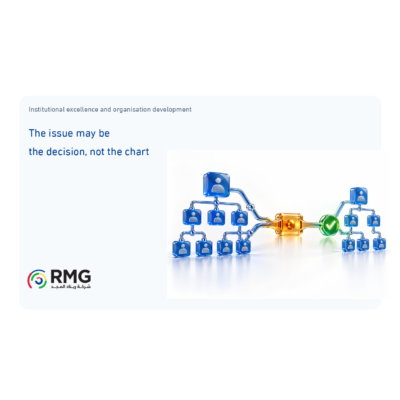
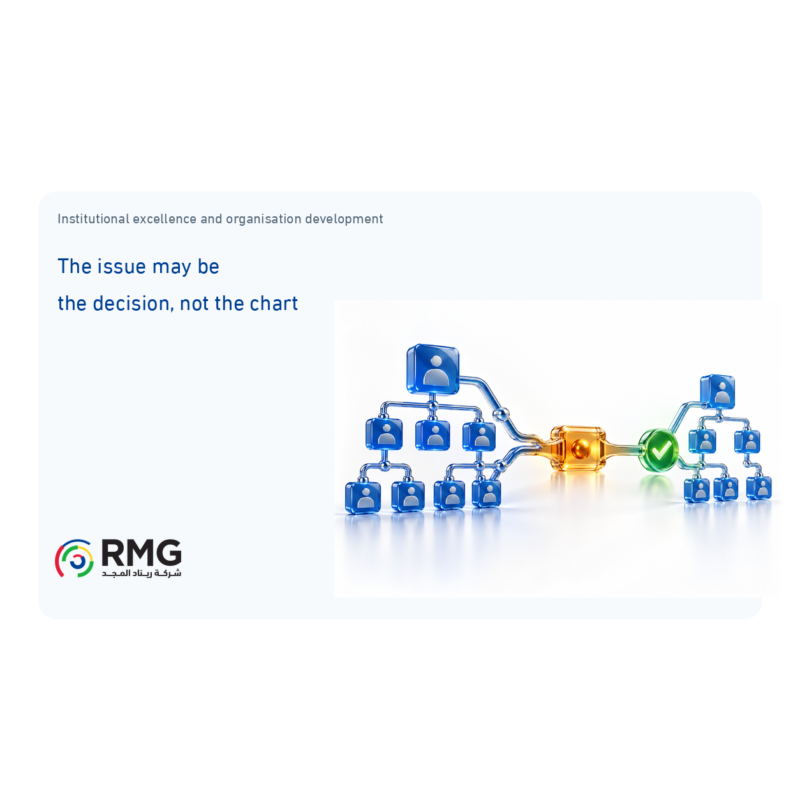
When a decision stalls between departments, changing the organisation chart may look like the immediate answer. Diagnosis starts by identifying where work waits, who has decision authority and what is missing at each hand-off. This article offers a practical map for distinguishing process, governance and structural issues before authorising change. It is an adaptable proposal for Saudi organisations, not an official standard or a substitute for their applicable requirements and approved authorities.
Begin with a real stalled decision
Choose a decision or output that repeatedly arrives late and define its start, end and beneficiary. Do not begin with the name of a unit to be moved. Gather actual cases, dates and required inputs while protecting sensitive data, so perception can be separated from an observable bottleneck.
Map the current path
Record steps, roles, approvals and hand-offs, including who asks for information and who waits. Include exception routes, not only the ideal path. The map may reveal sequential approvals with little added value, duplicate reviews or a decision without a clear authority owner.
Separate three problem types
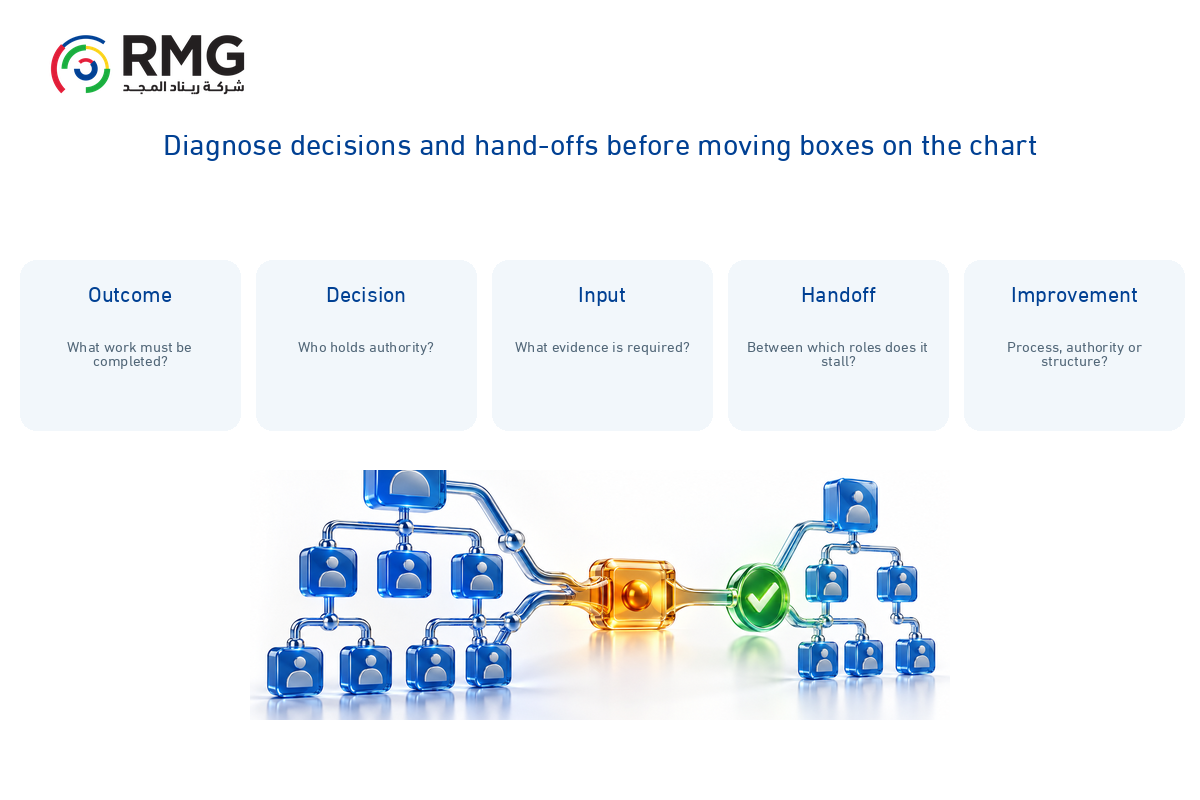
Delay may be procedural because of an unnecessary step, governance-related because decision rights are unclear, or structural because accountability is divided across units lacking resources. Remedies differ: process simplification does not always require reorganisation, and changing authority is not the same as moving a function.
| Field | Practical question |
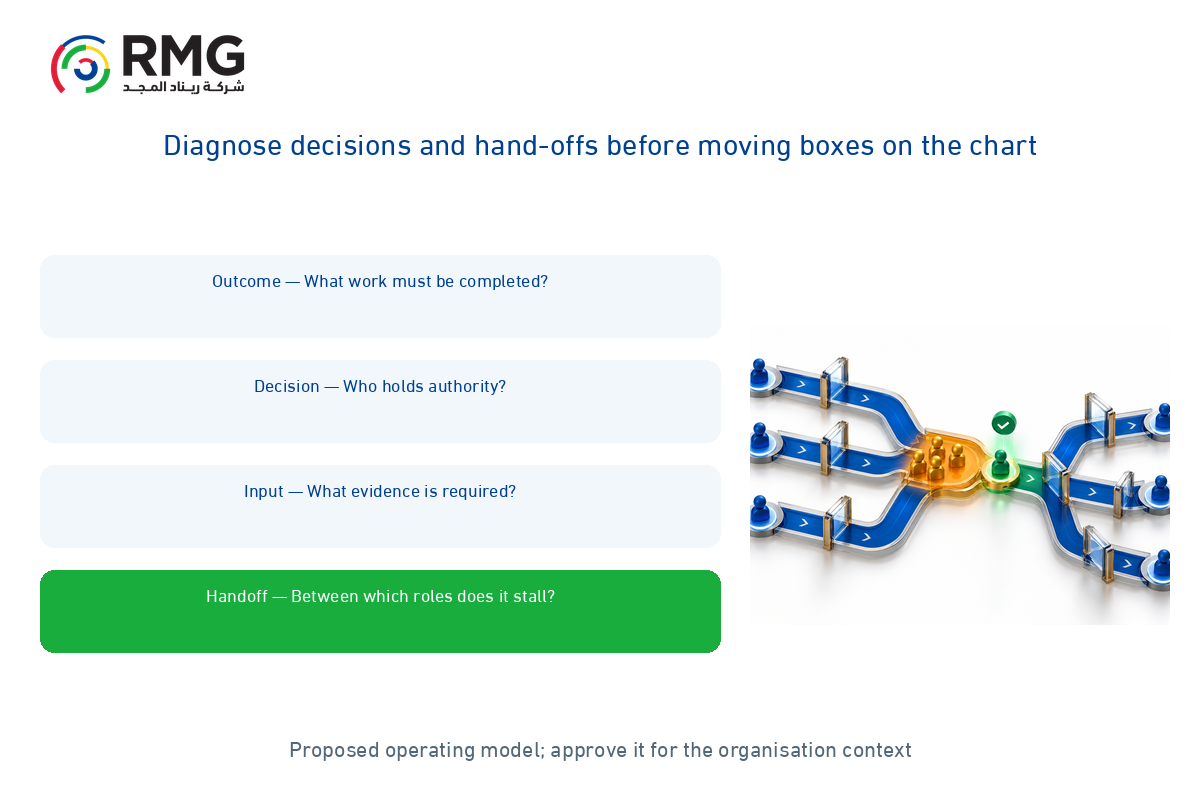
| Outcome | What work must be completed? |
| Decision | Who holds authority? |
| Input | What evidence is required? |
| Handoff | Between which roles does it stall? |
| Improvement | Process, authority or structure? |
Test overlap and accountability
Use a responsibility view that shows who decides, performs, is consulted and is informed, with an explicit definition for each role. Avoid making every leader a decision owner or assigning the operational outcome to a support function. Test absence, escalation and competing priorities as well as the normal case.
Compare a limited set of options
Options may include changing the procedure, delegating authority, creating one contact point, reallocating resources or adjusting structure. Compare effects on decision time, control, output quality and execution capacity. Any scores or weights are internal examples to be approved, not an official standard.
Turn the chart into an operating system
RMG describes an organisation chart as representing authority, responsibility and communication. Value emerges when the chart connects to role definitions, authorities, processes, measures and transition planning. Document the design decision and assumptions, then review the effect after implementation rather than treating chart approval as completion.
An example before moving a unit
Suppose an organisation attributes slow internal-request approval to a team’s position in the chart. A process owner traces the request and finds that files return because hand-off requirements are undefined, then wait for two departments when neither knows who makes the final decision. Moving the team could leave both causes intact. This is a hypothetical example, not a client case or project result.
Test a limited improvement
The test starts with a complete hand-off checklist, a decision owner identified under the approved delegation, and a distinction between consultation and approval. The team records when a complete file arrives, when a decision is made, reasons for return and who handles exceptions. Compare similar cases before and after the test, checking decision quality and control as well as time. Set no universal target percentage or deadline without a baseline and agreement from the process owner.
What leadership should receive
The decision pack contains the current flow, evidence of bottlenecks, the responsibility matrix, options and their effects, a recommendation, and an owner for implementation and review. Where structural change is justified, explain corresponding changes to job descriptions, delegation, systems and communication. The organisation authorises change through its actual authority arrangements; this proposed matrix grants no new decision rights.
Connect diagnosis to an actionable next step
If your organisation is reviewing its structure, start a discussion with RMG using a stalled decision and a documented work map. These can help define an appropriate scope for analysing structure, roles and responsibilities. Review the organisational-structure design service cited below, then agree the deliverables and intervention boundaries your organisation needs.