

Blog Body
Choosing a first AI agent can appear to be a technical question: which model should we use and which system should it connect to? An earlier decision is which task deserves delegation. Looking up an approved policy differs from preparing a request draft, and both differ from changing a record or sending a message for the organization. Calling all three an assistant hides their different consequences and authorities.
This article proposes a task matrix for AI and technology leaders and business owners. Each task is linked to its inputs, expected output, access rights and user-intervention boundary. The matrix and examples are illustrative operating recommendations, not an official risk classification, customer results or a guaranteed feature list for a particular product.
Start with a bounded task, not an entire job role
An HR assistant is a broad role. Showing the requirements in the approved version of a particular procedure is a task with reviewable inputs and outputs. State who requests it, why and where it begins and ends. Do not automatically delegate everything an employee can do, or assume that repetition alone makes a task suitable for independent execution.
Ask whether the task needs an agent at all. Organized search, a structured form or a clear deterministic rule may be enough. An agent trial becomes more useful when varied requests must be interpreted and connected to knowledge or bounded steps, with an effective way to check the result. If the objective is unclear or nobody owns the output, clarify the process before automating its ambiguity.
Separate retrieval, proposals and actions
Retrieval returns an answer or a location in an approved document. Preparing a proposal produces an editable draft without changing another system. Execution creates an effect beyond the conversation: a registered request, updated record or sent message. Moving between these levels should be an explicit decision, not an implied consequence of asking a question.
OWASP connects excessive agency with unnecessary functions, permissions or autonomy. [1] NIST discusses agent identity and bounded delegation while warning against approval fatigue. [2] These are practice references, not Saudi legislation or a product compliance certificate.
| Illustrative task type | Proposed input, output and permission boundary |
| Knowledge retrieval | Approved document and question → source-linked answer. Read the permitted scope without modifying it. |
| Draft preparation | Authorized or test data and template → draft for specialist review. No sending or live record creation. |
| Bounded execution | Clear request and established authority → a defined action within scope, with result verification and duplicate prevention. |
| Consequential decision or exception | Incomplete information or high impact → refer to the authorized owner, not an agent substitute for specialist judgment. |
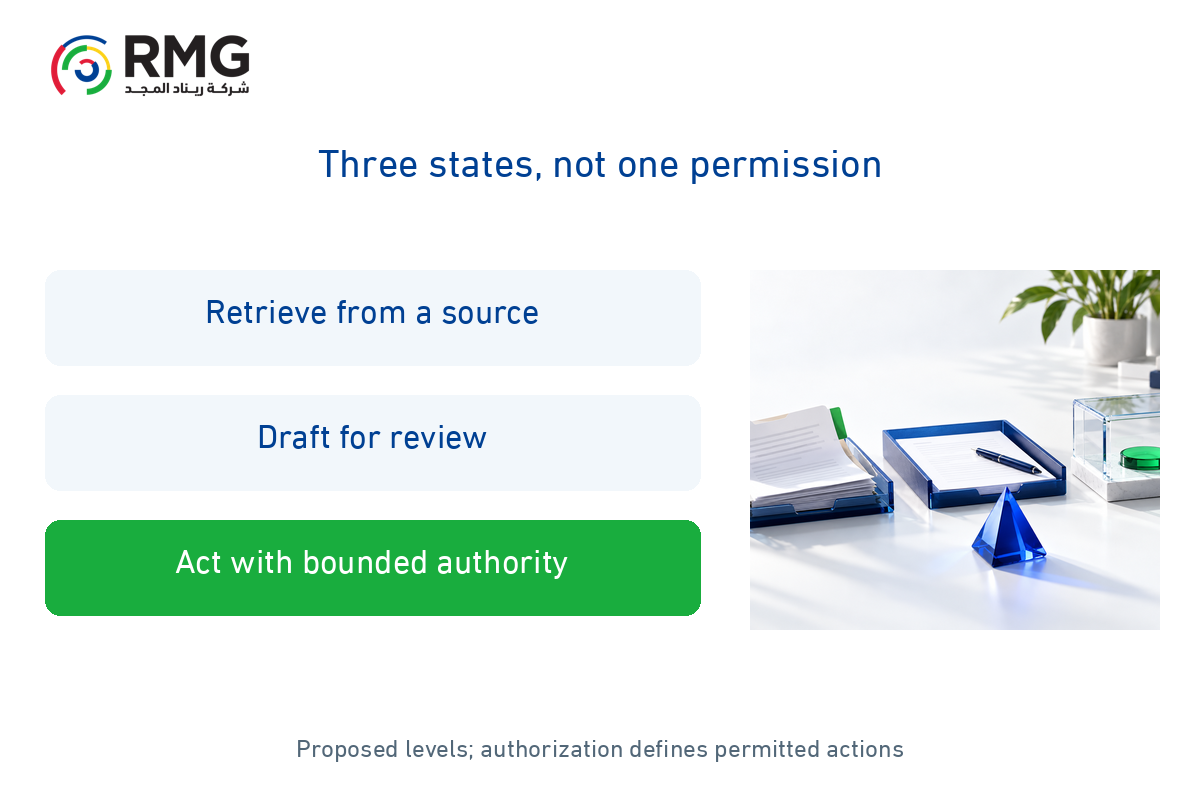
Proposed operating levels distinguish retrieval, drafting and execution rather than treating them as one permission.
Complete the task card before connecting tools
Record the task, owner and authorized user, then the permitted inputs, source and currency. Define the output precisely: a cited answer, draft fields or a verifiable request identifier? Also state exclusions, such as external sending, accessing another department’s data or changing a record outside the agreed scope.
Identify the required tools and allowed operations, not just system names. An agent may need to read a status field without changing the rest of a record. Identity infrastructure and the target system must enforce permissions; a conversational reminder alone should not be the enforcement mechanism. Specialists assess delegation, activity records and revocation for the actual environment.
Set understandable stop conditions: no approved source, conflicting versions, a changed recipient, amount or action type, or uncertainty about an earlier attempt. The agent should not guess or repeat the action automatically. It records what is established and what remains unknown, then returns the request to its authorized path. The stopping boundary is part of task design, not an exception added after launch.
Try the example in a test environment
In a hypothetical example, an IT department wants to help an employee prepare a support request for a device that cannot connect to the network. The initial task presents steps from an approved guide, then drafts a problem description using permitted device information. It does not include reading personal files, changing security settings or inventing a diagnosis.
Allowing live ticket creation later is a different task with its own scope, authority and verification. The interface shows a summary of the data and destination before execution under the approved delegation. A successful result is a request identifier or confirmed system state, not merely an agent saying done. If the outcome cannot be verified, reconcile the first attempt before creating another request.
This example defines requirements; it does not claim that Mojeeb includes this scenario out of the box. RMG’s Mojeeb page describes organizational knowledge, source-linked answers and integration through MCP or APIs. [3] The details of this connection, permissions and interface must be checked with the solution team and target-system owners before committing to an implementation scope.
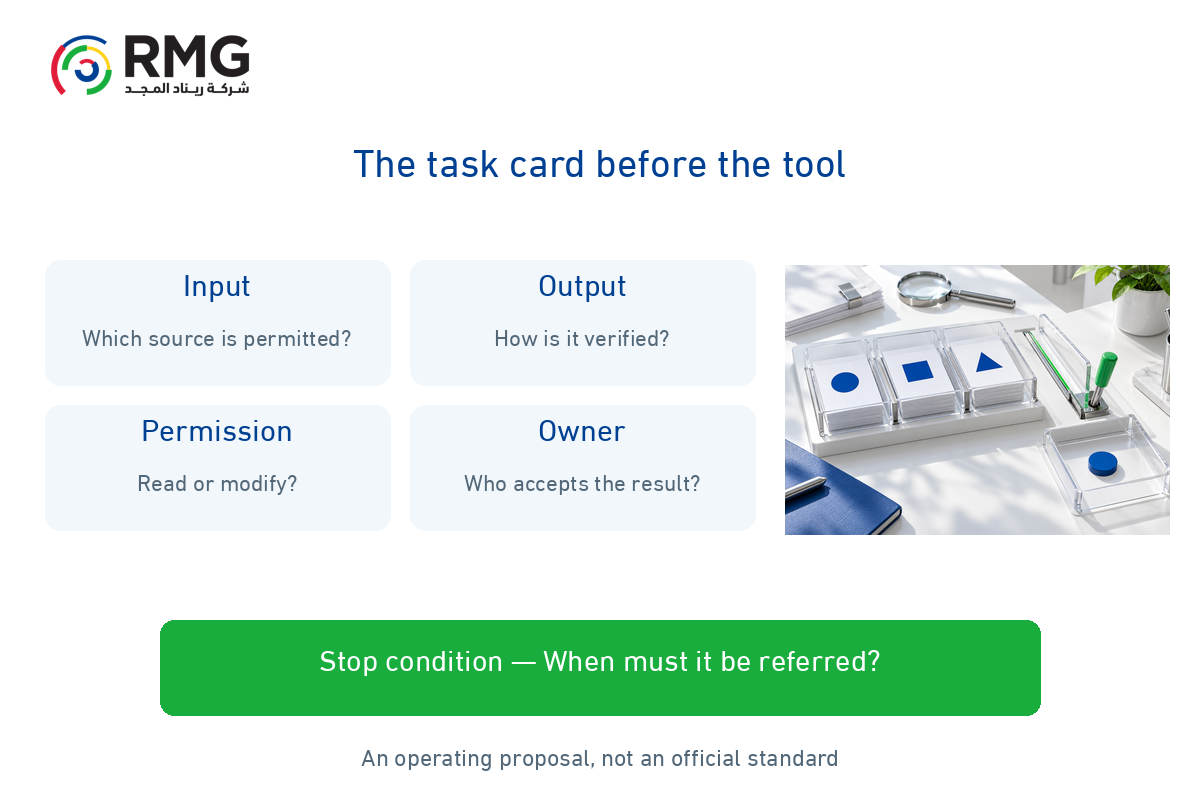
A proposed task card connects inputs, outputs, permission, ownership and stop conditions.
Measure correct outcomes and boundaries, not action volume alone
Test incomplete and conflicting questions, outdated documents, attempts to access unauthorized data and tool failure after execution begins. Evaluate refusal and referral as well as successful answers. One working example does not establish suitability across every department or situation. Record test limitations and reassess them before expansion.
Use measures suited to the purpose: citation accuracy for retrieval, draft completeness at review and the share of executed actions with confirmed outcomes. Any percentage needs a defined numerator, denominator, exclusions and real observations before calculation. Illustrative figures are not an ROI forecast or a promised time saving.
Before using personal data or live integration, specialists assess the Saudi Personal Data Protection Law, its implementing regulation, applicable national and sector requirements and internal policies. Local hosting alone does not establish compliance, and the matrix does not replace legal or security review. Start a discussion with RMG using one task card and its boundaries: good selection defines what an agent may do and what should remain an authorized human decision.