



Blog Body
At a performance meeting, one department reports a number of completed requests and another presents a different number under the same label. The discussion turns to which report is correct. Yet the disagreement may concern what completed means, which period is counted, or how reopened requests are handled. Before investigating a technical fault, both teams need a definition they can apply to the same records.
A shared glossary connects a term to its meaning and context. To make an indicator reproducible, it must also connect to a source, a calculation and accountable people. This article proposes a practical definition card, a way to test it, and a process for managing changes. The card is an operating aid, not an official compliance template or a substitute for data quality and access controls.
Start with the decision and the population being measured
Choose an indicator that repeatedly causes disagreement and identify the decision it supports. Does management need to know how much work was completed during the month, or how many requests received that month were completed? Both questions are useful, but their populations differ. Calling both request completion conceals a distinction that a redesigned dashboard cannot resolve.
Bring together the process owner, data owner, performance team and calculation implementer. Ask each to explain the current definition, including an example that should count and one that should not. Clarify potentially ambiguous terms such as complete, closed, cancelled, duplicate and unique beneficiary. Where a term legitimately has different meanings in different contexts, retain clearly distinguished definitions instead of imposing an unsuitable common meaning.
Connect business meaning to data and calculation
A business glossary explains terms. A data catalog describes available assets, their location and characteristics. An indicator card connects a definition to the fields and transformations producing its value. RMG’s metadata service page discusses linking business concepts with technical context, including terms, fields and data sources. [1]
Naming a source system is only a starting point. Identify the relevant dataset and fields, their accountable owner, and where filtering or aggregation takes place. Detailed source information may require restricted access. Publish an understandable business definition while keeping sensitive technical links available only to authorized users.
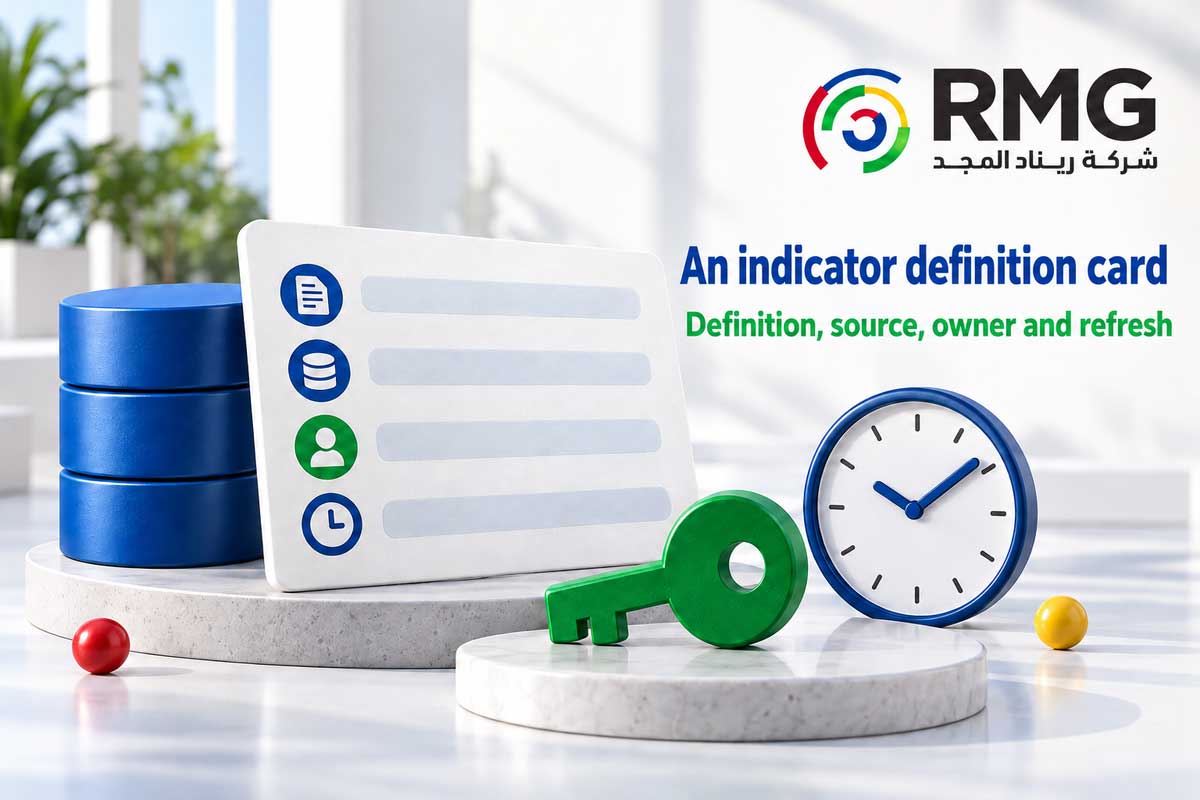
An indicator card connects meaning, source, ownership, calculation and refresh.
Create a compact, usable definition card
Use the following fields as a starting point, adding detail where the decision requires it. Give the indicator a stable identifier and link its reports and dashboards to that record. Keep the definition version distinct from the report version: a presentation change does not necessarily change what the indicator means.
| Field | What to specify |
| Name and definition | Stable ID, relevant language labels, meaning, purpose and what the indicator does not cover. |
| Scope and period | Population, inclusion and exclusion rules, time field, time zone and reporting cut-off. |
| Calculation | Unit, calculation rule, numerator and denominator where relevant, duplicates and missing values. |
| Source and transformations | System, dataset, reference fields, material transformations and authorized technical links. |
| Ownership | Definition owner and approver, card maintainer, calculation implementer and verifier. |
| Refresh and freshness | Extraction frequency, latest update, acceptable delay and how users see that delay. |
| Version and effective date | Definition version, approval and effective dates, change reason and affected reports. |
The UK Government Data Quality Framework guidance recommends describing temporal coverage and update frequency, maintaining metadata, and communicating definition changes. [2] One practical application is to display the latest refresh time and definition version beside an indicator or through an obvious dashboard link.
Test the definition with boundary cases
Consider a hypothetical example. One report counts all requests completed during September, including requests received earlier. A second counts requests received in September and completed by the end of that month. Both numbers may be correct under their respective definitions. Clarify the population and time field, name the measures precisely, and decide which supports the meeting’s decision.
Then test a cancelled request, a reopened case, a duplicate, a completion close to midnight and an event recorded late at source. Agree the expected treatment before comparing outputs. Run both methods on an agreed sample and examine the records responsible for the difference. Protect the data during reconciliation; avoid circulating complete personal records when restricted identifiers or suitable test data can establish the result.
If a difference remains after aligning the meaning, population and reporting time, investigate source quality, transformations and synchronization. A glossary must not conceal a calculation error, and a difference should not automatically be blamed on quality before checking meaning. Record the reconciliation result, unresolved issues and next owner so that the agreement can be tested again.
Assign decision rights and control definition changes
The business owner determines the indicator’s meaning within the organization’s decision rights. The data office supports documentation and consistency, while technical teams implement mappings and calculations. Saudi Arabia’s Data Sharing Policy defines metadata as information describing data and its use, and sets its scope around government data sharing. [3] Assess applicability separately; the card proposed here remains an operational aid.
Before changing an approved definition, identify affected reports and owners, and assess historical comparability. Document the new version and effective date. Decide explicitly whether earlier periods will be recalculated or whether a break in the series will be shown. Do not silently overwrite history. Preserve the previous definition so that earlier reported figures remain explainable, and tell users what changed and why.

A definition change needs a documented impact, version and effective date.
Start small and connect the glossary to everyday use
Select a small group of widely used indicators, publish their cards in a known location and connect them to the dashboards people actually use. Monitor whether these indicators have approved definitions, accountable owners and identified sources. Track overdue reviews and unresolved disagreements. Define these monitoring measures too: a large glossary does not prove that teams use its terms.
Organizations can discuss RMG’s metadata and data catalog services to connect business language with data assets. A practical first step is one disputed indicator: complete its card, test it with the departments concerned, and establish accountable maintenance before extending the glossary to further measures.