
Blog Body
The same complaint returns in different forms: “I uploaded the document again,” “I do not understand why it was returned,” or “I called, but nothing changed.” The service team responds to each case and closes it, yet the issue appears in next month’s report. The individual response may be complete while the underlying service problem remains. Closing the feedback loop connects what the organization heard to what it changed, then checks the effect.
This article proposes a practical record for experience teams and service and channel owners, moving from feedback to an evidence-informed decision. Adapt it to organizational procedures. It helps answer two separate questions: was this user’s case addressed, and is the same problem now less likely to recur within the relevant journey?
Separate complaint resolution from improvement verification
A complaint may be addressed through an individual correction and a clear explanation while a process change takes longer. Keep separate statuses: the complaint status under organizational policy, and an improvement status such as “under analysis,” “in implementation,” “under verification” or “effect verified.” A sent reply is not evidence that the cause was addressed, and assistance to the user should not wait for the improvement project.
The GOV.UK Service Manual recommends using support feedback to improve services and connecting support with the wider organization rather than isolating it in reactive problem handling. [1] In practice, link the case to a recurring-theme record owned by the service team. Many cases may relate to one theme, while one case may reveal several causes. The record should preserve these relationships instead of reducing everything to closed-ticket counts.
Organize feedback before interpreting recurrence
Collect feedback from the channels relevant to the service and record the journey stage: understanding requirements, applying, tracking progress or receiving the outcome. Preserve the user’s wording in the case record, then add a clear analytical category. “The service is slow” needs investigation: it may mean waiting for approval, missing status updates or difficulty obtaining assistance.
Distinguish contacts, cases and people. Three calls about one transaction do not necessarily mean three separate problems, but they reveal additional effort. Link duplicates when the data supports doing so, and retain follow-up counts alongside the case. If records cannot be connected across channels, disclose that limitation instead of assuming every contact represents a different person.
Complaint volume alone can fall because demand decreased or the complaint channel became harder to reach. Compare a cause against the relevant exposure: documents returned for an unacceptable format divided by applications reaching that document-upload stage, for example. Repeat-contact rates require a defined case cohort and follow-up period. Show the denominator, observation window and channel before making comparisons.
Verify the cause with the process owner
Review a sample of cases, what the user saw and what happened in the process. Talk to channel staff and the service owner, then test the explanation through task observation or permitted records. If the explanation is “the user did not read,” ask whether the instructions were visible, understandable and presented at the right moment, and whether they matched back-office requirements. A broad description is insufficient to choose a useful action.
Separate verified causes from hypotheses that need more evidence. Similar complaints may have different causes by device or application type. Escalate harm or disruption promptly under organizational procedures, while continuing the cause analysis so that a temporary workaround does not become the only response.
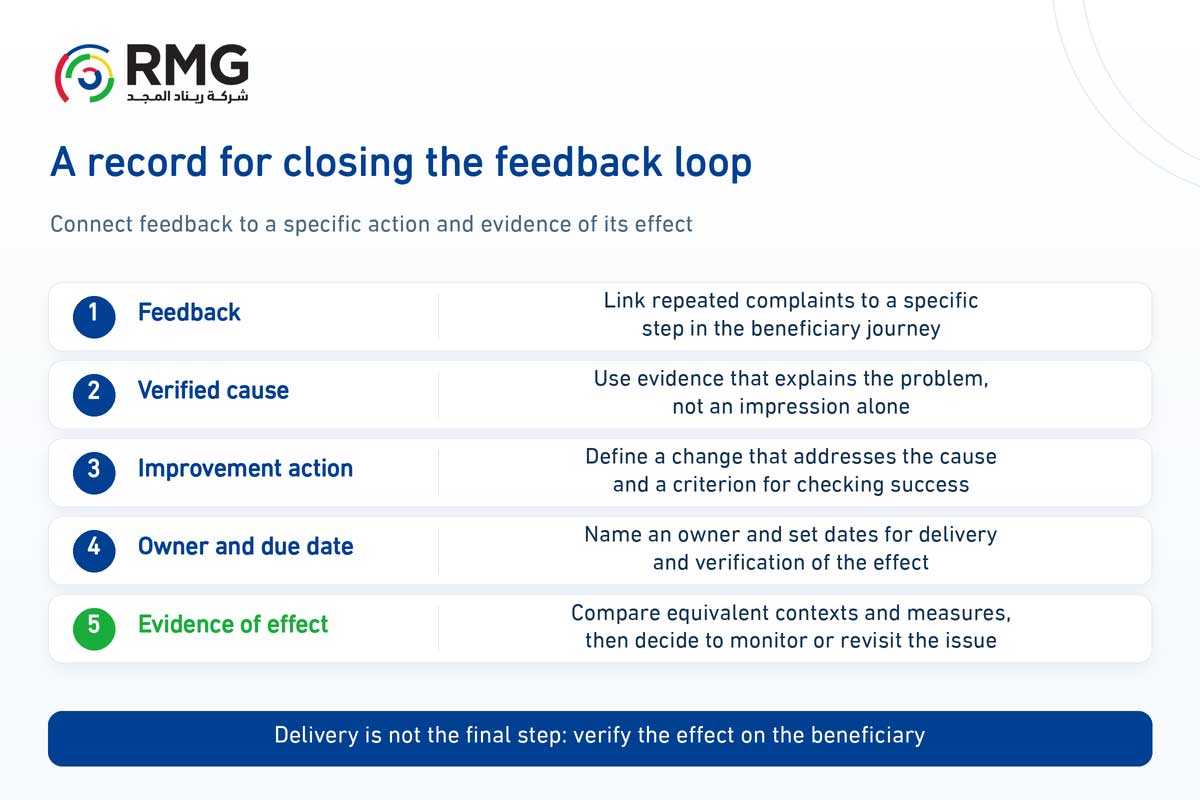
Implementation alone does not complete improvement; its effect on the user must be checked.
Use a compact record that connects decisions with evidence
The UK Ombudsman’s guide to learning from complaints recommends action plans with responsibility, timing and impact review. [2] Apply that principle through the proposed record below, adding evidence links and a follow-up decision. A “done” field should explain what was completed and what still requires verification.
| Record field | What the team records |
| Feedback and scope | Theme: ___ | Journey stage and channels: ___ | Linked cases and period: ___ |
| Cause and evidence | Verified cause: ___ | Unresolved hypothesis: ___ | Evidence link: ___ |
| Improvement action | Specific change and version: ___ | Expected behavior or outcome: ___ |
| Owner and timing | Implementation owner: ___ | Required approval: ___ | Delivery and verification dates: ___ |
| Effect and decision | Metric, denominator and baseline: ___ | Result and limitations: ___ | Continue, adapt or reopen: ___ |
Assign one owner to follow the action through, even when several teams contribute. The service owner reviews the change, a data specialist checks comparability, and the channel owner checks that user messages are consistent. Record external dependencies and escalation dates. Management reporting should show improvements awaiting verification alongside actions that have not yet been implemented.
A hypothetical example: documents returned because instructions are unclear
Suppose a service repeatedly receives complaints about a returned document. Every number below is hypothetical, not a client result. Case review shows that accepted formats appear only after an upload attempt and that the error message does not explain the requirement. During the baseline period, 60 of the 1,000 applications reaching the upload stage were returned for this reason: 6% of applications at that stage, not of all website visitors.
The service owner approves displaying accepted formats before upload, improving the error message and aligning contact-centre guidance. After implementation, there are 24 affected cases among 1,200 applications reaching the same stage during a comparison period: 2%. The direction is encouraging, but the team reviews application mix and concurrent changes, checks mobile use and repeat contact, and then decides whether to retain the change. This comparison alone does not establish that revised wording caused the result.
Earlier individual complaints may already be addressed while the improvement record remains “under verification” until the agreed follow-up window closes. If returns fall but abandonment rises, do not declare success; investigate whether the barrier moved elsewhere. Closure should reflect the outcome users need, rather than one reassuring operational measure.
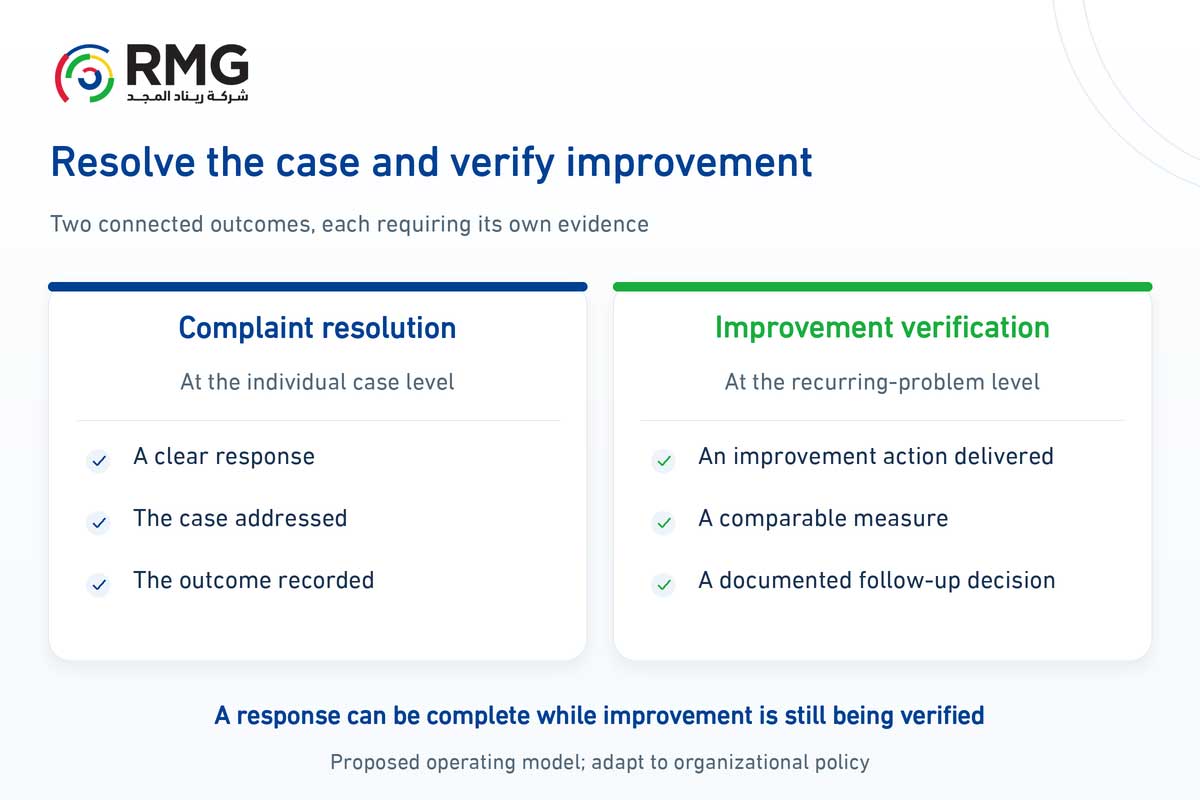
A response can be complete while improvement is still being verified.
Tell users what changed and follow the outcome
Give the user an understandable update suited to the case and agreed channel: what was addressed, what will take longer and when another update is expected. Do not imply agreement they have not expressed or promise an unapproved change. When sharing general learning, avoid identifying case participants and restrict individual details to those who need them for their work under organizational policy.
GOV.UK’s satisfaction guidance distinguishes the end of a digital transaction from the end of the service experience and includes listening to users who drop out. [3] Accordingly, separate satisfaction with complaint handling from satisfaction with the service itself. For surveys, show response counts, the intended audience and when the question was asked; do not assume respondents automatically represent all users.
RMG’s Voice of Customer and Active Listening service covers listening-channel design, feedback analysis, roles and follow-up mechanisms. [4] Start with one recurring complaint theme, gather evidence and record what changed because of it. Contact RMG’s experts to build a clear listening and improvement loop connecting user feedback to an owned action and an effect that can be verified.