

Blog Body
Is your facility a fortress or a target? Discover the secrets of Cybersecurity in the Government Sector 2026. Begin your security journey with Renad Al-Majd (RMG) and turn tomorrow’s threats into today’s victories!
As you read this sentence, thousands of attempts are being made to breach the codes of government entities worldwide. Have you ever asked yourself: What if your organization is the next target tomorrow? In 2026, the question is no longer “Will we be breached?” but rather “How will we endure when the breach occurs?” The digital space has become a silent battlefield, and the government sector is the grand prize that everyone seeks.
At Renad Al-Majd (RMG), we realize that protecting national facilities goes beyond simply installing security software. It is a battle of awareness, planning, and digital sovereignty. Let us take you on a realistic tour to understand how to transform your organization from an “easy target” into an impregnable “digital fortress” in the face of 2026 threats.
The Cyber Landscape 2026: Why Target the Government Sector?
Government entities are not just offices; they are repositories of citizen data and the backbone of vital services. In Cybersecurity for the Government Sector 2026, we find that motives have evolved. It is no longer limited to “ransomware” demands; it has expanded to include strategic espionage and the paralysis of sensitive facilities.
Today’s enemy uses Artificial Intelligence to launch precise “phishing” attacks that are difficult to detect by traditional means. These threats require us at RMG to provide technical solutions that stay one step ahead of the attacker, relying on predictive strategies rather than mere reactions.
The Most Terrifying Threats in 2026
We cannot build a wall without knowing the intensity of the rain. Here are the most prominent challenges facing government cybersecurity in 2026:
- Advanced Persistent Threats (APT): Silent infiltration attempts that remain inside systems for years.
- AI Identity Theft: Impersonating government officials to deceive employees and leak data.
- Data Poisoning: Manipulating government system data to trigger wrong decisions or destroy public trust.
Table: Comparison Between Past Threats and the Reality of 2026
| Threat Type | Previously (2022) | Reality of 2026 |
| Ransomware | Encrypting files and demanding money | Encrypting, selling, and publicly leaking data |
| Social Engineering | Random spam emails | High-precision Audio/Visual Deepfakes |
| Hacking | Exploiting known vulnerabilities | Zero-Day vulnerabilities discovered by AI |
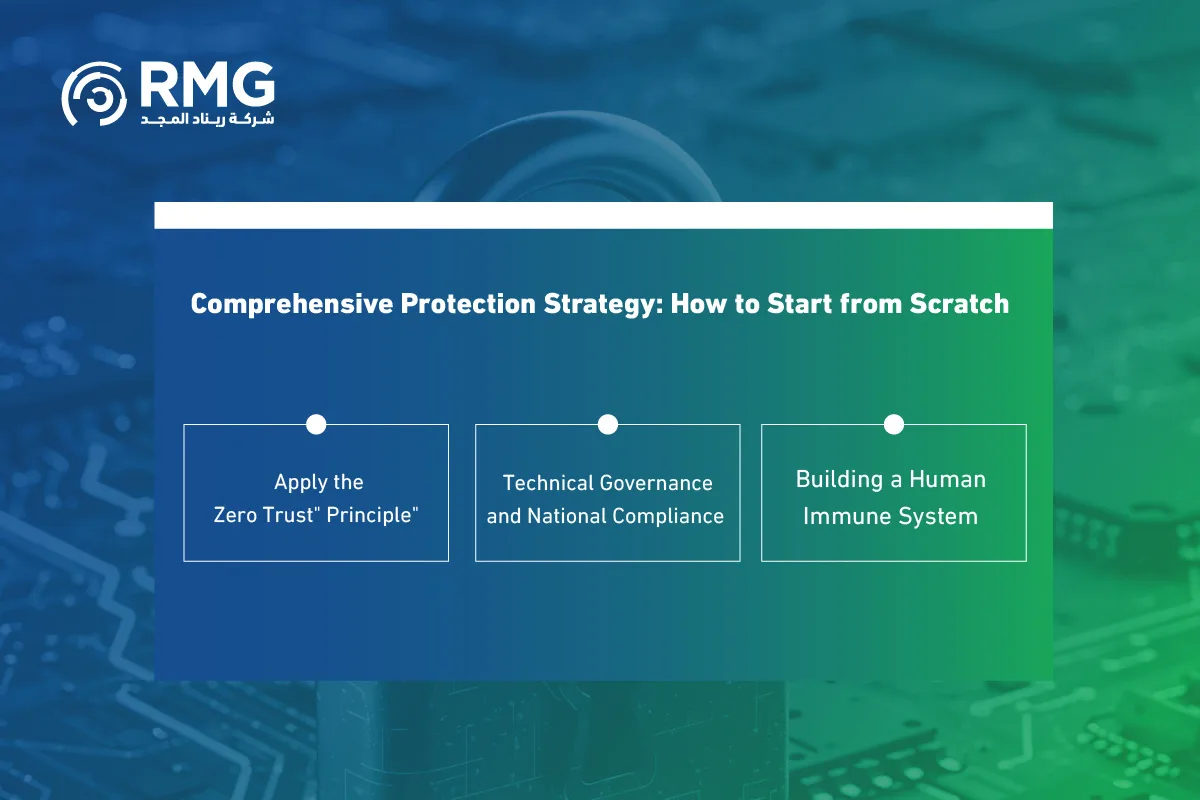
Comprehensive Protection Strategy: How to Start from Scratch?
To protect your organization according to 2026 standards, you need a defensive structure consisting of overlapping layers. RMG suggests the following path:
- Apply the “Zero Trust” Principle: Stop trusting any device or user, even if they are inside the ministry building. This means continuous identity verification and granting the “least privilege” necessary for an employee to perform their job.
- Technical Governance and National Compliance: Adherence to the National Cybersecurity Authority (NCA) controls is not a luxury. It is the roadmap that ensures full coverage of all gaps. At RMG, we help government entities transform these controls from paper texts into effective daily practices.
- Building a Human “Immune System”: The employee is often the weakest link, but they can be the strongest firewall. Continuous awareness programs must include real simulations of fraud attacks to train the human eye to spot danger before it strikes.
The Role of Emerging Technologies in Government Cyber Defense
Technical fire can only be fought with a stronger technical fire. Investing in modern technologies determines a facility’s resilience. Here is how technology enhances security in 2026:
- Security Automation (SOAR): Handling thousands of security alerts in seconds without human intervention.
- Predictive Analysis: Detecting abnormal patterns in network behavior before the actual attack begins.
- Sovereign Encryption: Protecting sensitive data with national encryption that ensures no external party can decrypt it.
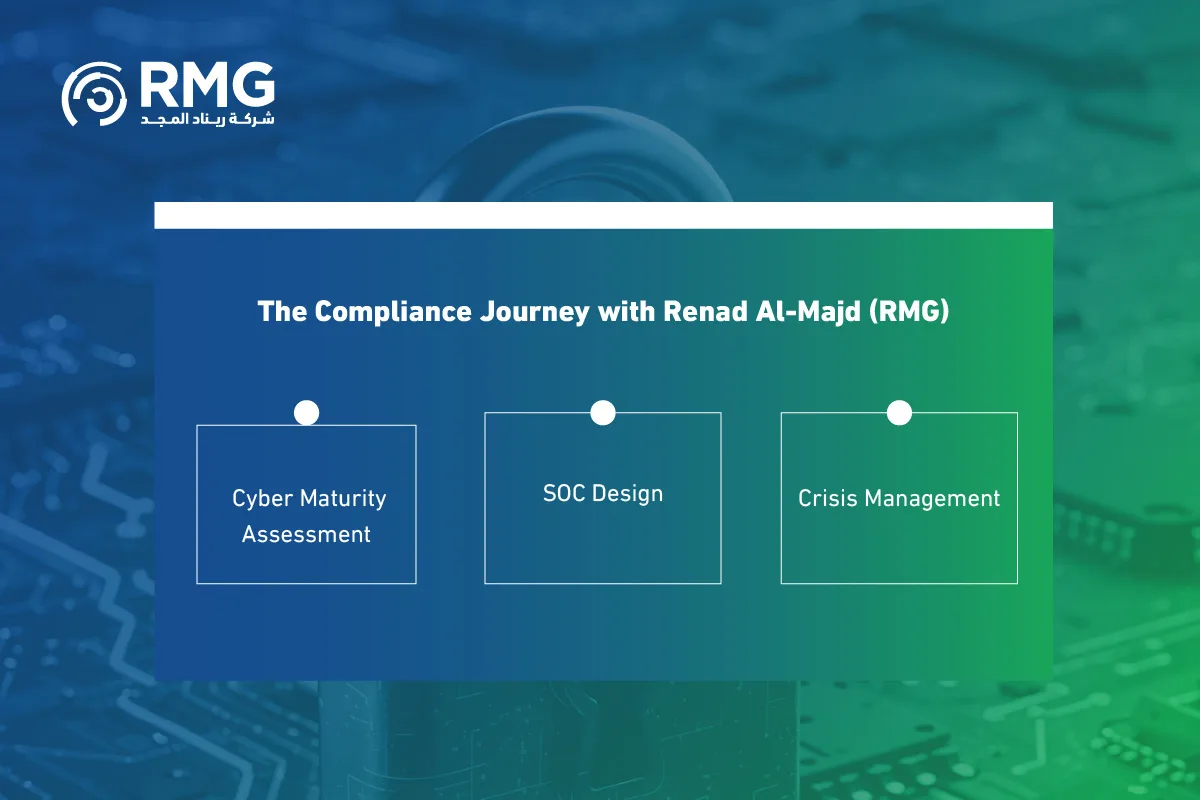
The Compliance Journey with Renad Al-Majd (RMG)
Why do government entities choose RMG as a partner? Because we don’t settle for “off-the-shelf” solutions. We dive into the details of each entity and provide:
- Cyber Maturity Assessment: A precise evaluation of where your organization stands compared to 2026 standards.
- SOC Design: Building Security Operations Centers that work 24/7 to monitor any suspicious movement.
- Crisis Management: Developing proactive plans for data recovery and ensuring business continuity in the event of a disaster.
Incident Response: What to Do When the Forbidden Happens?
In 2026, response speed is the difference between a “minor glitch” and a “national catastrophe.” Your organization must have a trained team that knows exactly its role the moment a breach alarm appears. At RMG, we believe that planning for “the day of the breach” is as important as building firewalls.
The Future of Government Security: Beyond 2026
The next challenge lies in Quantum Computing and its ability to break traditional encryption. Preparing for this future begins today by adopting quantum-resistant encryption technologies. In 2026, we are laying the foundation for institutions that do not fear the future but create it.
FAQs on Government Cybersecurity 2026
- What are the most important controls government entities must follow?
The Essential Cybersecurity Controls (ECC) issued by the NCA are the primary reference for ensuring compliance and risk reduction in Saudi Arabia.
- Is an antivirus enough to protect a government facility?
Absolutely not. In 2026, a facility needs an integrated ecosystem including advanced firewalls, intelligent monitoring systems, and high human awareness.
- Why is cyber compliance a legal necessity?
Because any negligence in protecting government data exposes the entity to legal accountability, affects national security, and results in significant financial fines.
Contact Renad Al-Majd (RMG) today to start evaluating your security posture and design a roadmap that protects your organization and ensures full compliance