

Blog Body
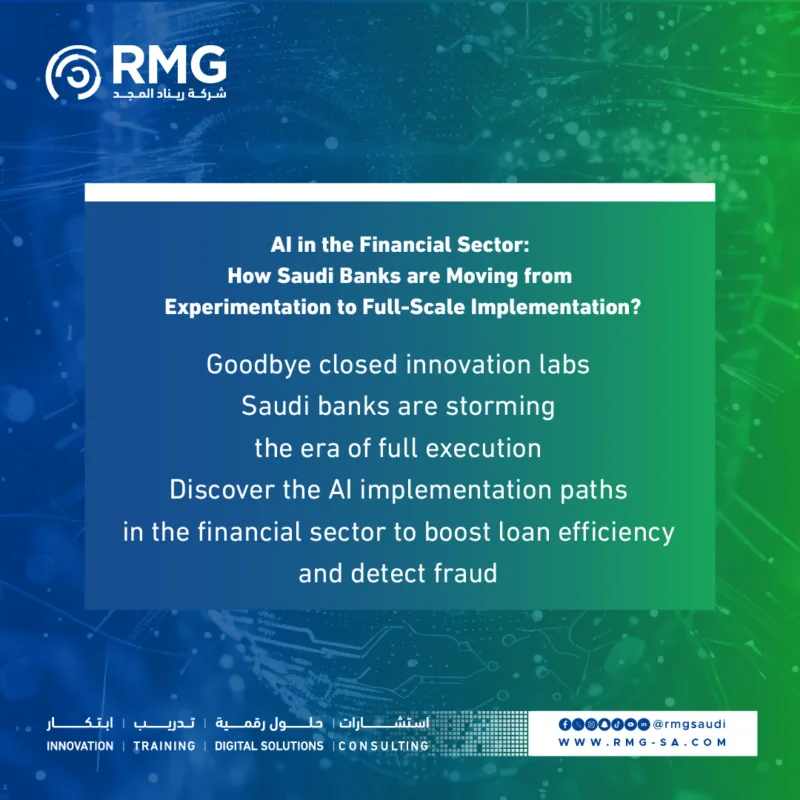
Goodbye closed innovation labs; Saudi banks are storming the era of full execution. Discover the AI implementation paths in the financial sector to boost loan efficiency, detect fraud, and personalize customer experience by 100%. See how Renad Al-Majd (RMG) leads your bank’s journey from “experimentation” to “digital dominance.”
The End of the Laboratory Era: The Great Financial Shift in 2026
For the past three years, Artificial Intelligence in the financial sector has been a glamorous topic in conferences and annual reports for Saudi banks. However, 2026 marks the major turning point. The age of “Proof of Concepts” (PoCs) conducted in isolated environments has ended, and the era of “Full-Scale Implementation”—felt by the customer in every financial transaction—has begun. Saudi banks are no longer testing if the technology works; they are now competing on the depth of integrating this technology into their Core Banking systems.
At Renad Al-Majd (RMG), we are closely monitoring this shift. We believe that the banks succeeding in this transition are those with the “technical courage” to transform their algorithms from mere auxiliary tools into autonomous decision engines. Moving to full-scale implementation means AI is now responsible for loan approvals, the guardian preventing fraud, and the advisor mapping out a customer’s financial plan—all without routine human intervention. This is the new standard for banking sovereignty in the Kingdom.
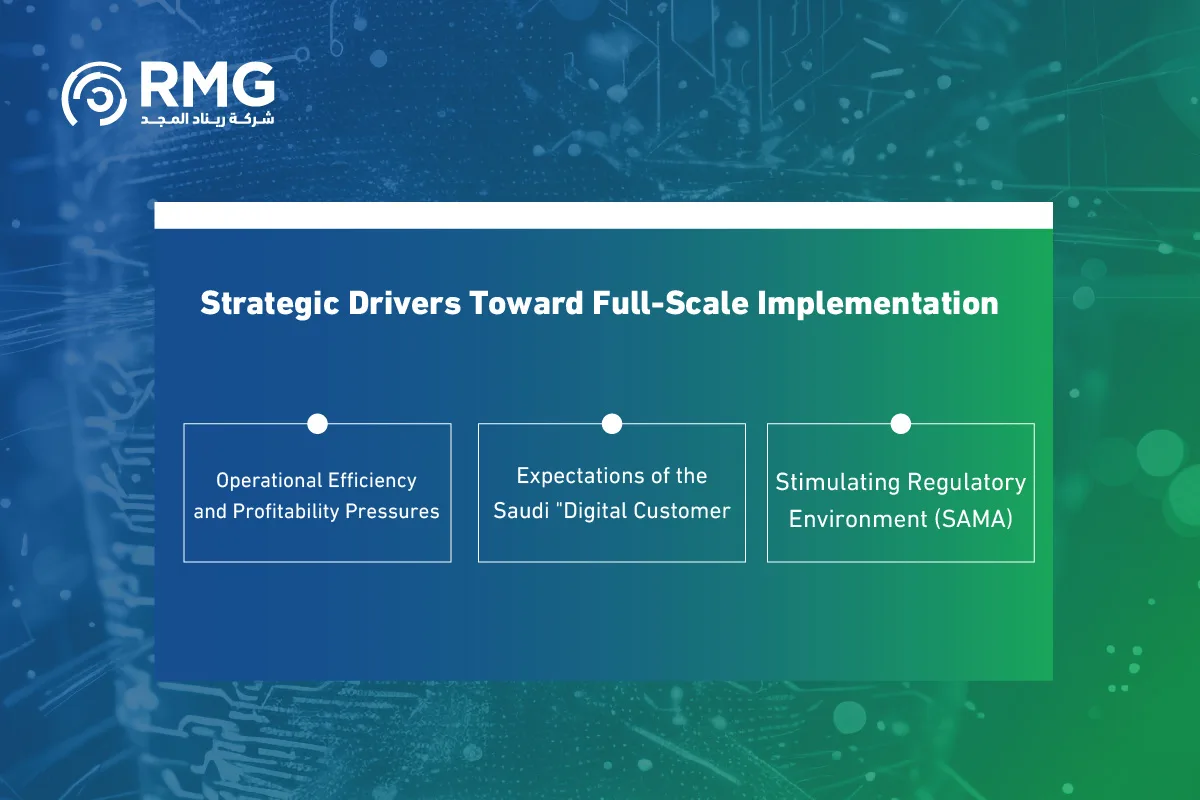
Strategic Drivers Toward Full-Scale Implementation
What is driving Saudi banks today to abandon their old caution and fully embrace AI? Our expertise at Renad Al-Majd (RMG) identifies three primary drivers:
- Operational Efficiency and Profitability Pressures: Amidst fierce competition with FinTech firms, traditional banks can no longer afford the costs of manual operations. Full AI implementation can reduce operational costs by up to 40% by automating back-office processes, allowing banks to redirect resources toward innovation.
- Expectations of the Saudi “Digital Customer”: Customers in the Kingdom—among the most tech-savvy in the world—no longer settle for generic banking services. They expect their bank to predict their financing needs before they even ask. Here, AI emerges as a tool for Personalization at scale, a marketing dream that RMG turns into a technical reality via real-time behavior analysis platforms.
- Stimulating Regulatory Environment (SAMA): The Saudi Central Bank (SAMA) plays a pivotal role by providing “Regulatory Sandboxes” and clear guidelines. This legislative support has given banks the green light to move AI from research rooms to the front lines of public service, ensuring the highest standards of financial security.
Domains of Sovereignty: Where is Full-Scale Implementation Most Visible?
When Renad Al-Majd (RMG) speaks of “Full-Scale Implementation,” we mean the penetration of technology into the very marrow of banking, specifically in:
- Instant Credit Auditing and Loan Granting: Previously, granting a loan to an individual or enterprise took days of human research. Today, AI analyzes “Creditworthiness” based on thousands of variables—from purchasing behavior to real-time bill payments. Decisions are made in seconds with an accuracy that exceeds human auditing by 95%.
- Cyber Defense and Advanced Fraud Prevention: Rule-based systems are no longer enough. Full-scale AI implementation acts as a “Digital Immune System” that identifies fraud through “behavioral patterns” rather than just passwords. If an unusual withdrawal attempt occurs, the transaction is frozen instantly.
- AI Banker (Personal Financial Assistant): We have moved from “automated replies” to “intelligent advisors.” AI allows the bank to offer customized investment advice based on income and expenses, even suggesting budget transfers to savings accounts or warning against overspending.
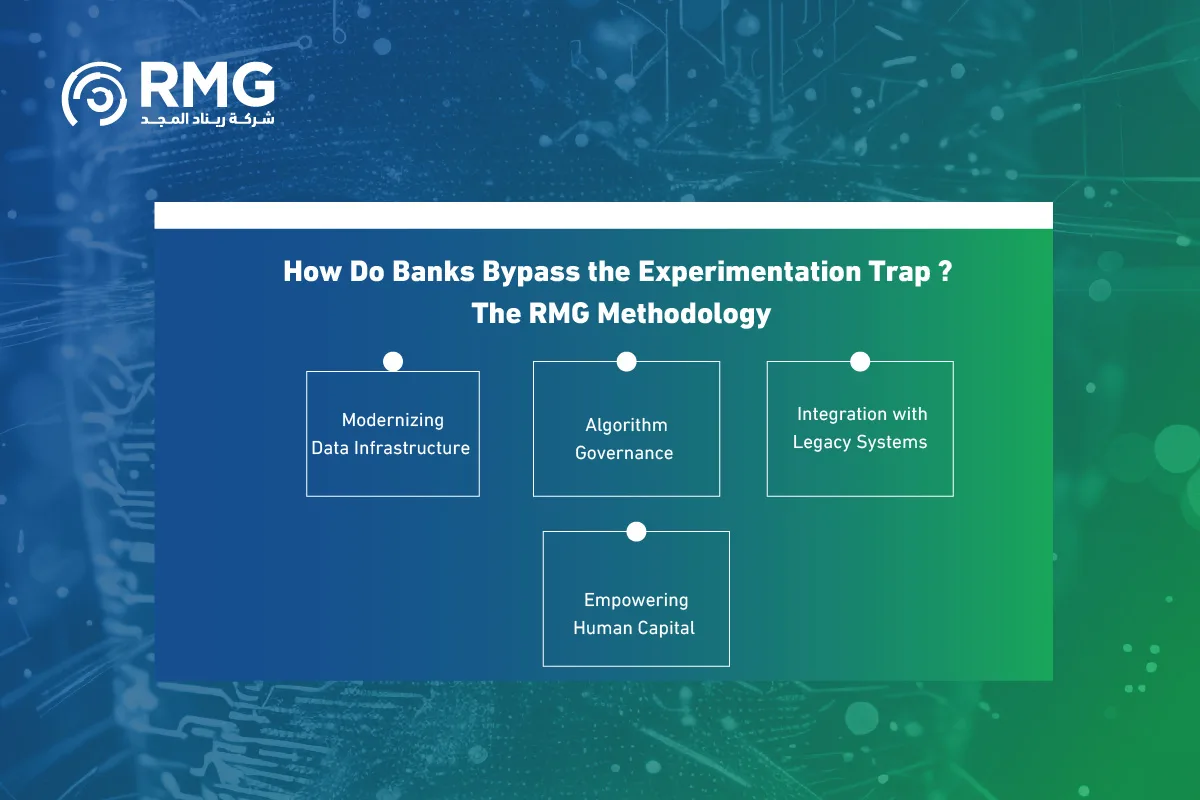
How Do Banks Bypass the “Experimentation Trap”? The RMG Methodology
Transitioning to full AI implementation is not just about buying software; it is a change in the organization’s DNA. At Renad Al-Majd (RMG), we follow an “Agile Transformation” methodology that ensures:
- Modernizing Data Infrastructure: Consolidating isolated “data islands” to create a 360-degree view of the customer.
- Algorithm Governance: Implementing strict frameworks to ensure Explainable AI (XAI), preventing biased or unfair decisions.
- Integration with Legacy Systems: Creating API layers that allow AI to operate on top of historical systems without needing to demolish them.
- Empowering Human Capital: Training “Digital Bankers” to collaborate effectively with their digital counterparts.
Why is Renad Al-Majd (RMG) the Strategic Partner for this Transition?
Excellence in AI requires a partner who understands both Saudi banking systems and global technical capabilities. RMG offers:
- Alignment with SAMA: Solutions designed to be automatically compliant with Central Bank standards.
- Focus on Value: We don’t sell “tech”; we sell “results,” such as increased loan portfolios or decreased fraud.
- Local Expertise: Deep understanding of the Saudi market and the specific needs of citizens and residents.
FAQs About Full AI Transformation in Banks
What is the difference between experimental AI and full-scale implementation? Experimental AI is limited (e.g., one department), while full-scale implementation integrates tech into “Core Systems” to influence all real-time banking decisions.
Does full AI implementation reduce data security?
On the contrary, it includes advanced cyber defense systems that outperform traditional ones, backed by RMG’s commitment to encryption and governance.
How long does the transition take?
Depending on data readiness, RMG’s methodology can show tangible results within 6 to 12 months.
Will AI replace employees in Saudi banks?
No, it will redefine their roles. Employees will focus on complex advisory tasks and high-level relationship management, while technology handles massive routine and analytical tasks.