












Blog Body
Discover how to build a successful cloud transformation strategy for your business. Your comprehensive guide from Renad Al-Majd to plan and implement a secure and efficient transition that keeps pace with the Kingdom’s Vision 2030, fosters efficiency and innovation.
At the heart of Saudi Arabia’s economic and developmental transformations, Vision 2030 stands as a beacon guiding the path of the future. Comprehensive digital transformation is one of the most important pillars of this ambitious vision, as advanced technologies, especially cloud computing, have become the main driver of enhancing the efficiency of the public and private sectors, improving the quality of services, and driving innovation.
Moving to the cloud is no longer just a technical update, but a critical strategic decision that touches every aspect of the organization’s business. However, this journey of opportunity is also fraught with challenges. Moving to the cloud without careful planning can lead to waste of resources, security gaps, and failure to deliver the desired return. Hence, the importance of having a cloud transformation strategy is of paramount importance Clear and thoughtful, acting as a precise compass that guides the entity’s path towards achieving its goals safely and efficiently. In this article, we’ll go over in detail the key pillars of building a successful strategy, and how it can be the roadmap that ensures your business reaches its desired digital future.
Why does your business need a cloud transformation strategy?
Before diving into the details of “how” building a strategy, it’s essential to understand the “why” of this step becoming inevitable. Adopting cloud computing without a unified strategic vision is like navigating a vast ocean without a map or a specific destination. You may make some momentary progress, but you’ll be prone to getting lost and facing unforeseen risks.
Risks of Lack of Strategy:
- Cost Overruns: Uncontrolled use of cloud resources leads to expensive and unpredictable bills, turning pay-as-you-go into a financial burden.
- Security vulnerabilities and poor compliance: Without a clear governance framework, it becomes difficult to ensure that sensitive data is protected and compliant with stringent national legislation, such as the requirements of the Digital Government Authority and the National Cybersecurity Authority.
- Vendor Lock-in: The total reliance on single-provider technologies without planning limits future flexibility and makes the transition to another provider costly and complicated.
- Fail projects and lack of value: When cloud transformation initiatives aren’t tied to real business goals, they turn into isolated technology projects that fail to deliver any tangible added value.
The cloud transformation strategy transforms this random approach into a structured and guided process, ensuring that every step taken serves the vision of the higher authority and directly contributes to achieving its goals.
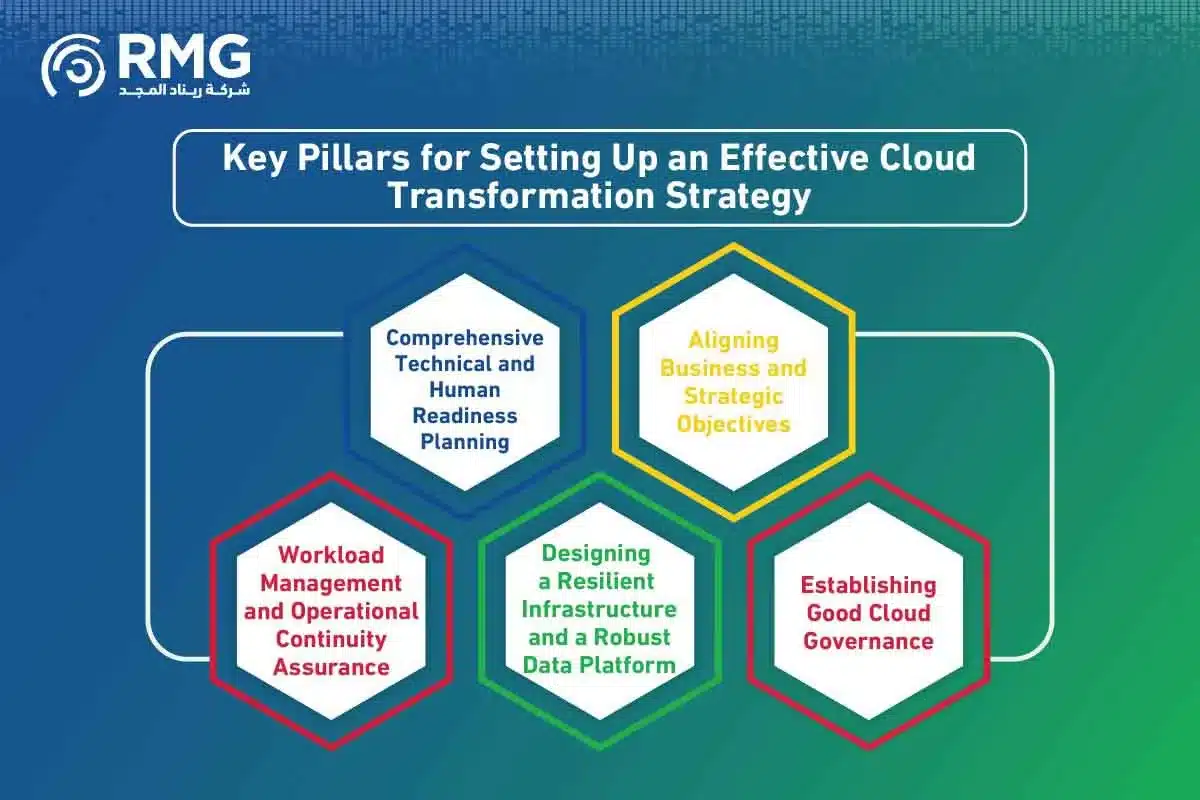
Key Pillars for Setting Up an Effective Cloud Transformation Strategy
A successful strategy relies on a comprehensive framework that covers all dimensions, from the commercial and administrative aspects to the technical and operational aspects. At Renad Al Majd, we rely on an integrated methodology based on five key pillars:
Pillar One: Aligning Business and Strategic Objectives
Technology is a means to an end, not an end in itself. Therefore, the starting point for any successful cloud transformation strategy is a deep understanding of the organization’s goals.
- Identify the drivers of the transformation: Is the goal to reduce operational costs, or to accelerate the launch of digital services, or to enhance work flexibility and enable employees to work remotely?
- Economic Feasibility Study: Making a strategic decision of this magnitude requires careful financial analysis. We conduct a comprehensive Total Cost of Ownership (TCO) analysis, which compares current infrastructure costs with projected expenses in the cloud. In addition, we measure return on investment (ROI) by identifying tangible benefits such as cost savings, increased productivity, and improved user experience.
Second Pillar: Comprehensive Technical and Human Readiness Planning
After the destination(s) have been identified, the starting point should be assessed. This pillar focuses on understanding the current situation and designing the desired future.
- As-Is Assessment: We conduct a comprehensive assessment of the current technical infrastructure, applications, systems, and processes. This assessment identifies the strengths that can be built upon, and the weaknesses that need to be addressed.
- To-Be Architecture: Based on the organization’s goals, we design the future cloud architecture. This includes identifying the right deployment models (public, private, hybrid) and service models (IaaS, PaaS, SaaS).
- Gap Analysis and Roadmap: By comparing the current situation with the target, we identify technical, operational, and human gaps. We then develop a detailed roadmap that outlines implementation stages, priorities, and responsibilities.
- Investing in human resources: Transformation is not only technical, but also cultural. The strategy includes a plan to manage change, identify required skills, and develop training and qualification programs for employees to ensure that they adopt new technologies and have the knowledge to manage them efficiently.
Pillar Three: Establishing Good Cloud Governance
Governance is the framework that ensures that the use of the cloud is done in a secure, regulated, compliant, and cost-effective manner.
- Compliance Management & Policies: We develop a framework that ensures full compliance with national regulations and legislation, while developing clear internal policies for managing cloud resources.
- Risk Management and Cybersecurity: We identify and assess security risks associated with the cloud environment and develop strategies to mitigate them, while applying security best practices at all stages of the transformation.
- Financial Management (FinOps): We establish cloud financial management (FinOps) practices that aim to maximize value from cloud spending. This includes budgeting, monitoring consumption, and continuously optimizing costs.
Pillar Four: Designing a Resilient Infrastructure and a Robust Data Platform
This pillar translates theoretical plans into an actionable technical design.
- Landing Zone: We design and configure a core and secure cloud environment that serves as a unified starting point for all future workloads. This environment is pre-configured with security, networking, and identity management policies.
- Data Governance Strategy: Data is an entity’s most valuable asset. We develop a comprehensive data lifecycle management strategy in the cloud, including classifying data according to its sensitivity, implementing strong security controls, ensuring its quality, and designing a data architecture that supports advanced analytics and artificial intelligence.
Pillar Five: Workload Management and Operational Continuity Assurance
This is where the actual implementation of migrating systems and applications to the new cloud begins.
- Analyze and categorize workloads: Not everything is migrated at once. We analyze and categorize all applications and systems (workloads) based on their importance, complexity, and readiness for the cloud to prioritize migration.
- Migration Strategies: For each workload, we determine the most appropriate migration strategy (e.g., Lift-and-Shift, Refactoring, or Re-purchasing) to achieve the optimal balance of cost, effort, and benefits.
- Ensure business continuity and operation: We develop robust business continuity and disaster recovery (BC/DR) plans leveraging cloud capabilities. We establish standard operating procedures (SOPs) and implement advanced monitoring tools to ensure the stability and reliability of services after the transition.
Renad Al-Majd: Your Strategic Partner in the Cloud Transformation Journey
Preparing a cloud transformation strategy is not just a consulting service that we provide, but a strategic partnership through which we are committed to the success of your organization. At Renad Al-Majd, we combine deep technical expertise with a thorough understanding of the requirements of the government sector and major organizations in the Kingdom. We do not just provide a theoretical document, but we work with you as a team to develop a realistic and actionable action plan that ensures a secure, efficient, and sustainable digital transformation that is in line with the ambitions of Vision 2030. Our integrated methodology ensures that every aspect is covered, giving your leadership Confidence to make informed decisions ensures your teams have the tools and knowledge needed to succeed.
Start your journey towards a promising digital future
Cloud transformation is a strategic journey that starts with the right first step. Don’t let technical complexities or organizational concerns get in the way of your journey towards efficiency and innovation. Let Renad Almajd’s experts guide you on this journey, and together we build a customized cloud transformation strategy that unleashes your full potential and puts you at the forefront of the digital future.
Get in touch with us today to request a specialist consultation, and let’s start shaping your successful cloud future.
