


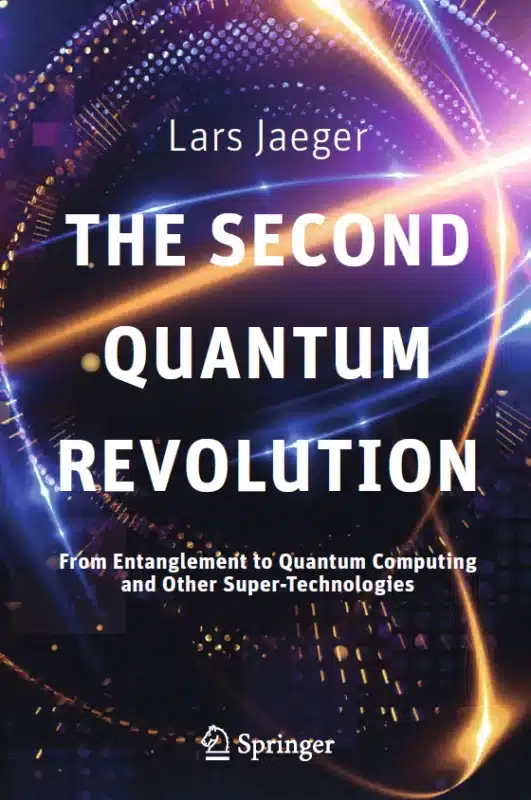
- Author: Lars Jaeger
- Publication date : January 16, 2019
- Page Number : 357 pages
The Second Quantum Revolution: From Entanglement to Quantum Computing and Other Super-Technologies
In an era increasingly defined by rapid technological advancement, a profound understanding of quantum physics is no longer a niche academic pursuit but a crucial component of navigating future innovations. Lars Jaeger’s “The Second Quantum Revolution: From Entanglement to Quantum Computing and Other Super-Technologies” emerges as a pivotal work, offering readers a comprehensive yet accessible exploration of this complex field.
The book demystifies the foundational principles of quantum mechanics and illuminates the path from esoteric theories to tangible, world-altering technologies, positioning itself as an essential guide for anyone seeking to grasp the underpinnings of our technological future.
Table of Contents
From Classical Upheaval to Technological Bedrock: The First Quantum Leap
The Dawn of Quantum 2.0: Forging New Technological Frontiers
Navigating the Quantum Realm: Fundamental Principles and Enduring Paradoxes
The Quest for Unification: Quantum Field Theories and the Standard Model
Beyond Physics: Philosophical and Spiritual Intersections
The Enigma of Entanglement: From Paradox to Practicality
The Future Forged by Quanta: Impact and Significance
Book Summary
From Classical Upheaval to Technological Bedrock: The First Quantum Leap
The book commences by establishing the profound impact of the initial quantum revolution. It details how the perplexing discoveries of the early 20th century, which shattered classical physics, paradoxically became the bedrock of modern technology.
The author illustrates how concepts such as quantization, wave-particle duality, and the probabilistic nature of the quantum world, though initially abstract, paved the way for transformative inventions. These include the laser, which revolutionized communications and medicine; the transistor, the cornerstone of all modern electronics; and the integrated circuit, which powers our digital age.
The book also highlights how quantum principles fundamentally reshaped chemistry and provided insights into biological processes, while also acknowledging the sobering initial application of quantum understanding in the development of the atomic bomb. This historical context is crucial for appreciating the scale and scope of the “second quantum revolution.”
The Dawn of Quantum 2.0: Forging New Technological Frontiers
Building upon this foundation, the author introduces “Quantum 2.0,” a new era characterized by the ability to manipulate individual quantum states. This second revolution, the book argues, promises technologies with even more profound societal implications. Key areas explored include:
- Nanotechnology: The book elaborates on Richard Feynman’s vision of “plenty of room at the bottom,” discussing the potential to construct materials and machines at the atomic scale. This includes the development of “wonder materials” like graphene with extraordinary properties and the prospect of nanobots performing tasks within the human body, such as targeted drug delivery or disease detection.
- Quantum Computing: A significant portion of the book is dedicated to explaining the principles behind quantum computers. Unlike classical computers that process information in bits (0s or 1s), quantum computers leverage qubits, which can exist in superpositions of states and become entangled, allowing for exponentially greater computational power.
The author discusses the potential of quantum computers to solve problems currently intractable for classical machines, such as complex simulations in chemistry and materials science, optimization problems, and breaking current encryption standards.
- Quantum Cryptography and Sensing: The book details how quantum phenomena like entanglement can be harnessed for inherently secure communication through quantum key distribution, making eavesdropping detectable. Furthermore, it explains how the extreme sensitivity of quantum states to their environment can be utilized for ultra-precise sensors for time, gravity, and magnetic fields, with far-reaching applications.
Navigating the Quantum Realm: Fundamental Principles and Enduring Paradoxes
To fully appreciate these technological advancements, the author guides the reader through the often counter-intuitive principles that govern the quantum world. The book lucidly explains:
- Wave-Particle Duality: The concept that entities like photons and electrons can exhibit characteristics of both waves and particles, a cornerstone of quantum mechanics.
- Superposition: The principle that quantum systems can exist in multiple possible states simultaneously until a measurement forces the system into a single, definite state. The double-slit experiment is presented as a classic illustration of this phenomenon.
- The Uncertainty Principle: Formulated by Heisenberg, this principle establishes fundamental limits on the precision with which pairs of complementary properties (like position and momentum) can be simultaneously known.
- The Measurement Problem and Wave Function Collapse: The book tackles the enduring puzzle of how and why the act of measurement causes a quantum system’s wave function (which describes its probabilistic state) to “collapse” into a single outcome. Schrödinger’s cat thought experiment is discussed as a vivid illustration of this paradox when applied to macroscopic systems.
- The Copenhagen Interpretation: The author outlines the historical standard interpretation of quantum mechanics, which accepts its probabilistic nature and the crucial role of the observer or measurement apparatus in defining reality. This interpretation, primarily developed by Bohr and Heisenberg, is contrasted with Einstein’s persistent objections and his belief in an underlying, more complete deterministic reality.
The Quest for Unification: Quantum Field Theories and the Standard Model
The narrative progresses to the more advanced framework of Quantum Field Theory (QFT), which describes particles as excitations of underlying quantum fields. The book clarifies:
- Quantum Electrodynamics (QED): As the QFT of electromagnetism, QED describes how photons mediate the electromagnetic force and led to the prediction of antimatter. The author explains how Feynman diagrams provide a visual and computational tool for understanding particle interactions within QED.
- The Standard Model of Particle Physics: The book presents the Standard Model as the current pinnacle of understanding fundamental particles (quarks and leptons) and their interactions via three fundamental forces (electromagnetic, weak nuclear, and strong nuclear), mediated by gauge bosons. The role of the Higgs mechanism and the Higgs boson in endowing particles with mass is also elucidated.
- Challenges of Infinities and Renormalization: The author does not shy away from the mathematical complexities, explaining the problem of infinities arising in QFT calculations and the technique of renormalization used to obtain meaningful, finite predictions.
- The Unfinished Picture: The book underscores that the Standard Model is not the final word, primarily due to its inability to incorporate gravity. The fundamental incompatibility between general relativity and quantum mechanics, stemming from their differing views on spacetime and the non-renormalizability of quantum gravity, remains a central challenge in physics. This leads to discussions on the “hierarchy problem” and the ongoing search for a “Theory of Everything.”
Beyond Physics: Philosophical and Spiritual Intersections
A distinctive feature of the book is its exploration of the profound philosophical implications of quantum mechanics. The author discusses:
- The Redefinition of Reality: How quantum physics challenges classical notions of an objective reality existing independently of observation. The book argues that quantum theory suggests a reality that is contextual and relational, where properties emerge from interactions rather than being inherent.
- Parallels with Eastern Philosophies: Intriguing connections are drawn between quantum concepts like non-duality and interdependence, and tenets of Eastern philosophies, particularly Buddhism (e.g., Nāgārjuna’s concept of śūnyatā or emptiness).
- Symmetry and Its Breaking: The book highlights the guiding role of symmetry principles in physics, as formalized by Noether’s theorem, which links symmetries to conservation laws. It also explains the significance of spontaneous symmetry breaking in phenomena like the origin of mass.
- A Caution Against Misinterpretation: While exploring legitimate philosophical terrain, the author also provides a critical perspective on the misappropriation of quantum concepts in pseudoscientific or mystical contexts, such as “quantum healing” or unsubstantiated claims about consciousness directly manipulating quantum events.
The Enigma of Entanglement: From Paradox to Practicality
The book dedicates significant attention to entanglement, arguably the most counter-intuitive and powerful quantum phenomenon. The author traces its evolution:
- From Paradox to Principle: Introduced in the context of the EPR paradox and Schrödinger’s cat, entanglement describes a situation where two or more quantum particles become linked in such a way that their fates are intertwined, regardless of the distance separating them. Measuring a property of one entangled particle instantaneously influences the properties of the other(s).
- Bell’s Theorem and Experimental Confirmation: The work of John Bell provided a theoretical framework to experimentally test the nature of these correlations against theories involving local hidden variables.
The book explains how subsequent experiments, notably by Alain Aspect, confirmed the predictions of quantum mechanics and the reality of non-local entanglement, effectively ruling out local hidden variables as an explanation.
- The Role of Decoherence: The concept of decoherence is presented as crucial for understanding why macroscopic entanglement is not readily observed. Environmental interactions cause the rapid decay of quantum coherence, leading to the emergence of classical behavior from the underlying quantum world. This resolves many aspects of the measurement problem but also presents a significant hurdle for quantum technologies.
The Future Forged by Quanta: Impact and Significance
“The Second Quantum Revolution” compellingly argues that the ongoing advancements in understanding and harnessing quantum phenomena will have a transformative impact across numerous sectors. The book explores the potential for breakthroughs in medicine (nanobots for diagnostics and treatment), materials science (programmable matter), information processing (the quantum internet), and artificial intelligence (quantum machine learning).
By elucidating these possibilities, the author implicitly underscores the necessity for individuals, organizations, and society at large to engage with and prepare for the ramifications of these emerging technologies. The book serves as a call to action for informed public discourse to ethically guide this technological wave.
Conclusion and Recommendation
Lars Jaeger’s “The Second Quantum Revolution” offers a masterful synthesis of the history, core principles, philosophical implications, and future trajectory of quantum physics.
By presenting complex ideas with clarity and precision, the book equips readers with the foundational knowledge needed to understand the technologies that will shape the 21st century and beyond. It is an invaluable resource for students, professionals, and anyone curious about the profound ways in which the quantum world is transitioning from a theoretical curiosity to a practical, powerful force in our lives.
The author successfully conveys not just the “what” of quantum physics, but also the “how” of its technological applications and the “why” of its deep significance for our understanding of the universe and our place within it.
About the Author
Lars Jaeger was a German-Swiss intellectual who distinguished himself through his unique ability to bridge disciplines that seldom intersect—ranging from theoretical physics and philosophy to investment science and science communication. Born on August 7, 1969, Jaeger studied physics and philosophy at the University of Bonn and École Polytechnique in Paris, before earning a PhD in theoretical physics from the Max Planck Institute in Dresden.
While his academic foundation was rooted in the sciences, Jaeger was equally passionate about exploring the intersections of technology, society, and spirituality. This was evident in his book Wissenschaft und Spiritualität, where he sought to reconnect scientific inquiry with human spiritual experience. He also ventured into quantitative finance and risk management, and was among the first to articulate the concept of “alternative beta” in the world of hedge funds—demonstrating his analytical reach from subatomic particles to global markets.
Far from a narrow academic, Jaeger authored a rich portfolio of works covering the historical evolution of science, its philosophical implications, and its role in shaping future technologies. Notable titles include The Second Quantum Revolution, which explores emerging quantum technologies, and Ways Out of the Climate Catastrophe, a deep dive into the global energy crisis. He also wrote a biography of the brilliant mathematician Emmy Noether, and co-authored Where Is Science Leading Us? with Michel Dacorogna—a prescient reflection on science’s trajectory and its impact on humanity.