


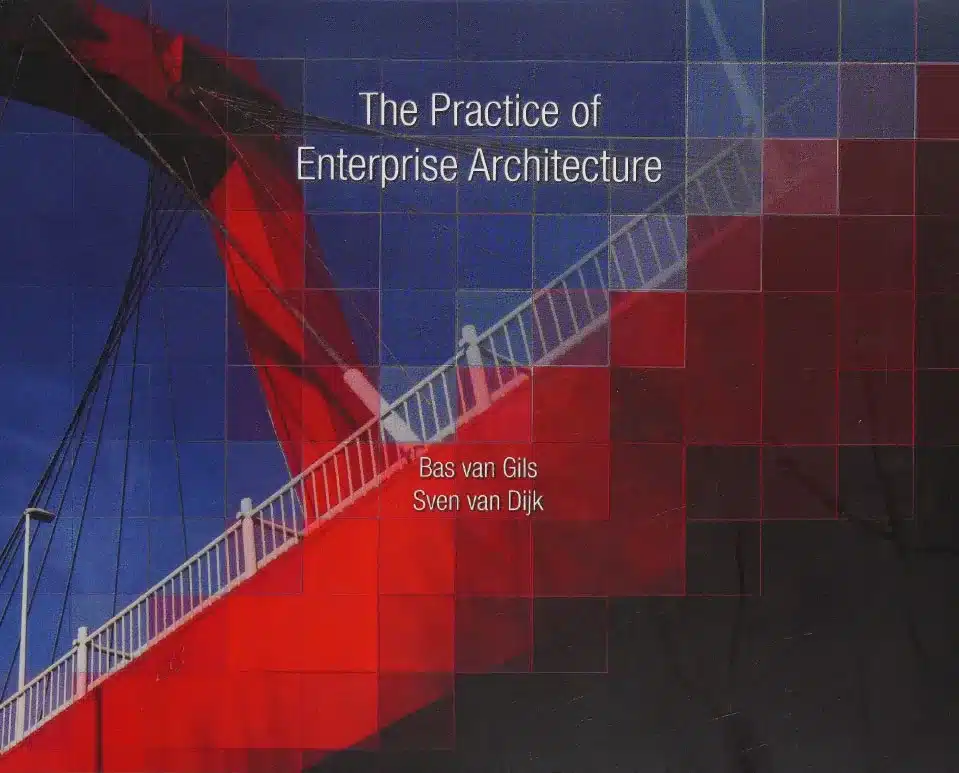
The Practice of Enterprise Architecture: Experiences, techniques, and best practices
Modern organizations navigate a landscape of constant technological and market change, making the alignment of business strategy with IT execution more critical than ever. The book, “The Practice of Enterprise Architecture: Experiences, techniques, and best practices,” presents itself as a fundamental reference for mastering this challenge. The authors, Bas van Gils and Sven van Dijk, offer a guide built not on abstract theory, but on a decade of practical experience, consolidating proven techniques and best practices to help organizations manage complexity and drive successful transformation.
Table of Contents
Part I: Foundational Theory
Chapter 1: Establishing the Need for a Practical Approach
Chapter 2: Defining the Role and Purpose of Enterprise Architecture
Chapter 3: The Open Group Architecture Framework (TOGAF)
Chapter 4: The ArchiMate Modeling Language
Part II: Building an Effective EA Capability
Chapter 5: A Phased Approach to Implementation
Chapter 7: Designing the Architecture Capability
Chapter 8: Making the Architecture Capability Work
Part III: Best Practices in Action
Chapter 9: Applying Advanced Techniques
Chapter 10: Driving Strategy with Capability-Based Planning
Chapter 11: Translating Strategy into Execution
Chapter 12: Integrating Architecture with Key Design Disciplines
Chapter 13: The Role of Standards and Governance
Chapter 14: Effective Architecture Modeling with ArchiMate
Part IV: Conclusion
Chapter 15: Final Takeaways and Call to Action
Book Summary
Part I: Foundational Theory
Chapter 1: Establishing the Need for a Practical Approach
The book begins by positioning Enterprise Architecture (EA) as an essential strategic discipline. The authors state their primary objective is to share actionable insights drawn from real-world consulting engagements. They frame the book as a valuable resource for a wide audience, from enterprise architects seeking to refine their craft to project managers and strategists who must collaborate with the EA function to achieve organizational goals.
Chapter 2: Defining the Role and Purpose of Enterprise Architecture
This chapter establishes the theoretical groundwork for EA. The authors define EA as a direct response to core management challenges, namely achieving organizational alignment, effectively managing change, and charting a course from a current state to a desired future. The book anchors its definition in the ISO/IEC/IEEE 42010 standard, presenting EA as the “fundamental organization of a system.” In essence, the authors indicate that EA provides a holistic “map” of the enterprise and serves as a “route planner” for its evolution.
Chapter 3: The Open Group Architecture Framework (TOGAF)
The authors introduce TOGAF as a comprehensive, open-standard toolkit for building and managing an EA capability. The book emphasizes that TOGAF’s primary value lies in its core component, the Architecture Development Method (ADM). This is presented as an iterative, phased process that guides architects through the entire lifecycle of architecture development, from initial vision to implementation governance and change management. The summary clarifies that TOGAF provides the “how”—the process for doing EA.
Chapter 4: The ArchiMate Modeling Language
Following the process, this chapter introduces ArchiMate as the open-standard language for describing enterprise architecture. The authors explain that while TOGAF provides the process, ArchiMate provides the structured language needed to create coherent and integrated models of the enterprise. The book highlights the language’s structure across three layers (Business, Application, Technology) and its extensions for modeling motivations (goals, principles) and migration planning, thus enabling clear communication with diverse stakeholders.
Part II: Building an Effective EA Capability
Chapter 5: A Phased Approach to Implementation
This chapter introduces the book’s practical, three-phase model for establishing an EA function within an organization. This model, derived from the TOGAF ADM, simplifies the process into manageable stages:
- Securing organizational commitment
- Designing the architecture capability itself
- Making the capability operational and effective.
Chapter 6: Securing Organizational Commitment and Involvement
The authors stress that gaining organizational buy-in is the most critical first step. The book advocates for a hybrid “top-down” and “bottom-up” approach, where strategic alignment is balanced with project-level governance. It also champions the use of open standards to avoid vendor lock-in and stresses the need to embed the EA practice within other management disciplines. The authors define the Architecture Board (AB) as the key governance body for ensuring compliance and championing the initiative.
Chapter 7: Designing the Architecture Capability
Here, the book provides practical guidance on structuring the EA function. The authors emphasize that frameworks like TOGAF must be tailored to the organization’s specific context, not rigidly adopted. They discuss the importance of building a team with diverse skills for both strategic and project-focused work and advise on selecting professional tooling. The authors recommend treating the implementation of the EA capability itself as a project, following an evolutionary “think big, start small” methodology.
Chapter 8: Making the Architecture Capability Work
This chapter focuses on the execution and maturation of the EA function. The authors present a set of best practices, including the development of a robust communication and training plan. They strongly recommend using a pilot project to demonstrate the tangible value of EA and measure its impact on project outcomes. The book also addresses the integration of EA with agile methods, positioning architecture as an enabler that provides “just enough” guidance in a timely manner.
Part III: Best Practices in Action
Chapter 9: Applying Advanced Techniques
This chapter serves as an introduction to the final part of the book, which shifts focus from establishing the EA function to applying specific, high-impact techniques in the daily practice of architecture.
Chapter 10: Driving Strategy with Capability-Based Planning
The book details Capability-Based Planning (CBP) as a powerful technique for bridging the gap between strategy and execution. The authors explain that by focusing on what an organization does (its capabilities, such as “Customer Relationship Management”) rather than how it does it, architects can better identify strategic gaps and plan incremental changes to improve business outcomes over time.
Chapter 11: Translating Strategy into Execution
This chapter offers a practical method for linking high-level business strategy to the enterprise architecture. The authors demonstrate how to use the Business Model Canvas to articulate strategy and then systematically map its building blocks to ArchiMate concepts. This technique provides a clear line of sight, allowing architects to analyze the impact of strategic decisions on the company’s operating model.
Chapter 12: Integrating Architecture with Key Design Disciplines
The book clarifies the crucial distinction between high-level architecture and detailed design. It presents a holistic view where EA connects with and informs other key design disciplines, including Business Process Management (BPM), Business Rule Management (BRM), and Data Management (DM), ensuring a cohesive approach to enterprise design.
Chapter 13: The Role of Standards and Governance
The authors focus on the value of standards in an effective EA practice. The book presents standards (e.g., for technology platforms) as a mechanism to improve efficiency, reduce operational risk, and lower the total cost of ownership. It provides a practical framework for managing a standards library, complete with a lifecycle and governance structure to ensure compliance without stifling necessary innovation.
Chapter 14: Effective Architecture Modeling with ArchiMate
The final best-practices chapter offers practical tips for using the ArchiMate language effectively. The authors provide guidance on balancing formal versus informal models, modeling application integrations, and developing reusable process architectures. They also explain how to use tables, matrices, and heat maps to generate views that communicate complex architectural information clearly to different stakeholders.
Part IV: Conclusion
Chapter 15: Final Takeaways and Call to Action
The authors conclude by summarizing the book’s core message: Enterprise Architecture is a practical, business-focused discipline that enables organizations to manage complexity by creating a clear and actionable link between strategy and execution. They reiterate the importance of a model-based and iterative approach. The book ends with a call to action, encouraging practitioners to contribute their own experiences to help mature the EA field.
Overall Impact and Significance
“The Practice of Enterprise Architecture” provides a clear and compelling argument for the role of EA in modern technology and business environments. The book’s significance lies in its relentless focus on practicality, moving beyond dense theoretical frameworks to offer tangible techniques and best practices. It demystifies EA, positioning it not as a bureaucratic overhead, but as a vital enabler of organizational agility, strategic alignment, and informed decision-making. The broader implication for any organization is that a well-executed EA capability can lead to reduced costs, mitigated risks, and a greater capacity to adapt and innovate in a fast-changing world.
Conclusion and Recommendation
This book stands out as a comprehensive and highly practical reference for anyone involved in the architecture and strategic planning of an enterprise. Its main contribution is the consolidation of field-tested experiences into a coherent and accessible guide. It is strongly recommended for novice and expert enterprise architects who wish to improve their effectiveness, as well as for managers and strategists who need to understand how to leverage EA to achieve their business objectives. The book successfully delivers on its promise to show not just what EA is, but how to make it work.
About the Authors
Bas van Gils
Managing Partner at Strategy Alliance, Bas van Gils is a seasoned expert in digital transformation, enterprise architecture, and data management. He has led strategic initiatives across sectors including government, finance, telecom, and education, with project experience spanning the Netherlands, Germany, the UK, the US, and Canada. Known for balancing academic rigor with practical relevance, van Gils advocates for people-centric transformation grounded in transparency and adaptive design. His published insights cover topics such as organizational involvement, leadership in digital contexts, and the role of data in strategic decision-making.
Sven van Dijk
PhD candidate at Leiden University’s Mathematical Institute, Sven van Dijk specializes in probability theory and operations research. His academic work is supervised by leading scholars from Leiden and the University of Birmingham, focusing on stochastic modeling and mathematical systems. Beyond academia, van Dijk co-authored Zombie Apocalypse Survival Guide, a satirical yet structured manual that blends humor with survival strategy, showcasing his ability to engage both technical and general audiences3.