


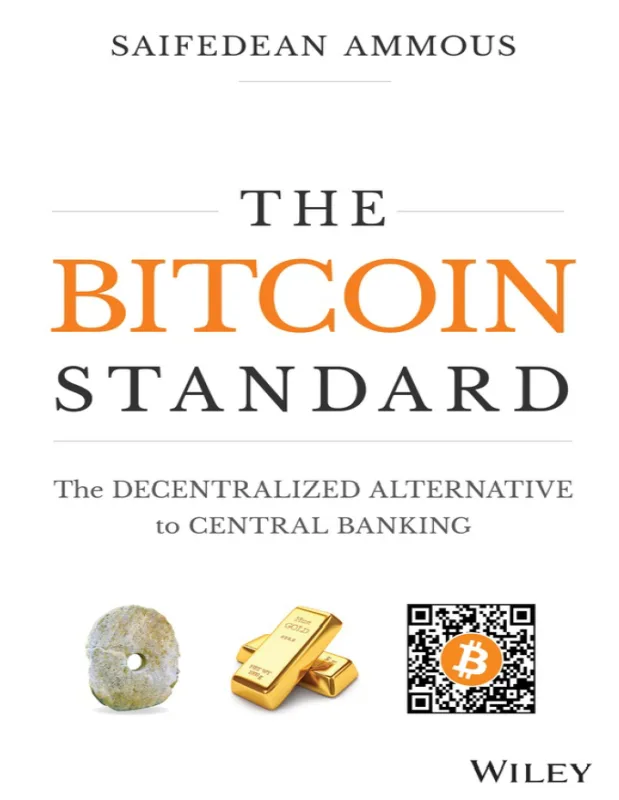
- Author: Saifedean Ammous
- Publication date : April 24, 2018
- Page Number : 304 pages
The Bitcoin Standard - The Decentralized Alternative to Central Banking
The book “The Bitcoin Standard” presents a deep analytical framework that deconstructs the ontological nature of money, moving beyond the superficial discussion of Bitcoin as a digital asset to present it as an engineering solution to a historical problem related to sovereignty and economic freedom. The book does not aim to be an investment guide, but rather foundational research into the history of monetary thought, through which the author aims to equip the reader with the intellectual tools necessary to understand the root causes of the instability of contemporary monetary systems, and how an innovation like Bitcoin can offer a viable practical alternative.
Table of Contents
Chapter 1: Money
Chapter 2: Primitive Money
Chapter 3: Monetary Metals
Chapter 4: Government Money
Chapter 5: Money and Time Preference
Chapter 6: The Capitalist Information System
Chapter 7: Sound Money and Individual Freedom
Chapter 8: Digital Money
Chapter 9: What is Bitcoin Good For?
Chapter 10: Bitcoin Questions
Book Summary
Chapter 1: Money
The book begins by establishing the primary principles of money, explaining that its emergence was a solution to the problem of the “coincidence of wants” in a barter system. The author defines the essential property that leads to the adoption of a commodity as money as salability, which is measured across three dimensions: salability across scales (ease of division and combination), across space (ease of transport), and most importantly, across time (ability to hold value). This last dimension is what distinguishes “hard money” from “easy money.”
The book introduces its central analytical concept under the description: “stock-to-flow ratio,” a quantitative measure of the hardness of money. Hard money is that which possesses a high stock-to-flow ratio, making it costly and economically unfeasible to increase its supply, thus protecting its value. In contrast, easy money falls into the “easy money trap,” where a rise in its price incentivizes its production in massive quantities, inevitably leading to the collapse of its value and the confiscation of savers’ wealth in favor of producers.
Chapter 2: Primitive Money
This chapter provides historical empirical evidence supporting the book’s central hypothesis by reviewing primitive monetary systems that collapsed due to the erosion of their hardness. The Rai stones of Yap Island represent a physical model of a distributed ledger, deriving their value from the extreme difficulty of their production and transport. This system collapsed when a Western captain used modern technology to extract them easily. Similarly, the book recounts how “glass beads,” which were valuable in West Africa, lost their value after European technology enabled their mass production, to the point they became known as “slave beads” for their role in the slave trade. These examples are a practical lesson that the continuity of any monetary system depends on its immunity to manipulation of its supply.
Chapter 3: Monetary Metals
The chapter traces the path of monetary evolution towards metals, highlighting the superiority of gold as the “primary money” thanks to its physical properties which give it the highest stock-to-flow ratio. The book reviews pivotal historical eras to prove the causal relationship between sound money and civilizational prosperity:
- The Roman Empire: Flourished with the “denarius” and “aureus” coins, but declined after emperors resorted to “coin clipping and debasement” to finance their expenses, which ignited inflation and led to collapse.
- The Byzantine Empire and the Renaissance: Their stability and prosperity are seen as evidence that civilizational progress is linked to the existence of a sound monetary standard, such as the Byzantine “bezant” and the Florentine “florin.”
- “La Belle Époque”: The book attributes the period of unprecedented global prosperity between 1871 and 1914 to the international gold standard, which unified the world economically. Under this system, national currencies were merely definitions of different weights of gold, which eliminated exchange rate volatility and allowed for the free flow of trade and capital.
Chapter 4: Government Money
This chapter details the transition to the era of “government money,” which began with World War I when belligerent nations suspended the convertibility of their currencies to gold to finance the war through inflation. This led to the emergence of “monetary nationalism,” where monetary policy became subject to central planning. The book reinterprets the “Great Depression,” asserting that it was not a failure of free markets, but an inevitable result of the inflationary policies pursued by the Federal Reserve in the 1920s, which were exacerbated by interventionist policies (such as price and wage controls) that prevented the market from correcting itself. It explains how the “Bretton Woods” system led the United States to a “deficit without tears,” allowing it to finance its spending by inflating the global reserve currency.
Chapter 5: Money and Time Preference
This chapter puts forward the central theoretical argument of the book: that the quality of money profoundly affects society through “time preference.”
- Sound money that holds its value promotes a low time preference, which encourages saving, investment, and capital accumulation. This future-oriented outlook is the basis of civilizational progress, and is reflected in all aspects of life, from elaborate art that takes decades to complete (like the works of Michelangelo) to the strength of family ties.
- Unsound money whose value deteriorates raises time preference, pushing society towards immediate consumption, indebtedness, and short-sightedness. The author links this deterioration to modern phenomena such as the culture of conspicuous consumption, the decline in the quality of art, and the disintegration of the family as the state replaces it as the primary provider of care.
Chapter 6: The Capitalist Information System
Drawing on the works of Austrian economists, the book explains that prices are the decentralized “information system” that coordinates economic activity. Sound money provides a stable unit of account that ensures the efficiency of this system. The author argues that central banks practice a form of “socialism of the capital market”; their manipulation of the interest rate distorts price signals, leading to the inefficient allocation of capital or what is known as “malinvestment,” which inevitably generates “business cycles” of boom and bust.
Chapter 7: Sound Money and Individual Freedom
This chapter asserts that “sound money” is a prerequisite for freedom, as it acts as a “natural check on government overreach and tyranny.” Unsound money gives governments the ability to finance their operations through inflation, enabling them to wage “perpetual war” and expand their power. The author introduces the concept of “The Bezzle” to describe the illusory wealth created by inflationary credit, which supports parasitic and unproductive economic sectors (such as bloated bureaucracies and the modern financial sector) that could not survive in a free market.
Chapter 8: Digital Money
The book presents Bitcoin as a technical solution to the problem of money, describing it as the first practical example of “digital money.” By employing a “proof-of-work system,” Bitcoin successfully solved the “double-spending problem” without the need for a third party, thereby achieving “digital scarcity.” Its monetary supply, capped at 21 million units and guaranteed by the “difficulty adjustment” mechanism, makes it the “hardest money ever invented,” and mathematically immune to any debasement.
Chapter 9: What is Bitcoin Good For?
This chapter identifies the strategic value of Bitcoin, asserting that its function lies not in everyday payments, but in:
- Store of Value: Its absolute scarcity makes it an unparalleled tool for preserving wealth across time.
- Individual Sovereignty: It provides individuals with “a clear technical solution to escape the financial influence and power of governments.”
- International and Online Settlement: It is uniquely suited for settling high-value final payments, similar to the role gold previously played, but with digital efficiency and without counterparty risk.
Chapter 10: Bitcoin Questions
The final chapter answers common questions. It explains that the “mining” process is not a waste of energy, but the cost of securing the network. It explains that Bitcoin’s decentralized nature makes it “antifragile” and resistant to change. It also discusses the limitations of on-chain scaling and rejects “altcoins” for being centralized. It debunks the hype around “blockchain technology,” asserting that it is an inefficient tool except in its original context: enabling the existence of sound digital money.
Overall Impact and Significance
“Programming Quantum Computers” makes a significant contribution by successfully bridging the gap between the abstract physics of quantum mechanics and the practical art of programming. Its primary impact stems from its novel pedagogical approach, particularly the use of Circle Notation and an interactive simulator. This methodology effectively demystifies counter-intuitive concepts like superposition and entanglement, providing developers with a much-needed mental model for how quantum algorithms work. The book helps to lower the barrier to entry for a new generation of quantum software developers.
Conclusion and Recommendation
“The Bitcoin Standard” is a foundational work that presents a powerful argument for the importance of sound money in building a free and prosperous society. By tracing monetary history, Saifedean Ammous provides an essential intellectual framework for understanding Bitcoin not as a speculative asset, but as a revolutionary advance in the technology of money. This book is vital reading for anyone seeking a deeper understanding of the intersection of economics, freedom, and technology in the 21st century.
About the Authors
Saifedean Ammous is a Palestinian-Jordanian economist and author best known for The Bitcoin Standard (2018), a foundational work linking Bitcoin to Austrian economics and critiquing fiat currency. He holds a PhD from Columbia University and previously taught economics at the Lebanese American University. Ammous now runs an online academy focused on sound money and decentralization, and hosts The Bitcoin Standard Podcast. His work promotes financial sovereignty and challenges conventional monetary systems.