


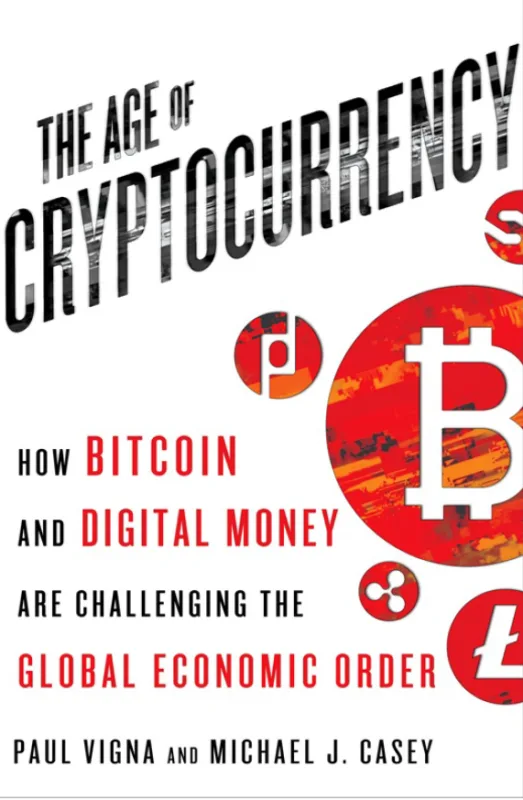
- Author: by Paul Vigna , Michael J. Casey
- Publication date : January 12, 2016
- Page Number : 384 pages
The Age of Cryptocurrency: How Bitcoin and Digital Money Are Challenging the Global Economic Order
The book begins its story with Parisa Ahmadi, a top student living in Afghanistan, where social customs impose strict restrictions on women’s financial freedom. The authors illustrate how receiving her income in Bitcoin gave her, for the first time, true financial sovereignty, allowing her to own her own “digital wallet,” far from the control of her family members. This story is used to establish the book’s central idea: cryptocurrencies are not just a speculative asset, but a revolutionary technology that holds the potential to empower marginalized individuals and challenge the centralized financial structure that has dominated the world since the time of the Medici family in the Renaissance. This traditional banking system, which began as a tool of empowerment, has over time transformed into a monopolistic structure that imposes exorbitant fees and increases the concentration of power.
Table of Contents
Chapter 1: From Babylon to Bitcoin
Chapter 2: Genesis
Chapter 3: The Community
Chapter 4: The Roller Coaster
Chapter 5: Building the Blockchain
Chapter 6: The Arms Race
Chapter 7: Satoshi’s Mill
Chapter 8: For the Unbanked
Chapter 9: A Blockchain for Everything
Chapter 10: The Round Peg and the Square Hole
Chapter 11: A Whole New Economy
Book Summary
Chapter 1: From Babylon to Bitcoin
This chapter provides a historical framework for understanding money, asserting that the essence of any monetary system is trust. To illustrate this point, the book reviews cases of monetary collapse in the Weimar Republic and Argentina, where the problem was not just the excessive printing of money, but a deep collapse of trust between citizens and the ruling authority. This breakdown of trust is what drives people to flee the local currency for more stable assets like the dollar or gold.
The book distinguishes between two schools of thought in defining money: the “metallist school,” which sees money as a commodity with intrinsic value, and the “chartalist school,” which views money as a social system for settling debts and credit, where the currency is merely a “token” of this social agreement. The authors adopt the chartalist perspective, asserting that cryptocurrencies offer a new model of trust that does not rely on human institutions, but on proven mathematical algorithms.
Chapter 2: Genesis
This chapter deals with the origin of Bitcoin at the hands of a mysterious figure known as Satoshi Nakamoto. On October 31, 2008, in the midst of the global financial crisis, Nakamoto published his white paper describing “a peer-to-peer electronic cash system.” This announcement was initially met with skepticism from the expert community, which had witnessed previous failed attempts to create digital money, such as David Chaum’s DigiCash project.
But Nakamoto’s innovation held two fundamental solutions: the first was the blockchain, a public and distributed ledger of all transactions, which prevents the “double-spending problem” without the need for a central authority. The second was a clever economic incentive system, where “miners” compete to solve complex computational puzzles to confirm transactions and add them to the chain, and their reward for this work is new bitcoins. This design draws its intellectual roots from the “Cypherpunk” movement of the 1990s, which advocated for the use of cryptography to enhance privacy and individual freedom.
Chapter 3: The Community
This chapter emphasizes that no currency can acquire value without a community that believes in it and uses it. After the mysterious disappearance of Satoshi Nakamoto in 2011, which reinforced Bitcoin’s “genesis myth,” the user community grew slowly. The defining moments in this growth were:
- The first real-world transaction: Programmer Laszlo Hanyecz buying two pizzas for 10,000 bitcoins in 2010, proving that the currency could be used to purchase real goods.
- The emergence of exchanges: The creation of the Mt. Gox exchange, which provided an easy platform to buy and sell Bitcoin for traditional currencies.
- Parallel markets: Sites like Silk Road played a controversial role in expanding the early user base, proving Bitcoin’s ability to function as a medium of exchange outside legal systems.
Chapter 4: The Roller Coaster
This chapter delves into the challenges facing Bitcoin adoption, most notably extreme price volatility and security risks. The authors begin by dissecting the traditional credit card payment system, revealing its complexities and hidden costs borne by merchants and consumers alike, amounting to 2-3% of each transaction. Bitcoin offers a promising alternative with significantly lower costs.
However, the average user faces two main obstacles: the first is security, as losing a “private key” means losing funds permanently, and hacks are possible. The second is the extreme volatility in value, which makes it unsuitable as a stable unit of account at present. The book cites the 2013 Cypriot banking crisis as an example of an event that drove people to resort to Bitcoin as a safe haven, leading to a massive increase in its price.
Chapter 5: Building the Blockchain
This chapter provides a simple yet profound explanation of how the blockchain works. Using the analogy of the Yap island community that kept records of stone ownership, the authors explain that the blockchain is a public and distributed ledger maintained by all participants in the network (nodes). When a transaction occurs, it is broadcast to the network, where “miners” group it into “blocks.”
To add a new block to the chain, miners must compete to solve a difficult computational puzzle (proof-of-work). The first miner to solve the puzzle receives a reward of new bitcoins and adds their block to the chain. The rest of the nodes then verify the validity of the new block, creating a decentralized consensus on the correctness of the ledger. This process makes forging transactions nearly impossible and ensures the integrity of the system without the need for a central authority.
Chapter 6: The Arms Race
This chapter describes the evolution of Bitcoin mining from an activity anyone could do on their personal computer—using a CPU—to a massive industrial arms race. The race began with the discovery that GPUs could be used, which were hundreds of times faster, and then escalated with the advent of specialized ASIC chips, hardware designed specifically for mining Bitcoin with enormous efficiency.
This development led to the emergence of giant “mining farms” that consume vast amounts of electricity, raising concerns about Bitcoin’s environmental impact and the concentration of mining power in the hands of a few large companies. This poses the threat of a “51% attack,” where a single entity controlling the majority of the network’s power could manipulate the ledger.
Chapter 7: Satoshi’s Mill
The focus in this chapter shifts to the entrepreneurial side of the Bitcoin world, describing the “digital gold rush” centered in Silicon Valley. The book paints a vivid picture of the startup culture in this field, through stories of young entrepreneurs who went from the margins to achieving vast fortunes, and through “hacker houses” like 20Mission in San Francisco that became hubs of innovation. It explains how the influx of venture capital (VCs) from major firms legitimized this nascent sector and helped accelerate its development.
Chapter 8: For the Unbanked
This chapter explores one of Bitcoin’s most powerful humanitarian applications: its ability to serve the estimated 2.5 billion adults worldwide who do not have bank accounts. In many developing countries, such as Afghanistan, Kenya, and Argentina, people suffer from corrupt or inefficient banking systems, exorbitant remittance fees, and devastating inflation.
Bitcoin offers a solution to these problems by enabling anyone with an internet-connected phone to have a digital wallet and control their own money. The book cites projects like BitPesa in Kenya, which integrates Bitcoin with the M-Pesa mobile payment system to dramatically reduce the cost of international remittances.
Chapter 9: A Blockchain for Everything
This chapter deals with the concept of “Blockchain 2.0,” the idea of using blockchain technology for applications beyond just currency. Since the blockchain is an immutable public ledger, it can theoretically be used to record and execute “smart contracts,” manage property records, and even create “decentralized autonomous organizations” that operate entirely automatically. The book reviews pioneering projects in this area such as Mastercoin and Ethereum, which aim to build platforms on which developers can create decentralized applications.
Chapter 10: The Round Peg and the Square Hole
This chapter analyzes the inevitable clash between the decentralized world of cryptocurrencies and the centralized world of governments and financial systems. It discusses the regulatory challenges facing Bitcoin companies, such as anti-money laundering laws and licensing requirements like the “BitLicense” in New York. It also uses the collapse of the Mt. Gox exchange as a case study to illustrate the risks of recentralizing power in a single, unregulated entity, and how this failure pushed part of the community to demand stricter regulation, while driving others to develop more radically decentralized and private tools.
Chapter 11: A Whole New Economy
This chapter places the rise of cryptocurrencies in a broader context: the shift towards the “sharing economy” and decentralization, represented by companies like Uber and Airbnb. The authors argue that these new models redistribute power from large, centralized institutions to individuals on the periphery. Cryptocurrencies represent the next stage of this transformation, applying it to money itself. The book discusses the social and political tensions that will inevitably result from this disruption, as jobs in traditional sectors (like banking) will be threatened.
Overall Impact and Significance
“Programming Quantum Computers” makes a significant contribution by successfully bridging the gap between the abstract physics of quantum mechanics and the practical art of programming. Its primary impact stems from its novel pedagogical approach, particularly the use of Circle Notation and an interactive simulator. This methodology effectively demystifies counter-intuitive concepts like superposition and entanglement, providing developers with a much-needed mental model for how quantum algorithms work. The book helps to lower the barrier to entry for a new generation of quantum software developers.
Conclusion and Recommendation
The book concludes with a realistic assessment of the future of cryptocurrencies. The authors acknowledge that they are still a niche product and face significant obstacles, including price volatility, security concerns, regulatory challenges, and competition from tech giants like Apple. However, they assert that blockchain technology has unleashed a new and powerful idea about “decentralized trust.” Regardless of the fate of Bitcoin itself, this idea has already begun to change the world, and it is impossible to turn back. Reality, as Hegel says, is a historical process, and the age of cryptocurrency has already begun.
About the Authors
Paul Vigna
An American journalist and author specializing in covering financial markets and digital currencies. He worked for over 25 years at The Wall Street Journal and Dow Jones Newswires, where he was one of the first journalists to systematically cover Bitcoin and cryptocurrencies. He co-authored The Age of Cryptocurrency and The Truth Machine with Michael Casey, and contributed to simplifying blockchain concepts for the general public. He has appeared on numerous television programs such as CNN, CNBC, and PBS, and is considered one of the leading media voices in the digital economy.
Michael J. Casey
An Australian journalist, author, and consultant, who serves as the Chairman of the Advisory Board at CoinDesk, and a senior advisor at the MIT Media Lab’s Digital Currency Initiative. He previously worked at The Wall Street Journal for 18 years, where he covered global economic affairs from various locations such as Argentina and Jakarta. He holds degrees in commerce, journalism, and Asian studies from Australian and American universities, including Cornell University. He has authored five books, most notably The Truth Machine and The Age of Cryptocurrency, and is known for his in-depth analysis of the impact of blockchain on the economy and society.