


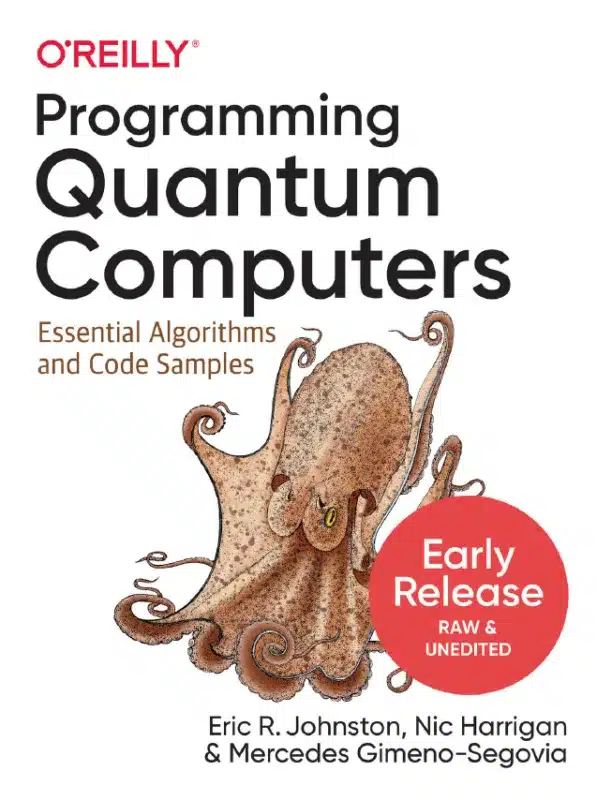
- Author: Eric R. Johnston , Nic Harrigan , Mercedes Gimeno-Segovia
- Publication date : August 13, 2019
- Page Number : 336 pages
Programming Quantum Computers: Essential Algorithms and Code Samples
As quantum computing transitions from a theoretical science to an engineering discipline, there is a critical need for resources that make its powerful concepts accessible to programmers and developers. “Programming Quantum Computers” serves as an essential, hands-on guide designed specifically for this audience. The book’s core value lies in its deliberate avoidance of deep quantum physics, focusing instead on building a programmer’s intuition. It provides a practical toolkit of algorithms, code samples, and unique visualizations, empowering software professionals to understand and begin programming this new class of processors.
Table of Contents
Chapter 1: An Introduction to Quantum Programming
Chapter 2: The Fundamentals of a Single Qubit
Chapter 3: Manipulating Multiple Qubits
Chapter 4: The Quantum Teleportation Protocol
Book Summary
Chapter 1: An Introduction to Quantum Programming
The book begins by establishing its core philosophy: quantum computing should be accessible to developers, not just physicists. The authors frame the Quantum Processing Unit (QPU) as a co-processor, analogous to a GPU, designed to accelerate specific, complex tasks that are intractable for classical computers. To facilitate a hands-on learning experience, the book introduces its primary tool: the QCEngine, a browser-based JavaScript simulator. This tool is central to the book’s pedagogy as it incorporates the authors’ unique Circle Notation for visualizing qubit states, providing an intuitive way to see the effects of quantum operations.
Chapter 2: The Fundamentals of a Single Qubit
This chapter introduces the fundamental unit of quantum information, the qubit, which can exist in a superposition of both 0 and 1. The book’s main contribution here is the introduction of Circle Notation, a novel visualization method that represents a qubit’s two key properties: magnitude (the probability of measuring a 0 or 1) and relative phase (a purely quantum property crucial for interference). The author then explains the “how” of single-qubit manipulation by detailing the essential QPU instructions- such as NOT, HAD (Hadamard), and PHASE -and their clear effects within the Circle Notation. The chapter culminates in a practical application: a simplified Quantum Key Distribution (QKD) protocol, demonstrating how these basic operations can be combined to achieve a useful outcome.
Chapter 3: Manipulating Multiple Qubits
The concepts are now extended to multi-qubit systems, introducing the profoundly non-classical phenomenon of quantum entanglement, where the states of multiple qubits become inextricably linked. The book shows how Circle Notation scales to represent these larger systems, with a register of N qubits being visualized by 2^N circles. The author then provides the practical tools for creating and manipulating entanglement, focusing on the CNOT (Controlled-NOT) gate as the primary method for creating an entangled Bell pair. The chapter also introduces other essential multi-qubit gates and powerful programming techniques like phase kickback, which allows for complex manipulations of a quantum register.
Chapter 4: The Quantum Teleportation Protocol
This chapter serves as a capstone, combining all the previously introduced concepts to build one of the most famous quantum protocols. The authors provide a clear, step-by-step guide to quantum teleportation -the perfect transmission of a qubit’s state from one location to another, a process that necessarily destroys the original state due to the no-cloning theorem. The book breaks down the entire protocol into five distinct steps, illustrating each with quantum circuits and the corresponding Circle Notation visualizations. The value of this chapter lies in showing how fundamental gates and entanglement can be composed into a sophisticated and powerful algorithm, reinforcing the practical, building-block approach of the book.
Overall Impact and Significance
“Programming Quantum Computers” makes a significant contribution by successfully bridging the gap between the abstract physics of quantum mechanics and the practical art of programming. Its primary impact stems from its novel pedagogical approach, particularly the use of Circle Notation and an interactive simulator. This methodology effectively demystifies counter-intuitive concepts like superposition and entanglement, providing developers with a much-needed mental model for how quantum algorithms work. The book helps to lower the barrier to entry for a new generation of quantum software developers.
Conclusion and Recommendation
This book is an exceptionally clear and practical guide that delivers on its promise to teach quantum computing from a programmer’s perspective. Its main contribution is its hands-on, visualization-first methodology, which provides an intuitive pathway for understanding the “what,” “why,” and “how” of quantum algorithms without requiring a deep background in physics. The book successfully equips readers with the foundational knowledge needed to write and understand real quantum code.
“Programming Quantum Computers” is highly recommended for software developers, engineers, computer science students, and any technical professional seeking a practical, code-centric introduction to the field of quantum computing.
About the Authors
Eric Johnston (“EJ”) is the creator of the QCEngine simulator, and also an acrobat and competitive gymnast. He studied Electrical Engineering and Computer Science at U. C. Berkeley, and worked as a researcher in Quantum Engineering at the University of Bristol Centre for Quantum Photonics. EJ worked at Lucasfilm for 24 years as a software engineer for video games and movie effects, along with motion-capture stunt performance.
Nicholas Harrigan Received a PhD for his research into quantum computing and the foundations of quantum mechanics. He’s since been a a data-scientist and a passionately prolific science communicator. Throughout he’s been fascinated by the relationship between physics and computing, and finds inspiration and motivation in the Unix command yes
Mercedes Gimeno-Segovia Develops architectures for quantum computing, during her PhD she designed the first photonic quantum architecture compatible with the silicon industry. She is interested in full-stack architectures, from the control interface with hardware devices to high level programming languages. She also plays the violin and is an avid reader and runner.