


Organizing and managing the hackathon

Introduction
In light of the technological acceleration and growing digital innovations, the Hackathon has become an effective tool to drive innovation, stimulate creative minds, and provide innovative technical solutions to meet challenges. This collaborative event allows participants to work in multidisciplinary teams to develop creative projects in a short period of time, contributing to the achievement of institutional and societal goals.

Choose Renad Al-Majd to organize your next hackathon!
At Renad Al-Majd, we have the expertise and ability to turn your ideas into reality by organizing innovative and effective hackathons.
Whether you’re seeking to foster innovation within your organization or develop technology solutions to address challenges, we’re here to support you.
We provide you with a team of subject matter experts, advanced technical tools, and ongoing guidance to ensure the success of the event. Let us help you achieve your goals and drive innovation forward.
What is a Hackathon?
The word “hackathon” is an abbreviation of the words “hacker” and “marathon”, and originally referred to all types of meetings between programmers to design software solutions in groups of 2 to 5 people at a specific time (usually between 24 and 48 hours) a day, and concluded with the participating teams presenting their projects to a jury.
Hackathons started as competitions focused on programming and software development, where programmers and designers come together to solve technical challenges in a limited time. But over time, hackathons have expanded to include other goals and areas beyond programming, such as social innovation and product design.
In hackathons that focus on social innovation, for example, participants work to provide solutions to social and humanitarian issues, such as improving education, reducing pollution, and enhancing health care. These events provide an opportunity for teams from different disciplines to work together, as these hackathons can be attended by social science professionals, entrepreneurs, and even artists, not just programmers.
In the areas of product design, the hackathons include multidisciplinary teams consisting of designers, engineers, and user experience specialists. The goal here is to develop prototypes of new products or improve existing products, with a focus on designing an optimal and commercially viable user experience.
This expansion of hackathons reflects the growing need for collaboration between different disciplines in order to address complex challenges, and contributes to the creation of new and impactful solutions in purely non-technical fields.
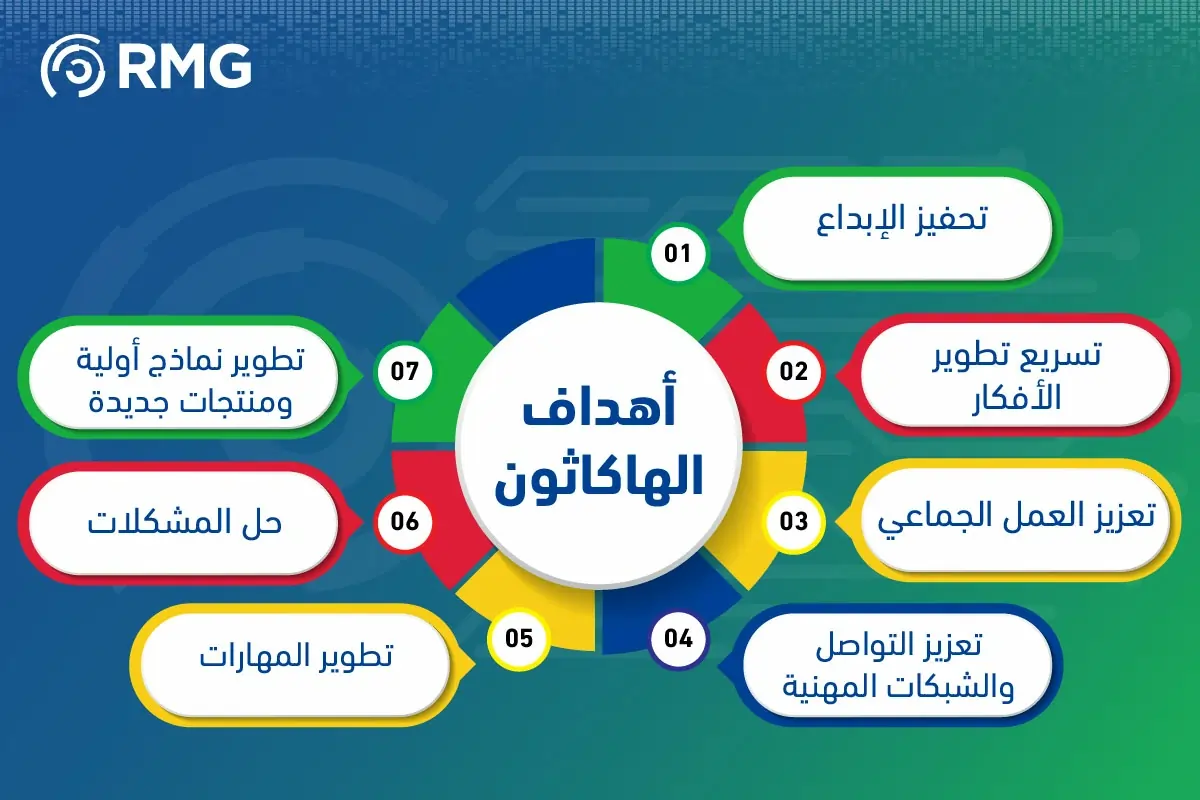
What are the goals of the hackathon?
- Stimulate creativity:Create an environment that encourages thinking outside the box and innovating new solutions.
- Accelerating Idea Development: The hackathon is about intense work in a short period of time, enhancing the participants’ ability to quickly turn ideas into prototypes, which is an important step in accelerating the idea lifecycle and developing projects.
- Promote teamwork:Build a spirit of collaboration and teamwork to achieve a common goal.
- Enhance professional networkingand networking: Hackathons are a platform to network with experts, investors, and potential companies, opening up opportunities for future employment, investment, or partnerships.
- Skills Development:An opportunity for practical learning and the development of technical and vocational skills.
- Problem Solving:Providing technical solutions to real problems in areas such as health, education, the environment, and others.
- Developing new prototypes and products: Presenting actionable prototypes at the end of the hackathon is a key goal, where participants are able to test their ideas and develop new solutions or prototypes that contribute to the development of various industries.
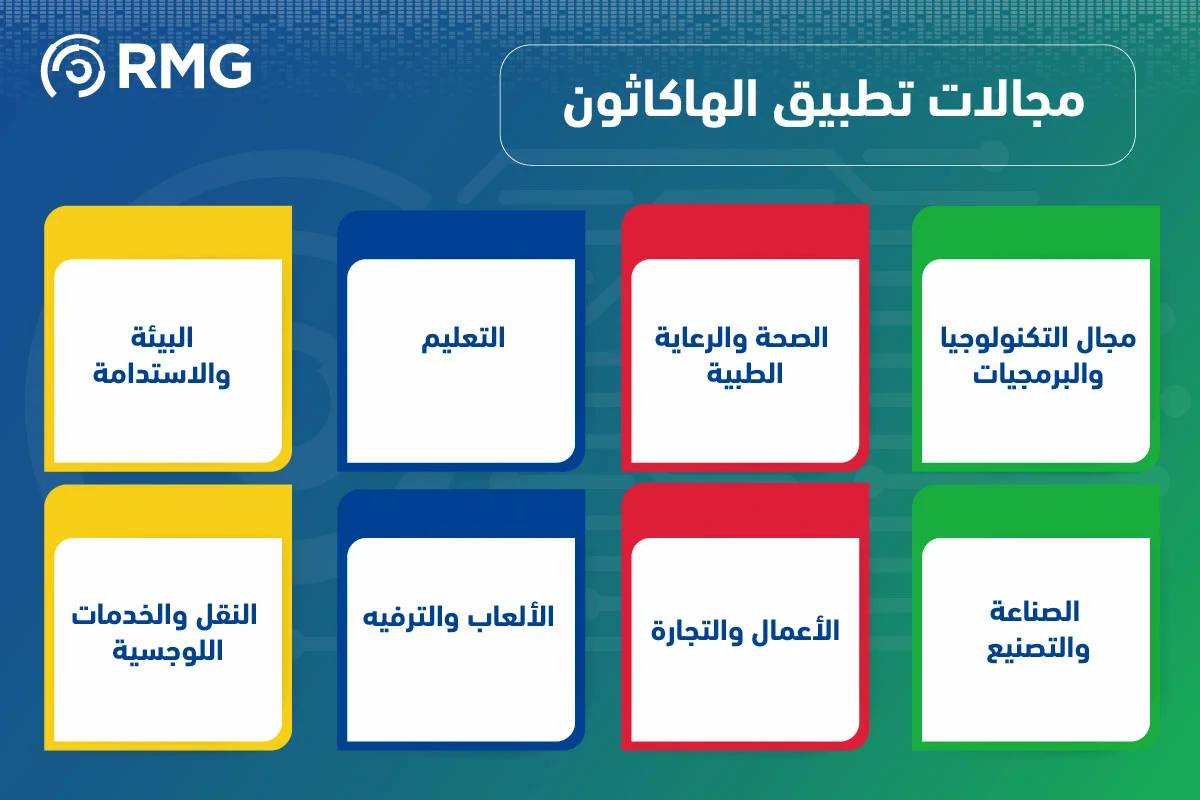
What are the areas of hackathon application?
The concept of hackathons has expanded and is no longer limited to the world of computing, as hackathons are organized to cover a wide range of fields, each focusing on developing innovative solutions to specific challenges. For example:
- In the field of technology and software, hackathons include application development, cybersecurity, and artificial intelligence.
- In Health & Healthcare, it focuses on health technology, digital health, and personalized medicine.
- In education, she is interested in e-learning, educational tools, and interactive learning.
- In environment and sustainability, it includes renewable energy, waste management, and climate change.
- In industry and manufacturing, it focuses on industrial automation, predictive maintenance, and the Internet of Things.
- In business and commerce, it includes e-commerce, business management, and digital marketing.
- In Gaming & Entertainment, it focuses on game development, virtual and augmented reality, and media production.
- In transportation and mobility, it is interested in autonomous vehicles, intelligent transportation, and logistics.
Challenges that the hackathon helps solve
What are the challenges of hackathons in the healthcare sector?
Rising health costs, shortages of medical staff, improved telecare services, and private and secure health data management.
The role of hackathons: Multidisciplinary teams can work to develop technological solutions to improve health data management, design applications for telecare, or create solutions that help reduce medical care costs. This helps in the development of digital tools such as health apps or smart diagnostic tools that support doctors and patients.
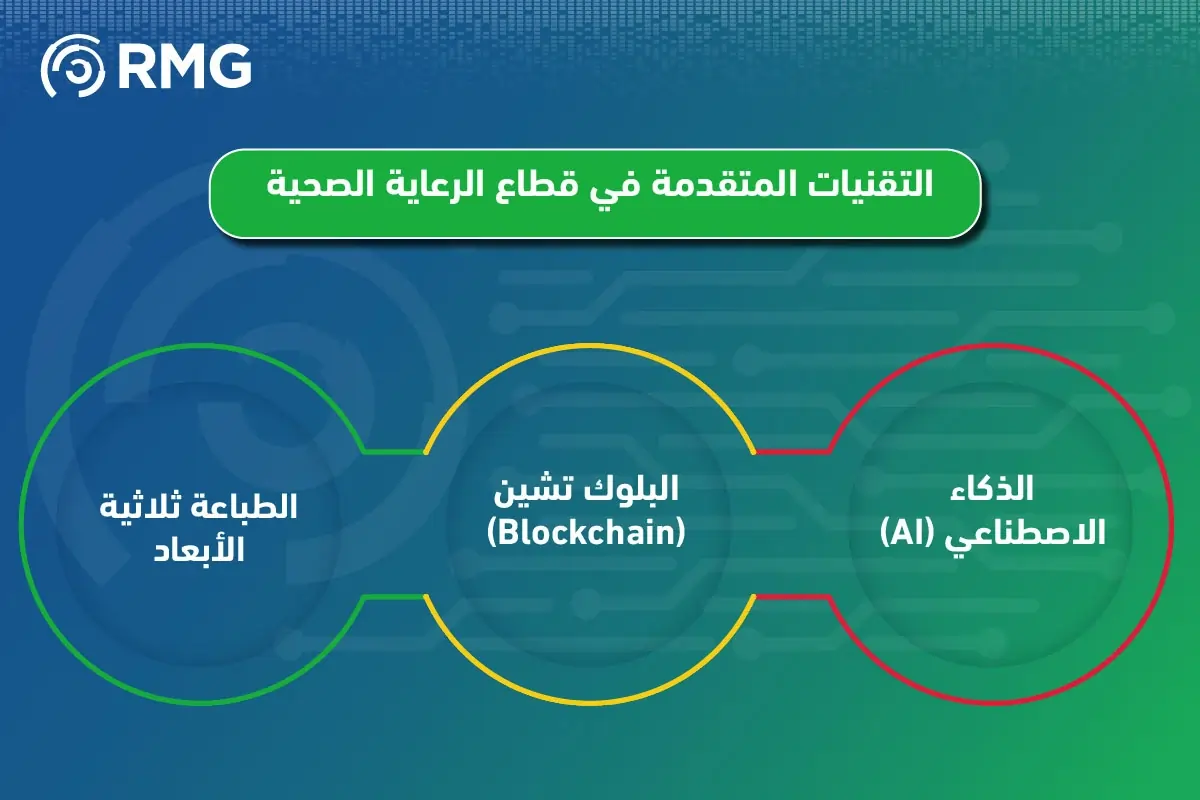
Advanced Technologies in the Healthcare Sector
Artificial Intelligence (AI)
It is used to analyze medical radiology images, predict diseases, and provide accurate treatment recommendations. AI enhances doctors' diagnostic capabilities and reduces medical errors.
Blockchain
It is used in health data management to ensure privacy and security, as it contributes to the preservation of patient records in an encrypted and secure manner, which prevents data manipulation.
3D printing
They are used in the production of prosthetics and the development of customized medical devices that correspond to the needs of patients.
Challenges in the Education Sector
The need to improve access to education, provide innovative learning tools, develop students’ critical thinking and creativity skills.
The role of hackathons: Developing interactive educational tools and online learning platforms, participants can contribute to the design of apps that help students improve their learning experience, develop solutions for inclusive education that reach remote areas, or produce creative educational content.
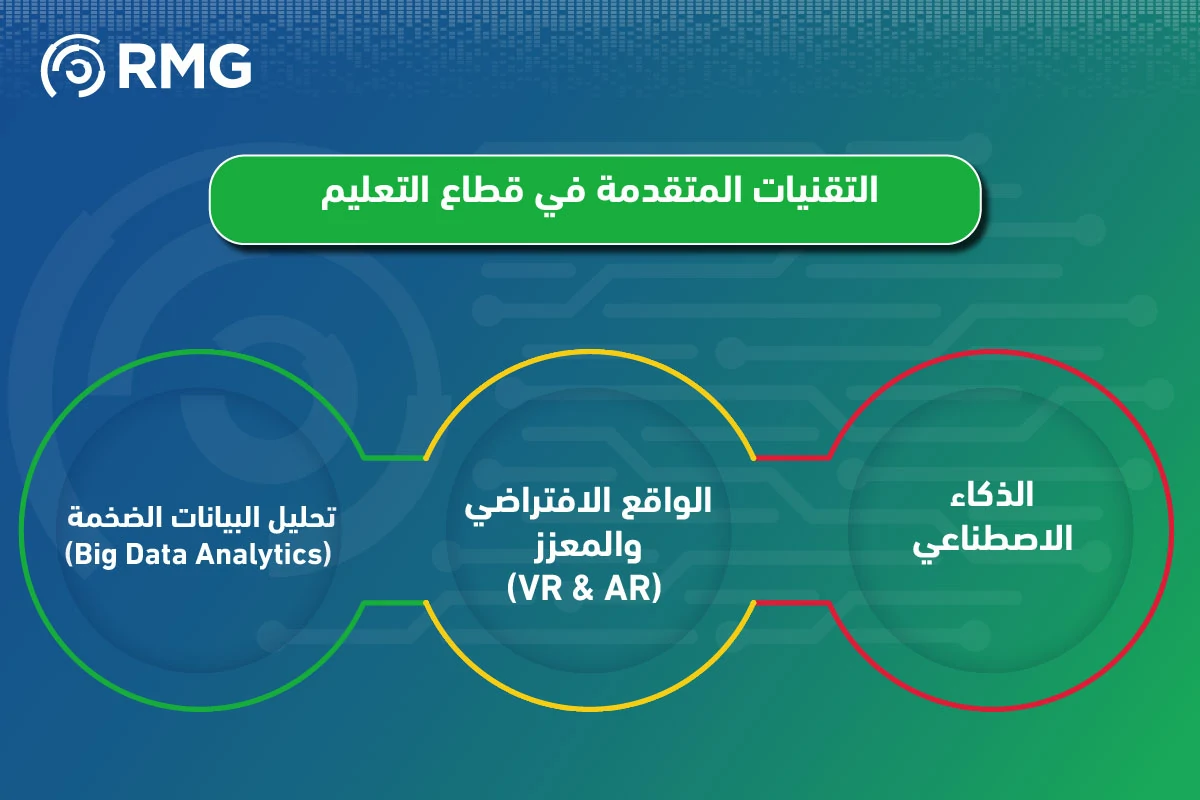
Advanced Technologies in the Education Sector
Artificial Intelligence (AI)
AI helps design personalized learning experiences for students, adapting to each student's level and providing appropriate learning recommendations, enhancing the personalized learning experience.
Virtual and Augmented Reality (VR & AR)
It is used in teaching students by simulating interactive learning environments, such as teaching chemistry or physics through virtual labs, which contributes to improved understanding.
Big Data Analytics
It helps to analyze student performance and identify points that need improvement, supporting educational decision-making and improving teaching curricula.
Challenges in the Fintech Sector
Digital transformation, combating financial fraud, improving access to financial services for unserved individuals. The role of hackathons: Through hackathons, digital solutions can be designed to easily manage money, develop fraud detection techniques, and improve cybersecurity. Financial applications and services can also be developed that are available to wider segments of society, especially in developing countries.
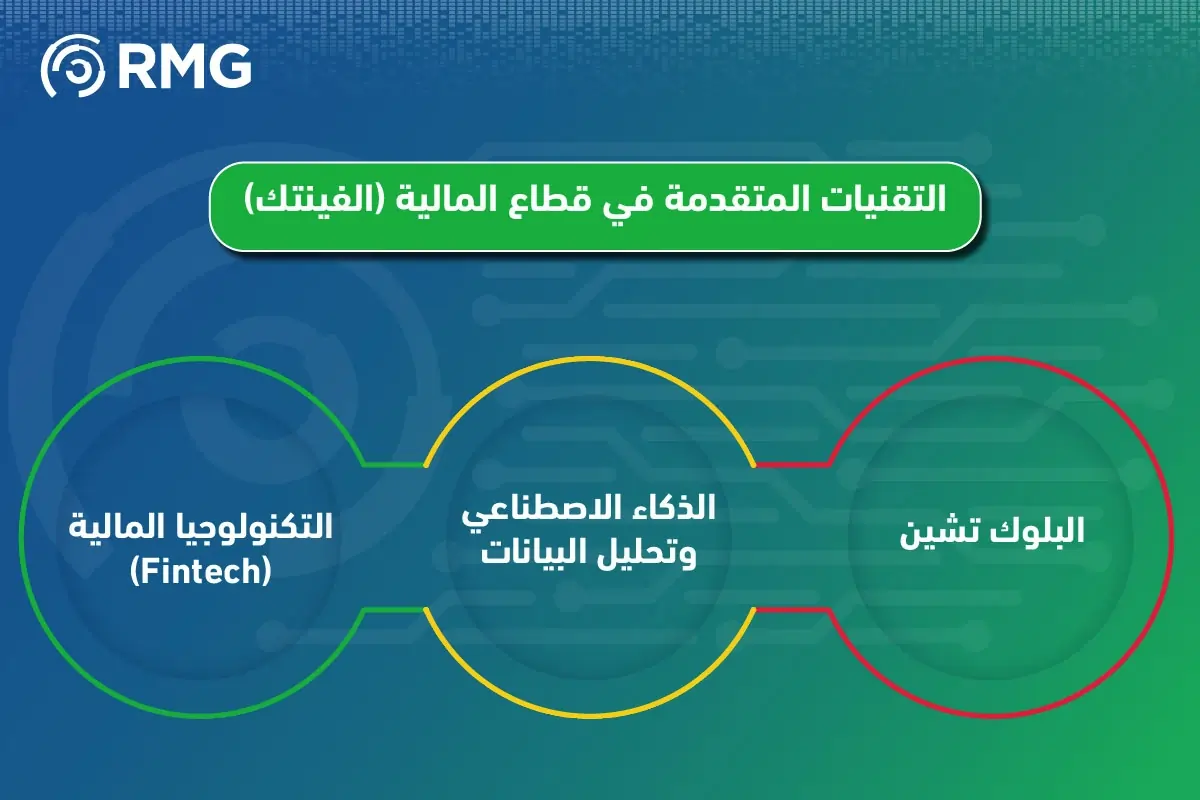
Advanced Technologies in the Financial Sector (Fintech)
Blockchain
It is used in creating secure and transparent payment systems, especially in applications that require confidentiality and identity verification, which reduces the risk of fraud.
Artificial Intelligence and Data Analytics
It is used to analyze customer behavior and identify financial patterns, contributing to the provision of personalized banking services, risk management, and the detection of suspicious activities.
Fintech
It includes solutions such as digital wallets and smart banking apps that facilitate financial transactions and provide access to financial services for larger segments.
Challenges in the Environment and Energy Sector
High levels of pollution, climate change, and the need to find renewable and sustainable energy sources.
The role of hackathons: Environmental hackathons help develop environmentally friendly solutions, such as air and water quality monitoring applications, or innovative waste management solutions. Prototypes for renewable energy projects, such as solar or wind, can also be designed and tested on a small scale.
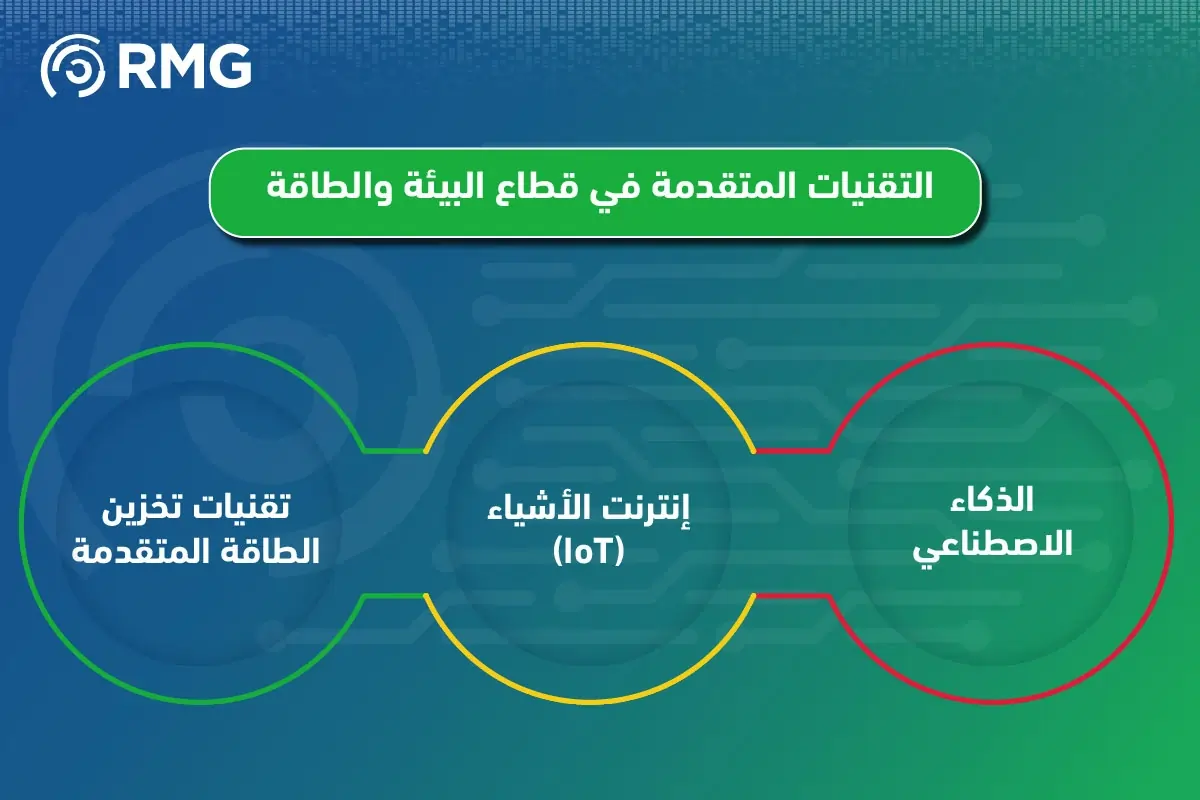
Advanced Technologies in the Environment and Energy Sector
Artificial Intelligence
It is used to improve energy consumption management by forecasting demand and directing resources more effectively, reducing costs and increasing efficiency.
Internet of Things (IoT)
It is used to monitor and analyze real-time energy consumption, and manage renewable energy resources, such as solar panels.
Advanced Energy Storage Technologies
These include smart batteries that contribute to the storage of renewable energy with high efficiency, which helps reduce dependence on traditional sources of energy.
What are the challenges in the transport and logistics sector?
Improving service efficiency, traffic management, and reducing the carbon footprint of transportation.
Role of Hackathons: Participating teams can develop smart traffic management applications, or solutions to reduce carbon emissions by improving transportation efficiency. Solutions can also be proposed for the development of smart transport and shared transport networks, reducing fuel use and improving the user experience.
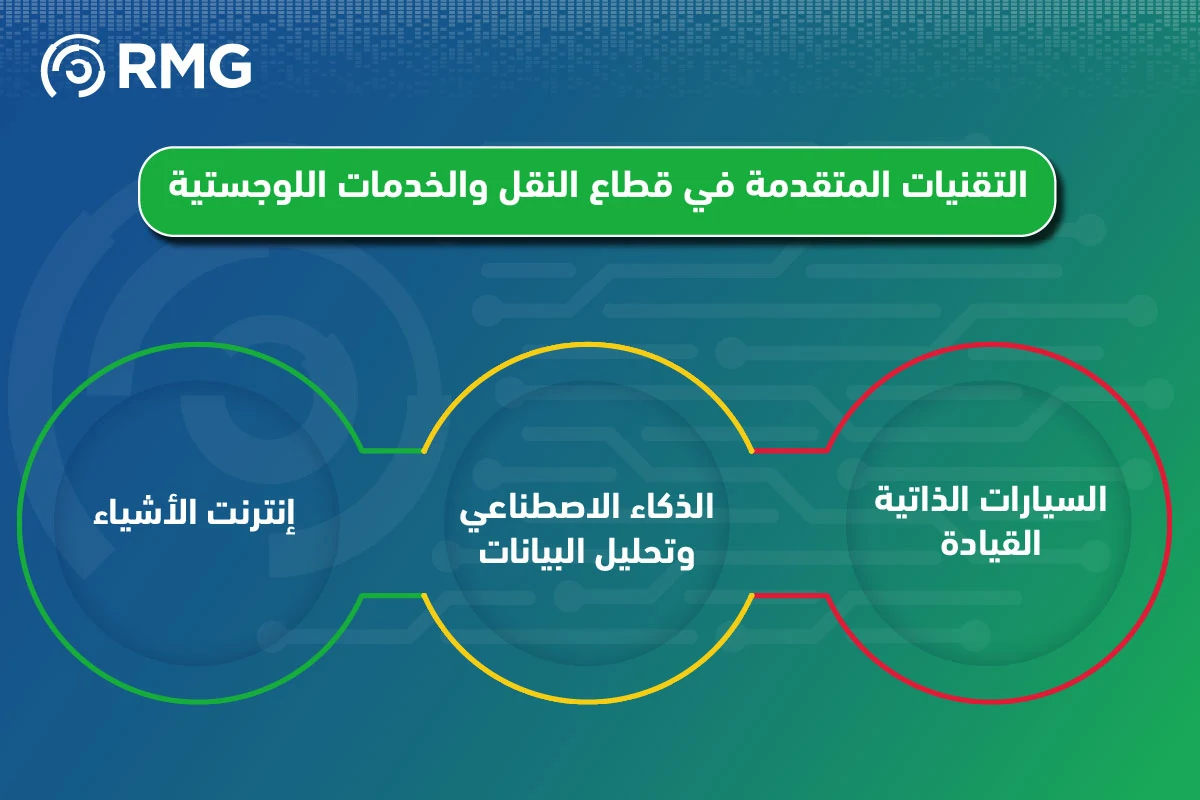
Advanced Technologies in the Transport and Logistics Sector
Self-driving cars
They are used to make transportation safer and more efficient, reduce human errors that lead to accidents, and contribute to improving traffic.
Artificial Intelligence and Data Analytics
They are used to improve shipping operations, transport routing, and demand forecasting, which helps improve operational efficiency and reduce costs.
IoT
It is used to track shipment movements and provide real-time visibility into the stages of transportation, contributing to improved supply chain monitoring and effective logistics management.
What are the challenges in the cybersecurity sector?
Increased cyberattacks, privacy protections, and the difficulty of predicting new security challenges.
The role of hackathons: Hackathons focused on cybersecurity bring together security experts and allow them to test new methods of data protection. Tools can be developed to detect cyberattacks at an early stage, or to design awareness solutions that help individuals and businesses strengthen security measures.
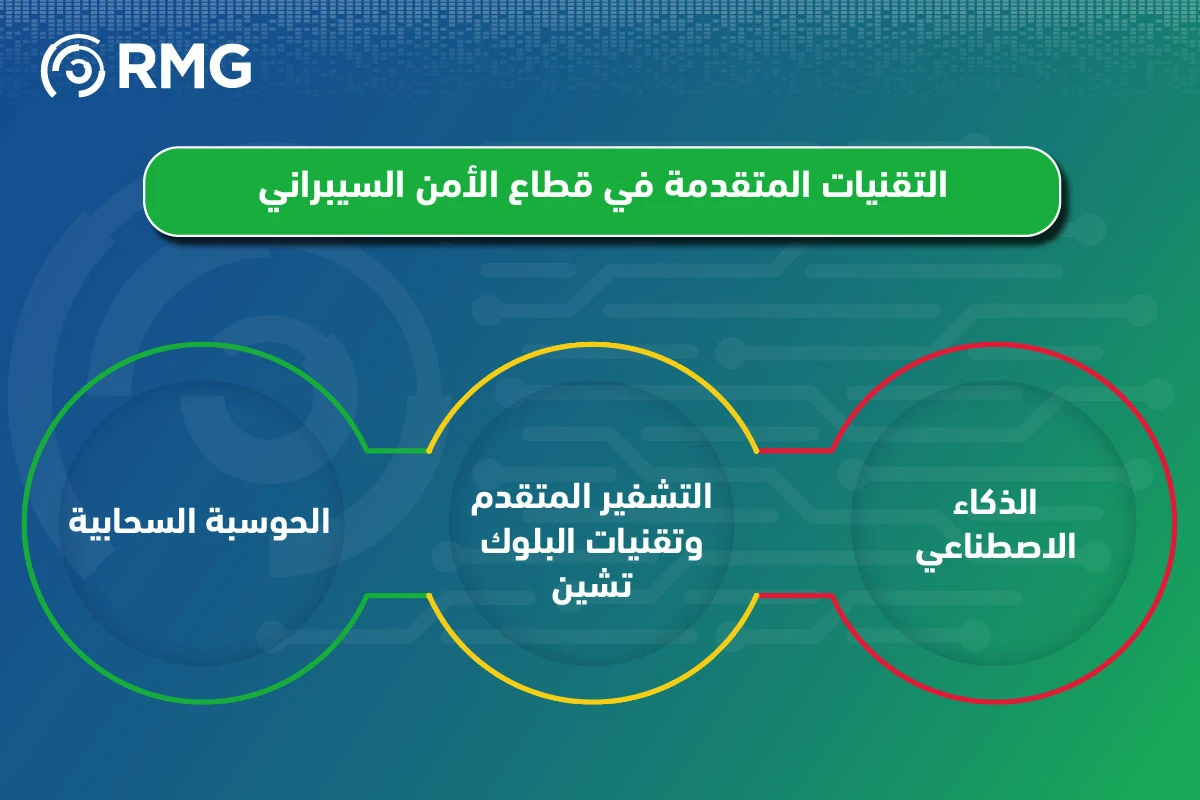
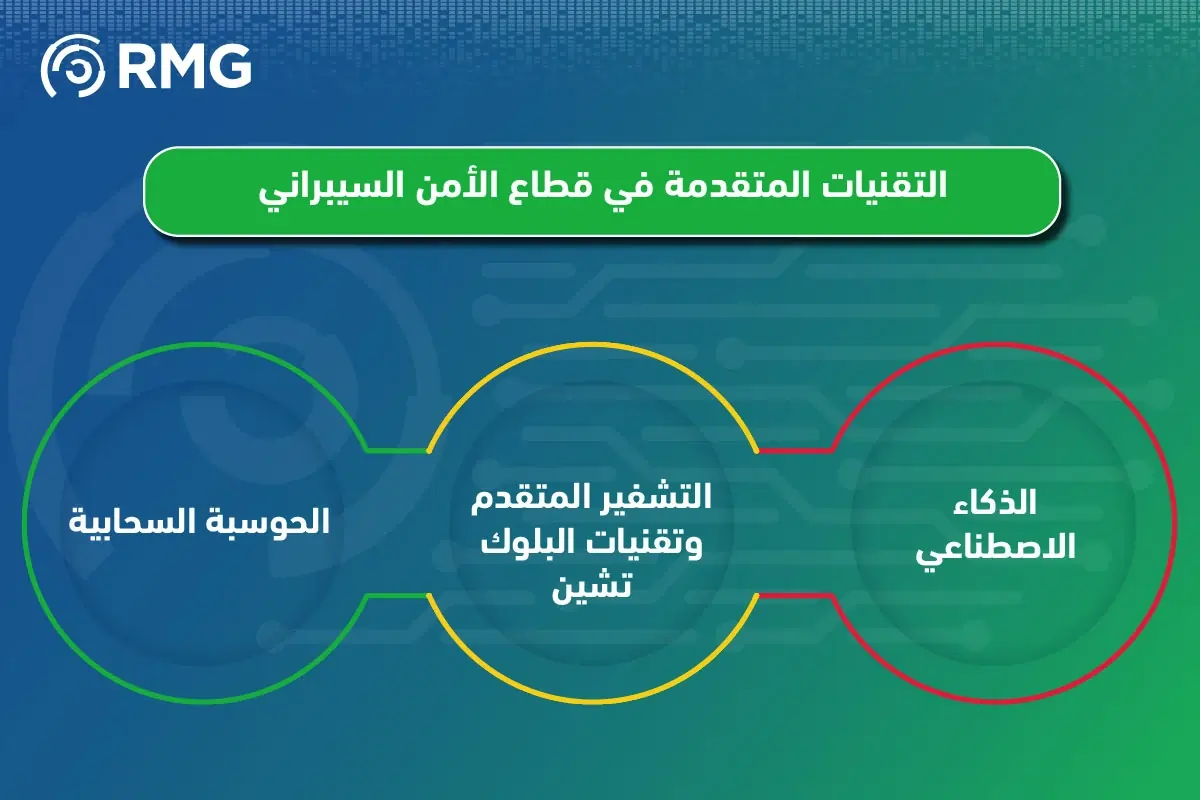
Advanced Technologies in the Cybersecurity Sector
Artificial Intelligence
It is used to detect cyber threats and analyze suspicious patterns in real-time, enhancing the ability of systems to respond to attacks faster and more accurately.
Advanced Encryption and Blockchain Technologies
These technologies contribute to the protection of sensitive data and ensure that information cannot be modified or accessed without permission, enhancing the security of digital infrastructure.
Cloud Computing
Used to secure data and ensure business continuity, cloud backup and data monitoring systems provide the ability to recover from attacks quickly.
What are the challenges in the tourism and hospitality sector?
Improve visitor experience, develop smart tourism, make tourism sustainable and environmentally friendly.
The role of hackathons: Participants can develop digital solutions, such as smart mobility apps or digital tour guides, which improve the visitor experience and help manage tourism resources in sustainable ways. Hackathons can also contribute to the development of solutions to reduce the environmental impact of tourism.
Advanced Technologies in the Tourism and Hospitality Sector
Artificial Intelligence
It is used to provide personalized recommendations to customers, analyze visitor ratings to deliver personalized experiences, and improve the user experience.
Virtual and Augmented Reality (VR & AR)
It allows visitors to experience places before they visit, encouraging them to plan their trips and contributing to improving the visitor experience.
IoT
They are used to intelligently manage hotel facilities, from temperature and lighting control to improved service, making your stay more comfortable and efficient.
The adoption of these advanced technologies fosters innovation and solves complex challenges in every sector, and opens up new avenues for continuous improvements that benefit society as a whole.
Hackathons allow companies and governments to access new ideas and innovative solutions through participating teams, making them a powerful tool to solve complex challenges and contribute to the sustainable development of every sector.
Hackathon organization
Organizing a hackathon requires careful planning and tight execution to ensure the success of the event.
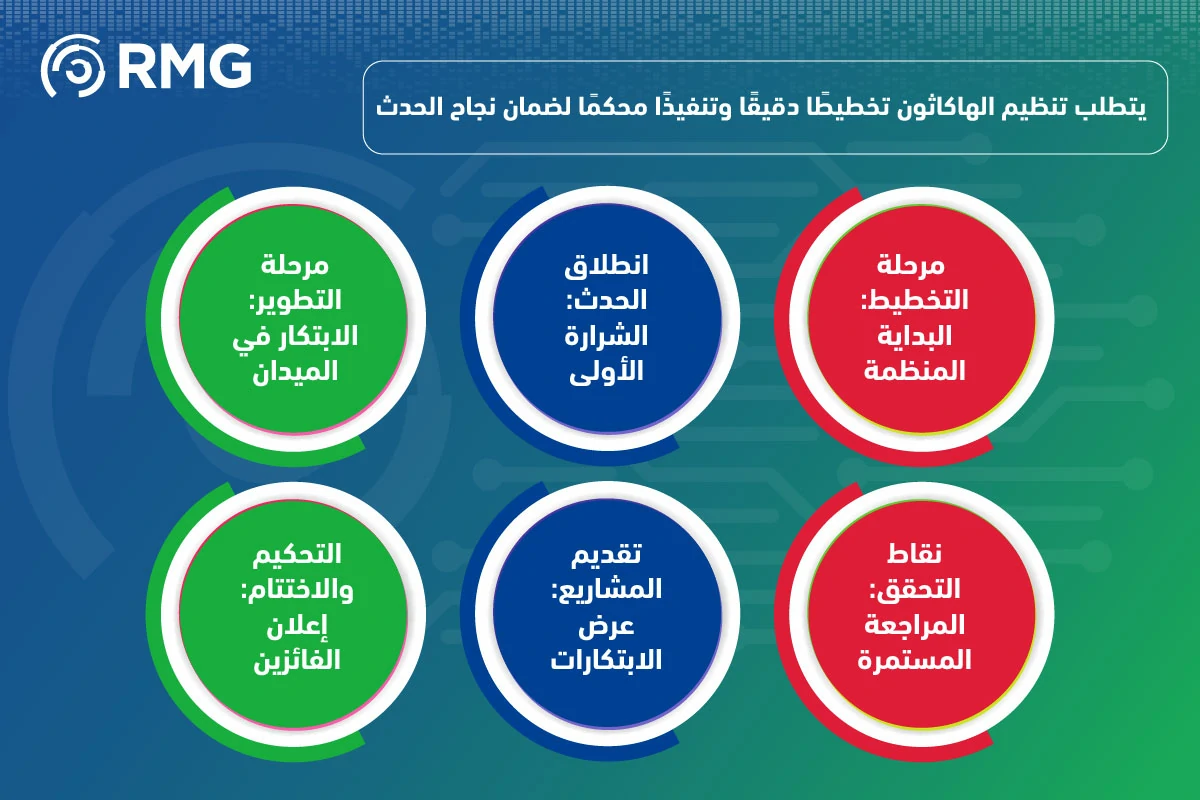
Preparation is the first step to the success of any hackathon. Includes:
– Setting goals: such as innovating new technology solutions or fostering collaboration between participants.
– Selecting the target group: such as students, engineers, or entrepreneurs.
– Define the topic: It could be artificial intelligence, sustainability, or public health.
– Logistics: Determine the type of event (in-person or virtual), duration of the event, and collaboration tools such as Slack or Zoom.
The event begins with an opening session to introduce participants to the goals and challenges.
– Workshops: Provides training for participants to develop their skills or learn about new tools.
– Team Formation: Teams are formed, either in advance or during the event.
– Brainstorming: Teams look for innovative ideas and make plans to implement them.
– Prototyping development: Work is done on building a prototype of the idea.
– Support and Mentorship: Organizers provide mentors and experts to support teams technically and strategically.
During the event, review sessions are held to track the progress of the teams and ensure that the work is running properly.
– Presentation of projects: Projects are presented to the jury through presentations or work models.
– Project Evaluation: Projects are evaluated based on criteria such as innovation, execution, impact, and commercialization.
– Evaluation: The winning projects are selected by a specialized jury.
– Honors: The awards ceremony will be held, with an opportunity to network with sponsors and investors.
Jury of the Hackathon
The judging committee of the hackathon is responsible for evaluating the submitted projects and selecting the winners. The committee is carefully formed to ensure a fair and objective assessment.
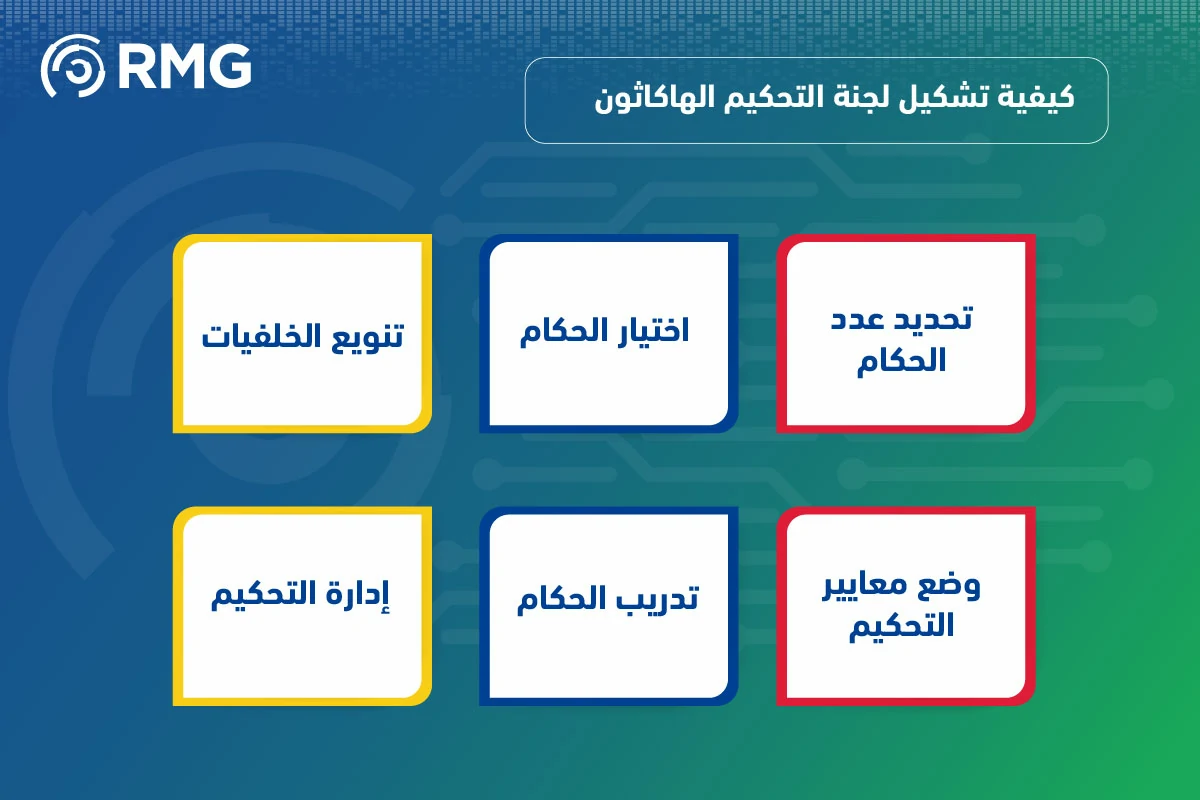
How to Form a Hackathon Jury
Determine the number of referees
The number of judges should be preferably individual (such as 3 or 5) to avoid a tie in the vote.
Setting the Criteria for Arbitration
Clear criteria should be defined for evaluating projects, such as innovation, execution, impact, and commercial viability.
Selection of referees
The judges must be experienced in areas relevant to the topic of the hackathon. This can include developers, designers, entrepreneurs, and academics.
Referees Training
Providing a training session for the referees to explain the standards and how to apply them fairly.
Diversify backgrounds
It is important that the reviewers have diverse backgrounds to ensure a thorough evaluation of the projects from different angles.
Arbitration Department
Organizing judging sessions to ensure that each project gets enough time for evaluation and discussion.
What are the judging criteria in the hackathon?
The judging criteria in hackathons focus on evaluating the quality of submitted ideas and projects based on several key factors. The most important criteria used:
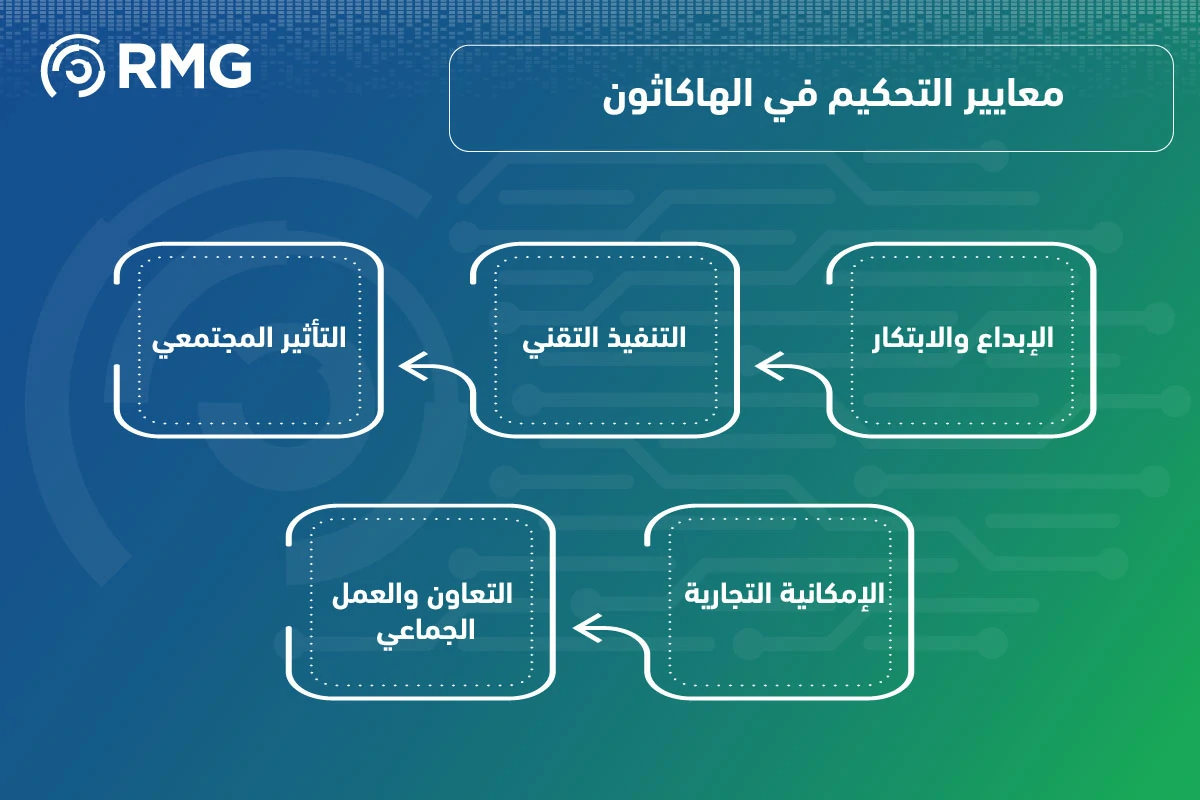
Creativity and Innovation
The novelty and innovation of the idea are assessed, as well as its ability to provide unique solutions to the challenges at hand.
Technical Implementation
It includes the quality of programming or design and the effectiveness of the technologies used in project development.
Community Impact
It is seen as the project's ability to improve the quality of life or achieve tangible positive change in the target area.
Commercial potential
Judging examines the viability of an idea into a marketable product or service, including a business model and market entry plan.
Collaboration and teamwork
Assesses the level of team interaction and effective distribution of tasks among its members, reflecting a collaborative and productive work environment.
These criteria are used to ensure that projects with real potential for success and sustainability are selected.
Common Rules and Regulations for Hackathon
To provide a productive and structured environment, each hackathon organizer sets a set of rules and regulations to ensure a fair and enjoyable experience for participants. These rules usually include the following points:
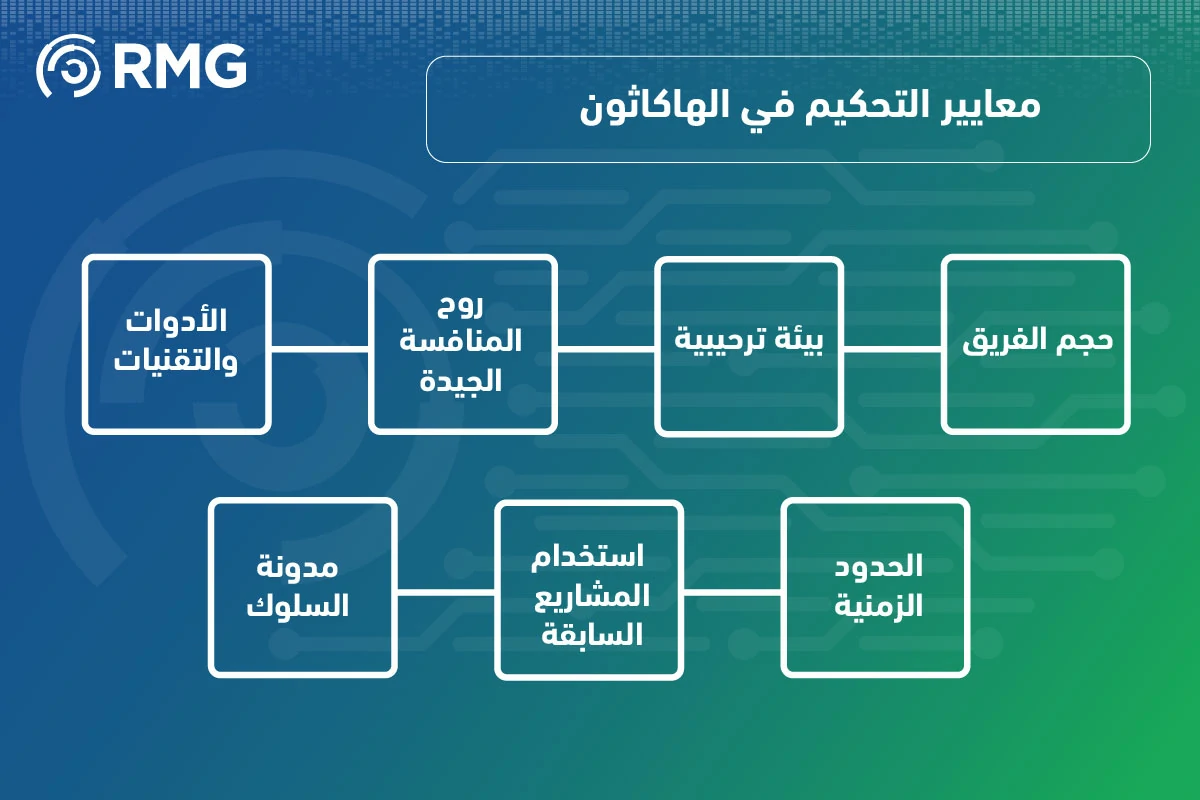
Team size
The minimum and maximum number of members of each team are set to ensure a balance between the required specializations. The number of members is often between 2 to 6 people.
Welcoming environment
Commits all participants to providing an inclusive environment that supports minorities and encourages diversity, fostering creativity and preventing discrimination in all its forms.
Good Competitive Spirit
The rules emphasize sportsmanship and a commitment to positive cooperation between teams.
Tools & Techniques
Tools and software are defined as permitted use, and the use of off-the-shelf resources may be restricted to ensure equal opportunities among participants
Time limits
Strict time limits (often between 24 and 72 hours) are put in place for projects to be completed, to ensure that everyone can work on equal terms.
Use of previous projects
The rules clarify whether it is allowed to resubmit projects in other hackathons or build on previous work. This depends on the regulator's vision and the terms of the competition.
Code of Conduct
It includes strict rules against unethical or unethical behavior, with clear procedures for reporting violations, ensuring the safety of participants and respect for all.
Prizes in the Hackathon
Prizes in hackathons are a pivotal element in motivating participants and encouraging them to be creative and provide innovative solutions. These awards vary widely, and include diverse categories:
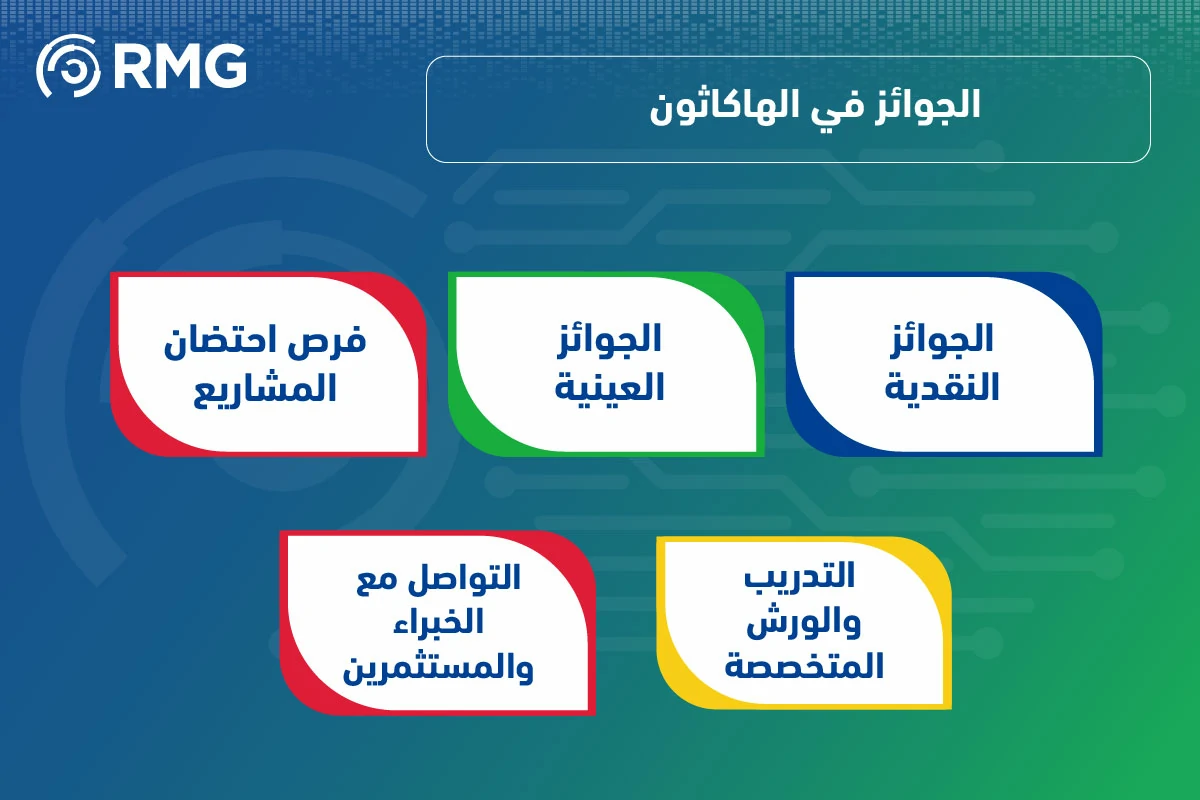
Cash Prizes
Financial prizes are the primary incentive offered by many organizers, as they can contribute to supporting winning teams to fund their projects or develop their ideas.
In-kind Awards
In-kind prizes range from electronic devices such as smartphones, laptops, or software development tools that contribute to enhancing the efficiency of teams in developing their technical solutions.
Opportunities to incubate projects
Some hackathons offer prizes that include opportunities to incubate winning projects through accelerators or support programs that provide the funding and mentorship needed to develop the project into a marketable product.
Training & Specialized Workshops
Awards sometimes include opportunities to attend training sessions or workshops with industry experts. These opportunities help the winning teams hone their technical and business skills, opening new doors for them to succeed.
Connect with experts and investors
The awards provide participants with an opportunity to network with industry professionals and investors who can fund innovative projects. Teams can also help find new opportunities for future jobs or cooperatives.
Awards not only encourage healthy competition, but also help promote teamwork. By honoring the entire team, the chances of success and sustainability of the winning projects increase, prompting participants to continue developing their solutions after the event.
Hackathon Organizing Patterns
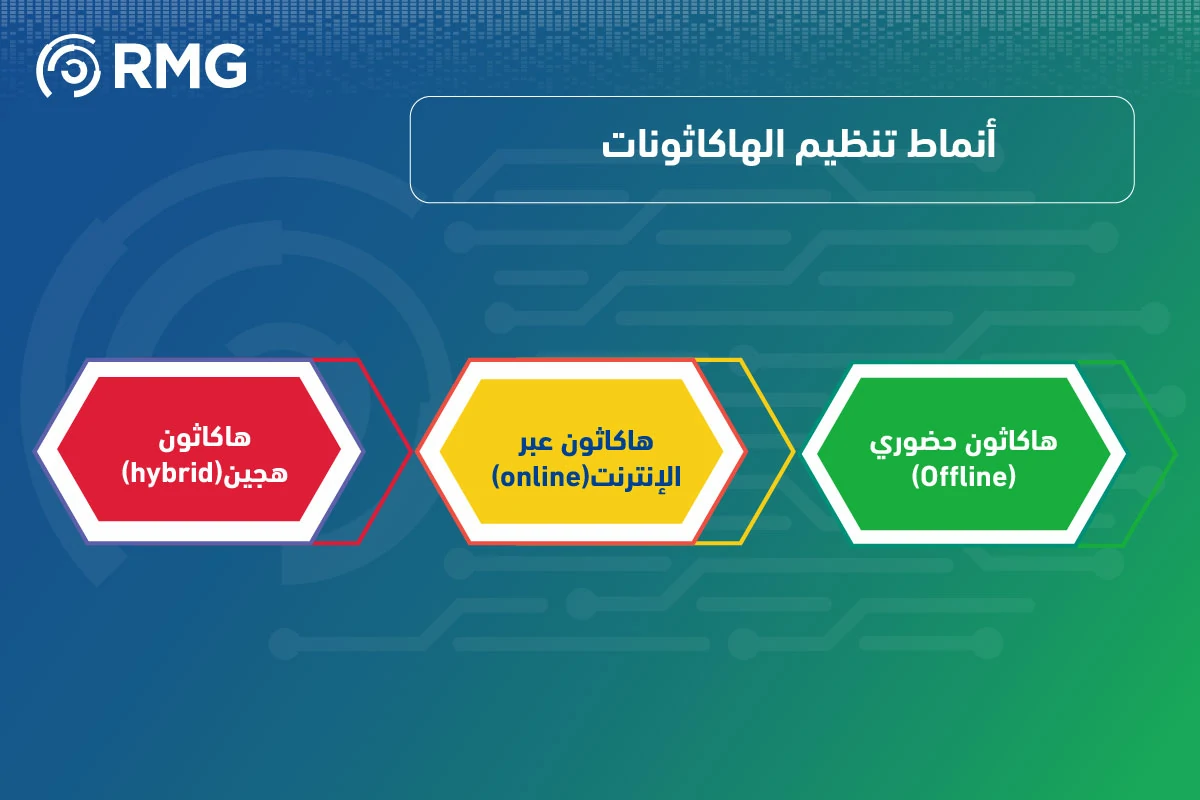
Hackathon environments depend on the way participants are organized and interacted, and vary between in-person, virtual online attendance, or hybrid mode.
Offline Hackathon
An in-person hackathon is the traditional format where the event is held in a specific venue, and all participants and organizers interact in person.
Online Hackathon
An online hackathon is an excellent way to work with talented experts from all over the world. The event is organized entirely online using collaboration and communication platforms and tools such as Asana, Slack, Zoom, and Skype. These hackathons are suitable for companies that have remote employees in different cities and countries, and remove geographical and financial restrictions.
Hybrid Hackathon
The hybrid hackathon combines in-person and online events, allowing participants to choose the most appropriate way for them to participate. This type of hackathon is aimed at a wider audience, allowing organizations to take advantage of the benefits of virtual and in-person events.
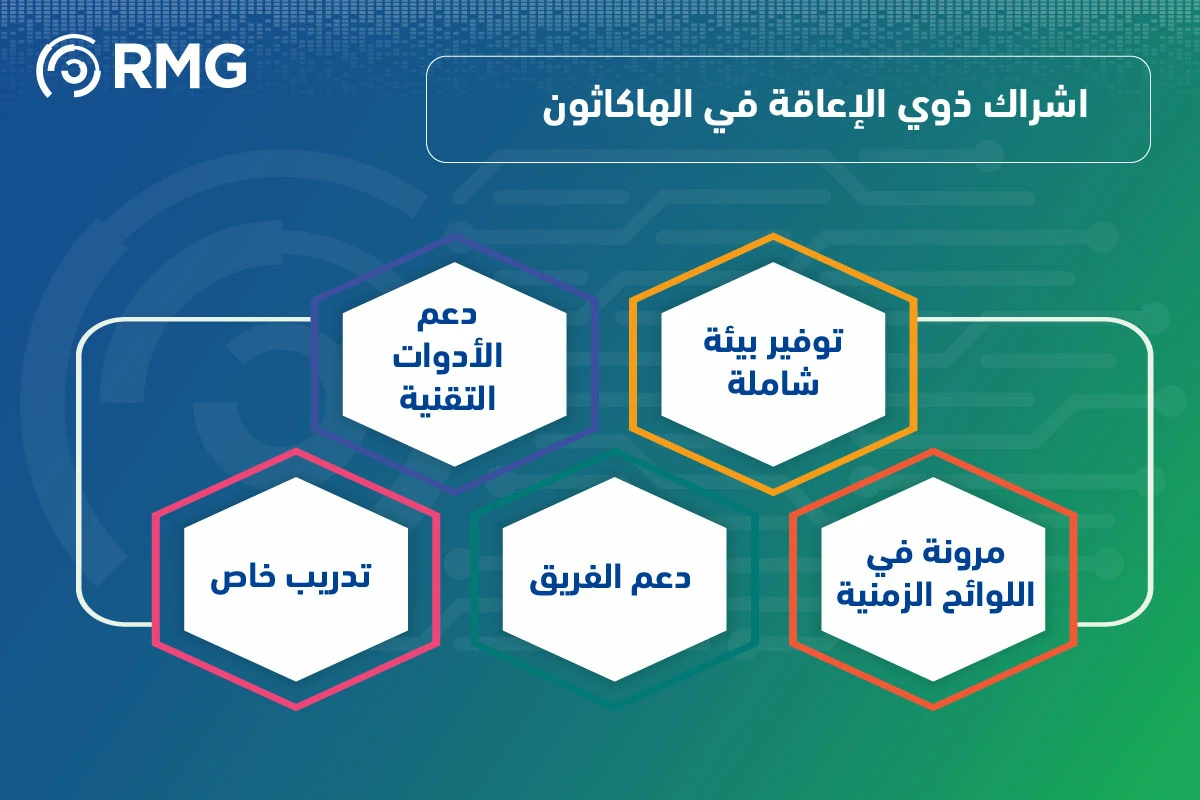
Inclusion of people with disabilities in the hackathon
Hackathons are inclusive platforms that seek to engage everyone, including people with disabilities, as part of its vision to promote diversity and creativity. To ensure effective participation of this group, rules and regulations should typically include considerations for the inclusion of special needs zoe, such as:
- Providing an inclusive environment: Event venues are designed to be accessible to people with mobility or sensory disabilities, with facilities such as:
– Wide corridors and wheelchairs.
– Sign language translation for hearing-impaired participants.
– Screens and aids for visually impaired participants.
- Support for technical tools: Provide customized tools and techniques such as text readers or braille keyboards, to ensure that all participants have equal access to resources.
- Flexible schedules:Participants with special needs may be given extra time or special accommodations to ensure they can give their best.
- Team support: Encourage teams to include people with disabilities to create a diverse team work environment that fosters innovation.
- Special training: Organizing introductory workshops aimed at integrating people with special needs, with a focus on developing their technical and creative skills.
Hackathons like the “Accessible Tech Hackathons” are a great example of empowering people with disabilities.
Engaging people with disabilities in hackathons can have a significant impact in developing comprehensive technology solutions that are compatible with everyone’s needs.
Here are some examples and case studies that highlight how comprehensive hackathons have improved outcomes and supported people with disabilities:
1. MIT Assistive Technologies Hackathon
2. Hackathon "Enable Makeathon" organized by the Red Cross
3. Hackathon "Hack Access Dublin"
4. Microsoft AI for Accessibility Hackathon
5. Mobility Unlimited Challenge Hackathon
1. MIT Assistive Technologies Hackathon
Location: Massachusetts Institute of Technology (MIT), United States.
Details: This hackathon is held annually and brings together students and professionals from diverse fields with special needs to design assistive technologies. The hackathon focuses on creating solutions to help people with mobility, hearing and visual disabilities.
Results: One notable project was a wearable device to help people with visual impairment navigate safely through sensor-based steering vibrations. The design was optimized with the participation of target users at all stages of development, increasing the effectiveness of the solution and making it more suitable for everyday use.
2. Hackathon "Enable Makeathon" organized by the Red Cross
Location: India (in collaboration with multiple countries).
Details: This hackathon is organized to develop technologies that help people with disabilities participate effectively in society. The hackathon focuses on creating practical and low-cost solutions. Designers, engineers, and end-users with special needs participate in the event.
Results: One successful solution was to design a low-cost prosthesis to help move the hands of people with amputations. The presence of people with special needs as primary participants contributed to the development of the model to be comfortable, light, and suitable for everyday mobility challenges.
3. Hackathon "Hack Access Dublin"
Location: Dublin, Ireland.
Details: This hackathon aims to promote inclusivity in cities and innovate to improve mobility for people with disabilities. The event will involve multiple categories of participants, including people with disabilities, to develop mobility solutions and design environments that are friendly to all.
Results: One of the resulting solutions was an AI-based application to recognize obstacles in the way of wheelchairs and alert users to safer routes. Users with mobility disabilities participated in the development and testing of this app, which helped improve the app’s accuracy and effectiveness in addressing real mobility challenges.
4. Microsoft AI for Accessibility Hackathon
Location: Global, organized by Microsoft.
Details: In this hackathon, Microsoft is focusing on using AI technologies to develop solutions for people with disabilities. Participants with disabilities are directly integrated into the design and development stages.
Results: One notable solution was a system that uses artificial intelligence to convert text into visual cues and sign language that helps people with hearing disabilities communicate more easily. This system was developed with the input of sign language speakers to ensure its accuracy and comprehensiveness, which improved the impact of the project and its suitability to the needs of users.
5. Mobility Unlimited Challenge Hackathon
Location: Organized by the Toyota Foundation, and aimed at participants globally.
Details: This hackathon seeks to stimulate innovation in the field of designing assistive devices for people with special needs, and focuses on improving mobility.
Results: One successful project was to design a smart electric wheelchair that can be controlled remotely using smartphones, so that it is easier to navigate in confined spaces. Engaging users with disabilities has helped improve the user experience and provide additional features that contribute to overcoming everyday challenges.
How has the inclusion of people with disabilities contributed to improving project outcomes?
Involving people with disabilities in hackathons has helped to:
- Gain a deeper understanding of needs: By engaging end users, teams have a deeper understanding of the challenges they face, contributing to the design of more practical and relevant solutions.
- Testing and optimizing solutions: Giving users with disabilities the opportunity to test prototypes during the hackathon helps detect issues early and make necessary adjustments.
- Raising awareness of the importance of inclusivity: These hackathons contribute to raising the awareness of designers and developers about the importance of inclusivity and providing solutions that work for everyone, which is reflected in the quality and diversity of projects.
- These examples show that inclusion of people with disabilities is not only an important element of inclusivity, but also a key factor in improving the quality of solutions and increasing their impact on users’ lives.
Intellectual Property Rights in Hackathons
The intellectual property rights of the teams participating in the hackathons is an important topic and needs to be clearly regulated to strike a balance between protecting the rights of the participating teams and providing an environment that encourages innovation. The handling of intellectual property rights varies based on the rules of each hackathon.
Here are some common approaches to managing IP rights for projects after the event:
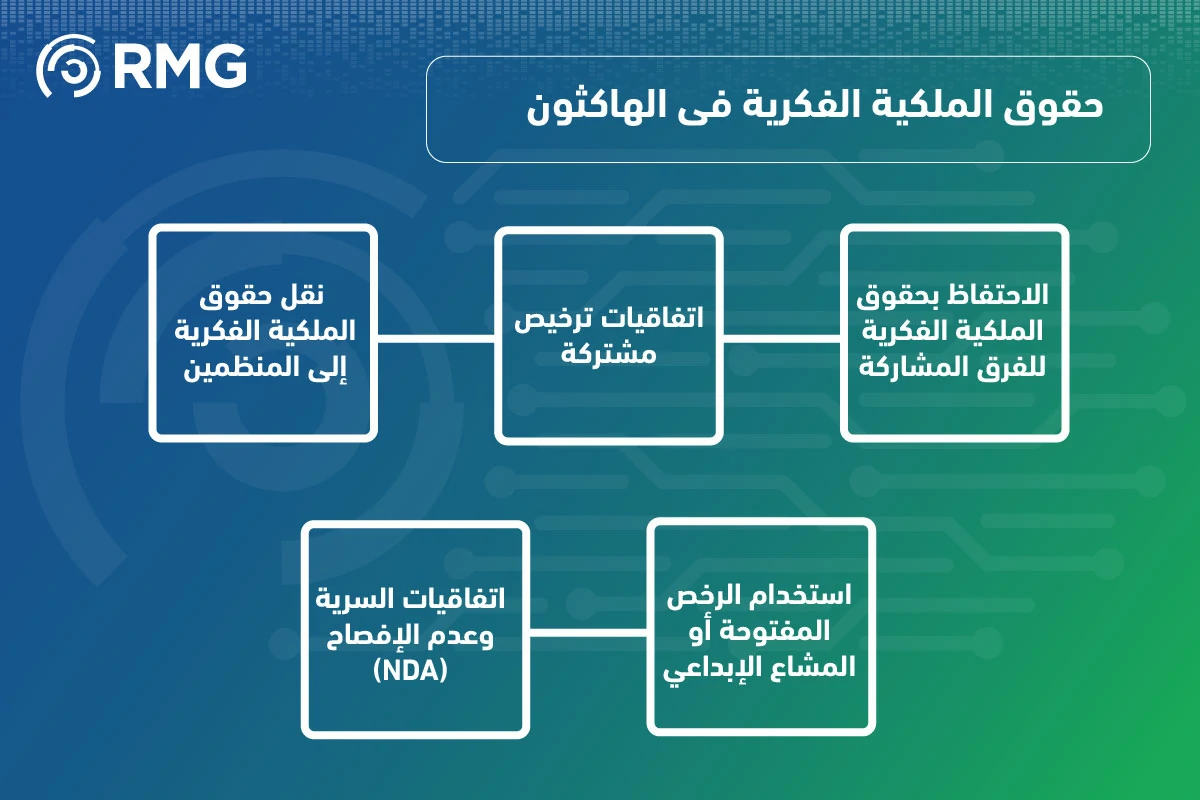
In many hackathons, participating teams are given the full right to retain the intellectual property of the projects they are working on, which means that all rights related to innovations, codes, or prototypes remain theirs after the hackathon ends.
This approach helps to encourage participants by guaranteeing their right to develop their projects later or seek out investors without having to waive any rights.
In some hackathons, joint licensing agreements are signed that give organizers the right to use innovations or codes developed during the event for a specific period or in a specific scope, while the intellectual property rights remain the property of the participating teams.
These conventions are usually used to promote ideas and apply them within the organized organization, but they allow participants the freedom to develop their innovations independently outside of the framework of the hackathon.
In rare cases, some hackathons may require the transfer of intellectual property rights to the organizers, especially if the event is funded by a company that wants to own the innovations developed.
This rule is often spelled out in registration documents to avoid any confusion, and participants may be offered financial prizes or employment contracts in exchange for a waiver of rights.
Some hackathons encourage the use of open-source licenses or a Creative Commons license to protect innovations. This helps to disseminate knowledge and share innovations with the community, while ensuring that shareholder rights are mentioned.
This approach is suitable for hackathons that aim to innovate for non-profit goals or to support open innovation in the community.
Sometimes, teams may be required to sign confidentiality and non-disclosure agreements (NDAs) to protect the ideas and technologies used, particularly in hackathons that deal with sensitive or proprietary information.
Confidentiality agreements help protect the intellectual property rights of participants as well as protect the private interests of organizers, especially if the hackathon addresses solutions to real problems within organizations or companies.
Best Practices to Ensure Clarity of Intellectual Property Rights in Hackathons
- Clarify the rules in advance: Organizers should clearly explain how to manage IP rights at the beginning of the hackathon and include them in the registration documents.
- Signing contracts when needed: To ensure the rights of all parties, it is advisable to sign contracts that specify whether the intellectual property rights will remain for the participating teams or will be shared with the organizers.
- Encourage flexible agreements: Agreeing to share IP flexibly can be helpful for teams to move forward with the development of their projects, both within and outside the organization.
- Fair and clear management of intellectual property rights encourages innovation and helps participants develop their projects with confidence.
IT Hackathon
For information technology and digital transformation, the hackathon is an intensive collaborative event that brings together programmers, developers, technology solution designers, and entrepreneurs to work in multidisciplinary teams to develop innovative solutions that contribute to addressing technical challenges or achieving strategic goals.
This type of hackathon focuses on designing and developing technology projects that serve the goals of digital transformation such as improving the efficiency of government services, accelerating operational processes, or improving the user experience using the latest technologies such as artificial intelligence (AI), Internet of Things (IoT), blockchain, cloud computing, big data applications, and others.
Hackathons are an ideal platform for many entities to achieve their technical and innovation goals. Among the most prominent entities that can benefit are government entities to discover innovative technology solutions that support digital transformation and improve public services, and technology companies to develop new products and services and discover talent. Hackathonsalso help universities enhance students’ skills and encourage them to innovate. Nonprofits see in hackathons an opportunity to develop technical solutions that address societal and environmental issues. Startups take advantage of them to test their new ideas and get support from experts, and hackathons are used by digital transformation advocates to accelerate the adoption of new technologies.
Hackathons can be organized during launch periods or major updates, national or global events, as internal initiatives to stimulate creativity, before the launch of major projects, or in times of crisis and challenges to develop fast and effective technology solutions.
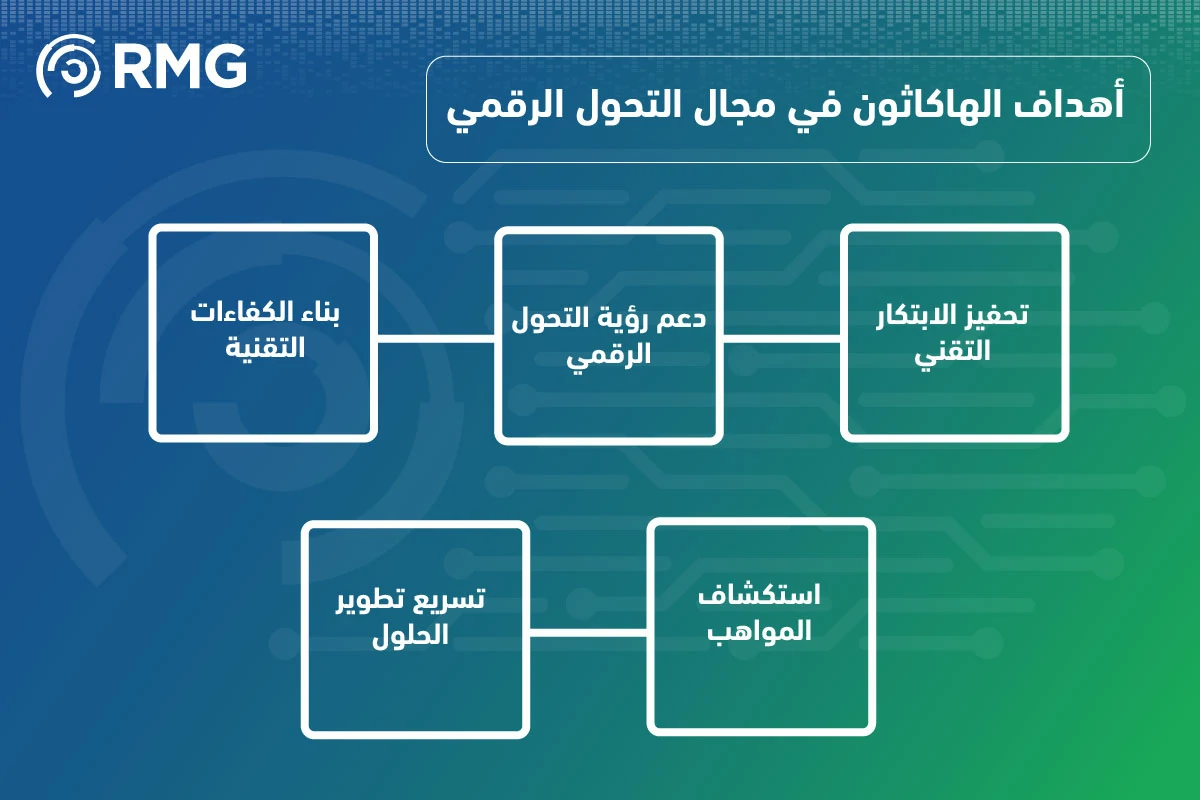
What are the objectives of the hackathon in the field of digital transformation?
- Stimulating technical innovation:Developing digital solutions that meet market needs or address specific challenges.
- Supporting the Digital Transformation Vision:Promoting the use of technology in government and private organizations to support digital strategic transformation.
- Technical Competency Building: Giving participants an opportunity to develop their skills in programming, design, and project management.
- Talent scouting: Attracting creators and innovators who are able to deliver entrepreneurial technology ideas.
- Accelerate solution development:Reduce the time needed to move from idea to prototype.
The added value of holding the hackathon in the field of information technology
Holding hackathons brings multiple benefits that add great value to organizations and communities, especially in the fields of information technology and digital transformation. These benefits include:
Stimulating innovation and creativity
The roles and responsibilities of each team or department within the organization should be clearly and precisely defined, and this helps improve efficiency and productivity
Hackathons provide an open environment that encourages participants to think outside the box and develop innovative technology solutions that address contemporary challenges in non-traditional ways.
Effectively the goals of the organization.
Accelerating digital transformation
By investing creative ideas in real-world projects, hackathons contribute to the digital transformation by providing viable solutions based on the latest technologies.
Talent Discovery & Talent Acquisition
Hackathons are an effective platform to discover technical talent and creators in the fields of programming, design, and business development, helping organizations attract the best talent.
Strengthening cooperation and partnerships
Hackathons bring together multiple actors, such as governments, tech companies, and universities, fostering collaboration and knowledge sharing between these parties to achieve common goals.
Developing quick solutions to problems
Involving employees, students, or community members in hackathons fosters a sense of participation and belonging, and motivates them to contribute effectively to the achievement of institutional or societal goals.
Improving Corporate Reputation
Holding hackathons shows organizations as leaders in innovation and technology, enhancing their reputation and increasing their appeal to potential customers and partners.
Developing sustainable solutions
With a focus on environmental and societal issues, hackathons contribute to building sustainable solutions that support long-term development goals.
The most popular hackathons in the field of information technology:
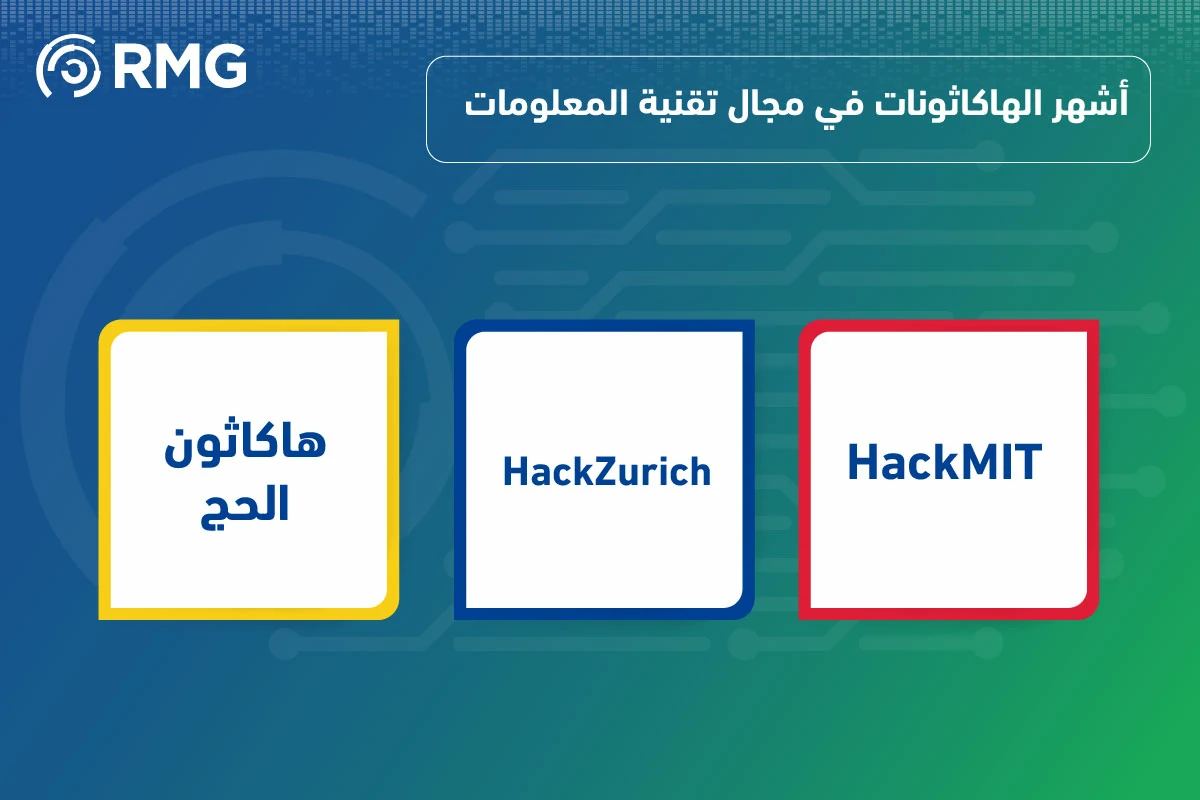
HackMIT
It is an annual hackathon organized at the Massachusetts Institute of Technology (MIT) in Cambridge, Massachusetts. Founded in 2014 and runs for weekends, it brings together thousands of students from all over the world to work on innovative projects. Objective: To encourage innovation and creativity among students by providing a collaborative environment for the development of new technological solutions.
HackZurich
Organized by a team of founders Jonathan Eisenring, Ramsus Roth, and Sitara Garibi. This team is organizing one of Europe's largest hackathons, which attracts programmers from all over the world to work on innovative technology projects in Zurich, Switzerland. Objective: To promote international cooperation in the field of technology and to encourage the development of innovative technology solutions.
Hajj Hackathon
It is the first hackathon of its kind in the Middle East, held in the Kingdom of Saudi Arabia under the supervision of the Saudi Federation for Cybersecurity, Programming and Drones, and with the support of Google. The event was launched on August 1, 2018 at the Jeddah Forums and Events Center. Objective: To develop applications and technologies that serve the pilgrims of the Holy House of God, the competition included all sectors and fields related to the services provided in the Hajj such as health, financial solutions, transportation, food, communication, and traffic.
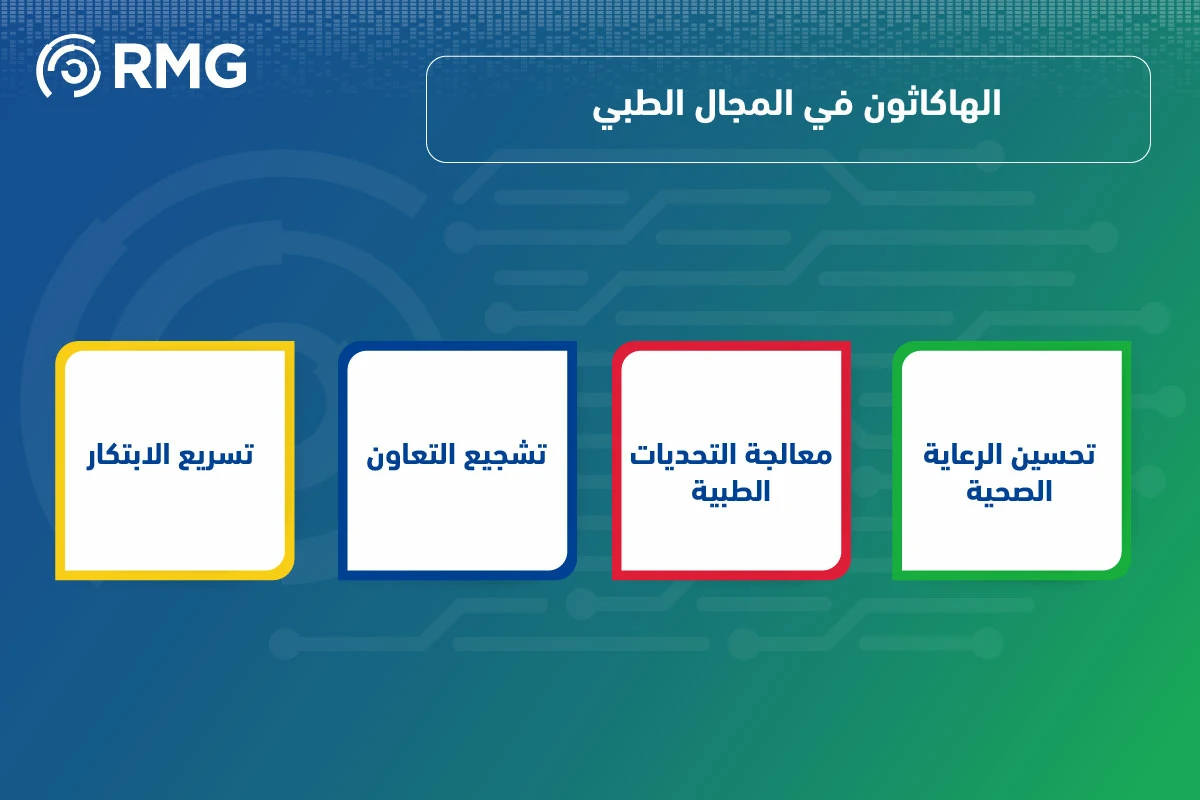
Hackathon in the Medical Field
Hackathons in the medical field aim to develop innovative technological solutions to improve healthcare and address medical challenges. In order to:
- Improving Healthcare:Developing new technologies and tools to improve the quality of healthcare and provide more effective medical services.
- Addressing medical challenges:Finding innovative solutions to complex health challenges such as chronic diseases, early diagnosis, and health data management.
- Encourage collaboration:Bringing together doctors, engineers, designers, and entrepreneurs to work together on joint projects, fostering collaboration between different disciplines.
- Accelerate innovation:Accelerate healthcare innovation by providing a collaborative and competitive environment that encourages creative thinking and the development of new solutions.
The added value of medical hackathons
Improving Quality of Life
Through the development of new medical technologies, the quality of life of patients can be improved and better healthcare can be provided.
Save time and costs
Innovative solutions can help reduce the time and costs associated with healthcare, making it more efficient and effective.
Promoting education and training
Hackathons provide learning and training opportunities for participants, helping them acquire new skills and develop their existing ones.
Supporting the local economy
By encouraging innovation and entrepreneurship in the medical field, hackathons can contribute to supporting the local economy and creating new jobs.
Stimulating R&D
Hackathons encourage research and development in medical fields, leading to new discoveries and continuous improvements in healthcare.
The most popular hackathons in the medical field
Health Innovation Hackathon
Organized by King Saud Bin Abdulaziz University of Health Sciences in the Kingdom of Saudi Arabia. Focuses on exploring innovative and creative solutions in eight different health tracks
SDAIA AI in Healthcare Hackathon
Organized by the Saudi Data and Artificial Intelligence Authority in cooperation with Stanford University. It aims to develop artificial intelligence applications by integrating data into the medical field
MIT Hacking Medicine Hackathon
It is organized by the Massachusetts Institute of Technology (MIT) in the United States. This hackathon aims to develop innovative solutions to improve healthcare. Work on projects that contribute to improving the quality of health care and providing new solutions to medical challenges
Industrial Hackathon
The main objective of industrial hackathons is to stimulate innovation and accelerate the development of technical solutions that can improve industrial processes, increase efficiency, and reduce costs. It also aims to enhance cooperation between industrial companies and innovators, and provide a platform for the exchange of ideas and experiences.
The added value of the hackathon in the industrial field
Stimulating innovation
Hackathons encourage participants to think outside the box and come up with new and innovative solutions.
Accelerating development
It provides an intensive environment that allows participants to focus on developing their solutions quickly.
Enhancing cooperation
It brings together different disciplines and expertise, fostering collaboration and knowledge sharing.
Develop skills
It gives participants an opportunity to develop their technical and creative skills.
Building networks
It allows participants to network with industry experts and investors.
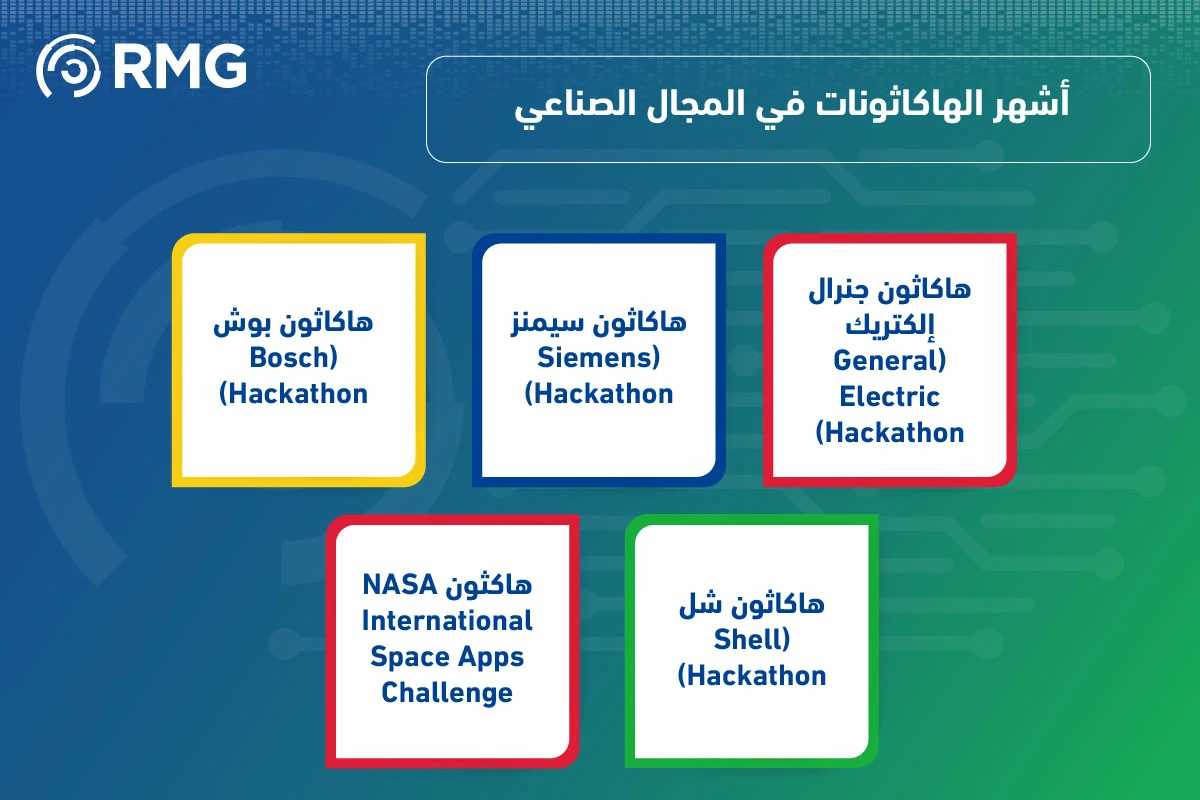
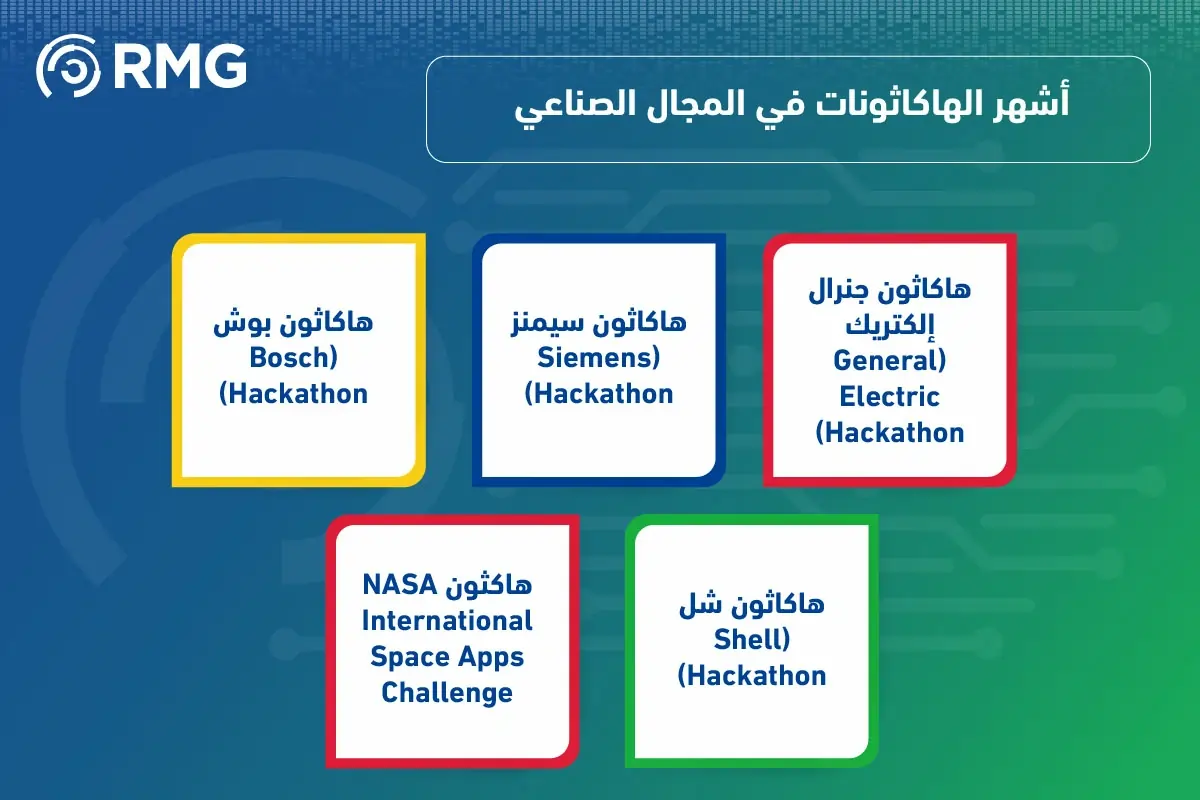
The most popular hackathons in the industrial field
MIT Hacking Medicine Hackathon
It is organized by NASA to stimulate innovation in space exploration and improve life on Earth through the development of new technological solutions.
Siemens Hackathon
Organized by Siemens, the hackathon aims to promote innovation in the field of industrial automation and improve productivity through the use of modern technologies.
Bosch Hackathon
It is organized by Bosch to work on projects that contribute to reducing breakdowns and improving maintenance efficiency.
NASA International Space Apps Challenge Hackathon
This hackathon is organized by Shell in multiple locations around the world. The event aims to develop technical solutions to improve oil and gas extraction processes.
General Electric Hackathon
Organized by King Saud Bin Abdulaziz University of Health Sciences in the Kingdom of Saudi Arabia. Focuses on exploring innovative and creative solutions in eight different health tracks
Education Hackathon
The main objective of education hackathons is to stimulate innovation in the field of education through the development of new tools and technologies that contribute to improving the learning experience for students and teachers alike. It also aims to enhance cooperation between the various stakeholders involved in education and provide a platform for the exchange of ideas and experiences.
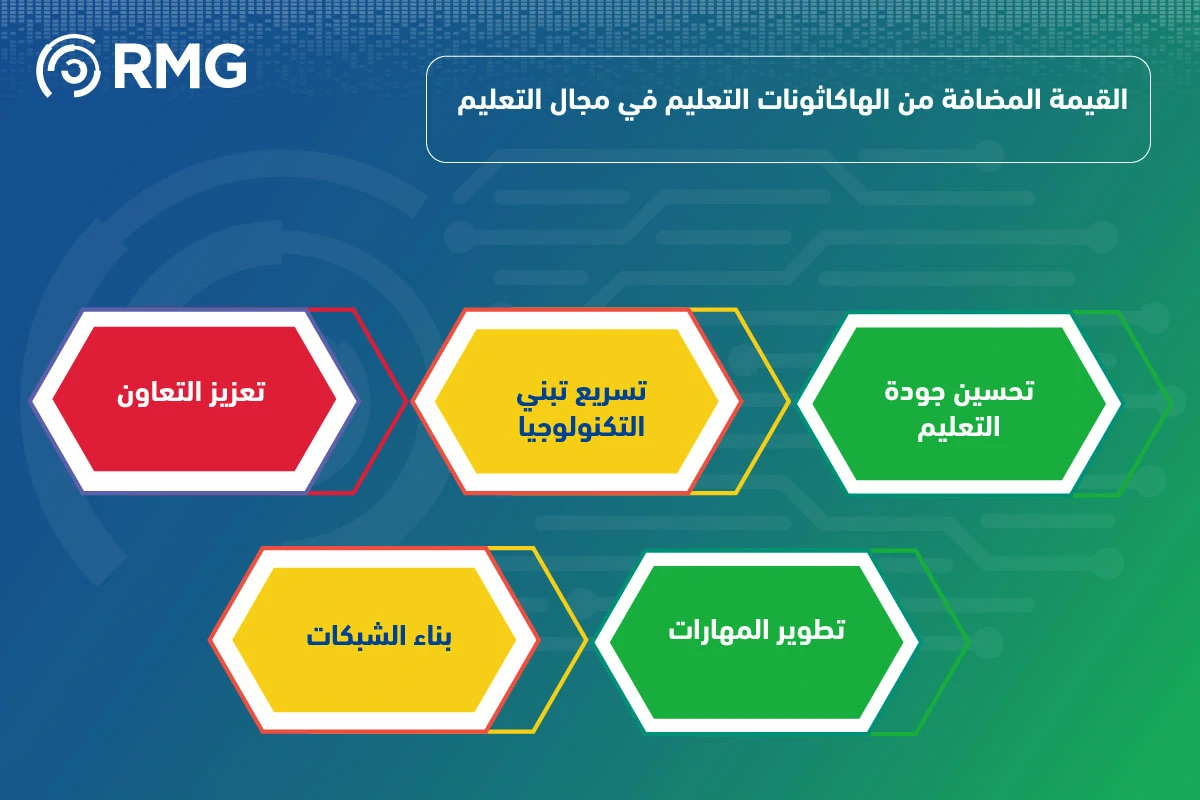
The added value of education hackathons in the field of education
Improving the quality of education
Hackathons encourage the development of innovative educational solutions that contribute to improving the quality of education.
Accelerating technology adoption
It provides an intensive environment that allows participants to quickly develop and test new learning solutions.
Enhancing cooperation
It brings together different disciplines and expertise, fostering collaboration and knowledge sharing.
Develop skills
It gives participants an opportunity to develop their technical and creative skills.
Building networks
It allows participants to network with education and technology experts and investors.
The most popular education hackathons in the field of education
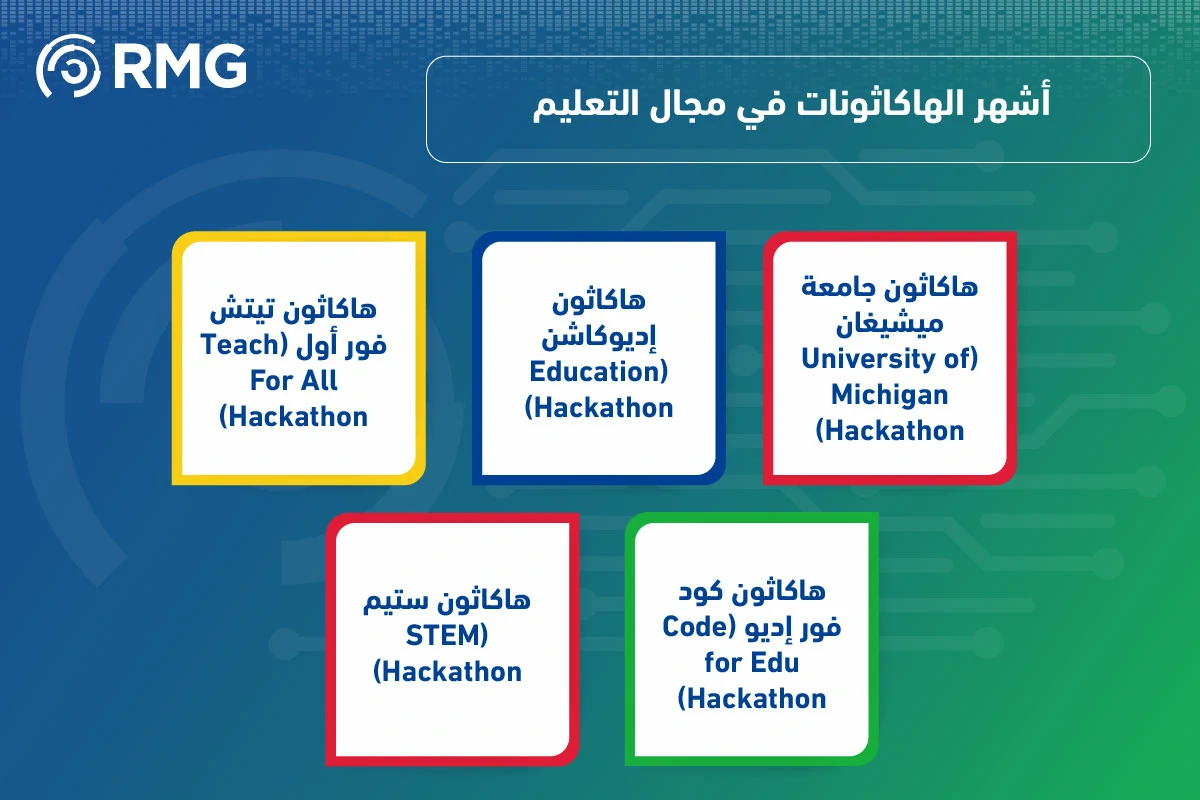
STEM Hackathon
It is organized by educational institutions and technology companies in different cities, and focuses on developing educational solutions in the fields of science, technology, engineering, and mathematics.
Teach For All Hackathon
Organized in multiple locations around the world, Teach For All aims to develop innovative educational solutions to support education in remote and underserved areas.
Education Hackathon
Organized by a group of educational institutions in different cities, it focuses on developing educational applications and interactive tools to improve the learning experience.
Code for Edu Hackathon
Organized by a group of developers and educators in different cities, it focuses on developing educational platforms based on programming and technology.
University of Michigan Hackathon
Organized since 2013 in Ann Arbor, Michigan, this hackathon brings students together to work on innovative projects in a collaborative environment. The event aims to encourage students to innovate and be creative by providing a platform to exchange ideas and develop new technology solutions.
Examples of successful projects from previous hackathons
Here are some examples of successful projects that have emerged from previous hackathons and become widely used business solutions or products, highlighting the value of hackathons as a platform for innovation:
1. GroupMe App
Hackathon: TechCrunch Disrupt Hackathon
Description: GroupMe started as a group networking idea at the TechCrunch Hackathon in 2010, allowing users to create simple, structured chat groups for quick communication between friends or teams.
Commercial success: After its initial success, “GroupMe” was sold to Skype for about $85 million. The app is still widely used as an effective means of communication, confirming the impact of hackathons in creating successful business ideas.
2. "Easy Taxi" App
Hackathon: Startup Weekend in Brazil
Description: Developed during the 2011 Startup Weekend hackathon in São Paulo, Easy Taxi is an app that helps users book taxis quickly and easily, especially in high-traffic cities.
Commercial Success: The app has expanded to more than 30 countries and 420 cities around the world, and has become a major application in mobility solutions before later being integrated with other platforms.
3. The "Slack" app
Hackathon: Originated as a side project during an internal hackathon at Tiny Speck
Description: “Slack” is a communication platform for businesses, where teams can exchange messages and manage projects through dedicated channels. It started as an in-house tool during a team management hackathon within social game developer Tiny Speck.
Commercial success: Since its launch in 2013, Slack has become one of the most popular corporate communication tools, and was acquired by Salesforce in 2021 for $27.7 billion, making it an example of spontaneous innovations that can turn into global products.
4. "Augmedix" system
Hackathon: Google Glass Hackathon
Description: Developed as a solution based on Google Glass, Augmedix aims to help physicians record and follow up medical records hands-free, allowing physicians to focus on patients.
Commercial Success: The system has been adopted in many hospitals in the United States, and has become an effective tool in improving clinical work efficiency by providing augmented reality technology solutions for healthcare documentation.
5. "Carousell" App
Hackathon: Startup Weekend in Singapore
Description: Developed as an e-commerce platform at the Startup Weekend in 2012, Carousell allows users to buy and sell used products through a simple and user-friendly interface.
Commercial success: The app has expanded into several countries in Asia and has become one of the most prominent platforms for buying and selling used products. The company has received significant investments, which has cemented its position as a successful e-commerce startup.
6. "Medable" Project
Hackathon: Health 2.0 Hackathon
Description: Designed as a platform to enable digital clinical research, Medable uses artificial intelligence and medical data to accelerate scientific research.
Commercial success: The platform has expanded to become one of the leading research tools in clinical research, especially during the COVID-19 pandemic, as it has helped accelerate data collection and analysis.
7. Zapier App
Hackathon: Startup Weekend in Columbia, Missouri
Description: Zapier helps users automate online tasks by connecting different apps (such as Gmail, Slack, and Google Sheets) and performing automated actions.
Commercial success: The app has attracted millions of users around the world, making it one of the most popular tools for automating digital tasks, and reflects the value of innovation during hackathons.
STEM Hackathon
It is organized by educational institutions and technology companies in different cities, and focuses on developing educational solutions in the fields of science, technology, engineering, and mathematics.
Teach For All Hackathon
Organized in multiple locations around the world, Teach For All aims to develop innovative educational solutions to support education in remote and underserved areas.
Education Hackathon
Organized by a group of educational institutions in different cities, it focuses on developing educational applications and interactive tools to improve the learning experience.
Code for Edu Hackathon
Organized by a group of developers and educators in different cities, it focuses on developing educational platforms based on programming and technology.
University of Michigan Hackathon
Organized since 2013 in Ann Arbor, Michigan, this hackathon brings students together to work on innovative projects in a collaborative environment. The event aims to encourage students to innovate and be creative by providing a platform to exchange ideas and develop new technology solutions.
How do these examples highlight the value of hackathons?
- Turn ideas into tangible products: Hackathons enable teams to test and develop their ideas in a creative environment, allowing them to turn innovations into actionable products.
- Networking with investors and supporters: Hackathons provide opportunities to network with investors, enabling teams to attract investments and turn their projects into business solutions.
- Solutions with a Wide Impact: Hackathons often result in solutions that address real and tangible problems, as illustrated by examples that started as hackathon projects and ended up as business solutions with global impact.
These examples highlight the role of hackathons as a fertile environment for innovation, where small ideas can be transformed into big projects that make a real difference in the market

The Role of Technology in Hackathons
Technology has become a key factor in the success of virtual or hybrid hackathons, as technological tools and platforms provide an inclusive environment that enables participants to collaborate and exchange ideas regardless of their geographical location. With collaboration platforms like Slack, Zoom, and Microsoft Teams, it’s easy for teams to communicate and coordinate efforts in real-time. These tools help organize meetings, exchange documents, and provide feedback, enhancing team engagement and facilitating orderly workflows.
In addition, project management platforms such as Trello and Jira effectively divide and distribute tasks among team members, allowing progress to be tracked clearly. Code development platforms and software projects, such as GitHub and GitLab, help develop software projects and format code, allowing teams to work on a joint project simultaneously without complications.
These tools also allow for the hosting of hybrid hackathons, where participants can attend physically or remotely, opening up more diversity of experiences and facilitating the participation of experts from different countries, enhancing the quality of ideas presented. Thanks to technology, hackathons have become more inclusive and flexible, as participants can focus on innovation and problem-solving instead of worrying about logistical barriers.
Cross-sectoral collaboration
Collaboration between different sectors, such as universities and tech companies, is a crucial element in creating a more diverse and inclusive hackathon environment. This collaboration enhances the ability of hackathons to generate more integrated innovative solutions. Here are some ways collaboration between different sectors can improve hackathons:
1. Integrate academic and applied knowledge
The Role of Universities: Universities offer an academic environment rich in basic research and deep scientific knowledge. University students and their professors contribute to hackathons by presenting theoretical and innovative ideas, as well as their expertise in research and development.
The Role of Tech Companies: Tech companies provide advanced technological tools, such as software, hardware, and practical practices that can be implemented directly. These companies contribute to the provision of technical resources and equipment that help teams turn ideas into commercially viable solutions.
Integration: Collaboration between these parties helps to transform academic research into practical applications that solve real-world problems. Universities can provide a deep theoretical understanding of problems, while companies provide practical technical solutions.
2. Support interdisciplinary innovation
Employing multiple expertise: By bringing together teams from different academic backgrounds (e.g., engineering, social sciences, and design) with experts from tech companies, a hackathon can tackle problems from multiple angles. This fosters innovation as challenges are viewed from different perspectives, leading to more holistic solutions.
Encouraging intersectoral partnerships: This collaboration creates a flexible environment that allows participants from different fields (technology, education, healthcare, design, economics) to work together in problem solving. New ideas are fostered when knowledge and experience from diverse sectors intersect.
3. Provide integrated resources and care
Universities: Universities provide spaces for teamwork, research labs, and access to specialized professors who can provide scientific guidance and mentorship to participants. Students can benefit from academic and research training that gives them more depth in understanding hackathon issues.
Tech companies: Tech companies provide software development tools, cloud platforms, and sometimes financial support. Some companies also provide training programs and workshops for participants to provide them with the technical knowledge needed to develop their projects.
4. Expand the network of participants and experiences
Diverse team participation: Collaboration between universities and tech companies enhances the diversity of hackathon participants. Students from various academic fields, such as engineering, medicine, economics, and social sciences, can work alongside professionals from tech companies. This diversity contributes to the creation of a fertile environment for creativity and increases opportunities for innovation.
Training opportunities and networks: Collaboration between the academic and business sectors provides tremendous opportunities to expand the professional networks of participants. Students can benefit from collaborating with large companies for internship or job opportunities after the hackathon ends.
5. Create innovative and diverse solutions
Integrative solutions: By integrating different disciplines, such as technology, health, and education, integrative solutions focused on greater impact can be delivered. For example, in a hackathon focused on improving healthcare, teams can integrate big data and artificial intelligence with medical understanding to achieve innovative solutions in diagnosis and treatment.
Design for All: Collaboration between universities and tech companies allows for a focus on developing comprehensive solutions that suit the needs of all groups, such as people with disabilities or underserved communities.
6. Achieving the sustainability of innovative solutions
Universities and companies together: Universities contribute to the provision of ongoing research that can support the sustainability of innovations developed in the hackathon. Universities, in collaboration with companies, can follow the evolution of these solutions until they are ready for commercialization or wider application.
Technology transfer: A partnership between universities and tech companies can accelerate the transfer of technology from academic research to actual commercial applications, ensuring that innovative solutions can achieve sustainability in the market.
Examples of cross-sector collaboration
Collaboration between different sectors, such as universities and tech companies, is a crucial element in creating a more diverse and inclusive hackathon environment. This collaboration enhances the ability of hackathons to generate more integrated innovative solutions. Here are some ways collaboration between different sectors can improve hackathons:
HackMIT
It is a hackathon organized by MIT students, and many major tech companies such as Google, Facebook, and Microsoft participate. This collaboration gives students the opportunity to work on the latest technologies and enhances their hands-on experience in dealing with real challenges, contributing to the development of innovative solutions that are commercially viable.
Health 2.0 Hackathons
These hackathons bring together academic institutions and major health companies to develop innovative solutions using technology to improve healthcare. This collaboration includes the development of technological platforms to improve disease diagnosis or accelerate drug research.
Why Choose Renad al-majd?
With our deep expertise in technical consulting and innovation management, we help you design and implement hackathons that contribute to achieving your corporate goals and supporting your strategic vision.
Extensive Experience
We have deep experience in technical consulting and innovation management, ensuring you with innovative and effective solutions.
Supporting Vision 2030
We contribute to achieving your corporate goals and supporting Saudi Arabia's Vision 2030 for digital transformation.
Custom Design
We offer customized solutions that match your unique needs and help you achieve your goals efficiently.
Dedicated Team
Our team includes experts and specialists in the fields of technology and innovation, ensuring you the best results.
Tangible results
We focus on delivering tangible and measurable results, enhancing the value of your investment in innovation.
Strategic Partnerships
We work with a wide range of strategic partners to ensure that we deliver the best solutions and services.
Ongoing support
We provide ongoing support to ensure the long-term success of your technology and innovation initiatives.
Call now for a consultation and find out how we can help you achieve your goals.
Choose Renad Al-Majd for an exceptional experience in designing and implementing hackathons that contribute to achieving your corporate goals and supporting digital transformation.