


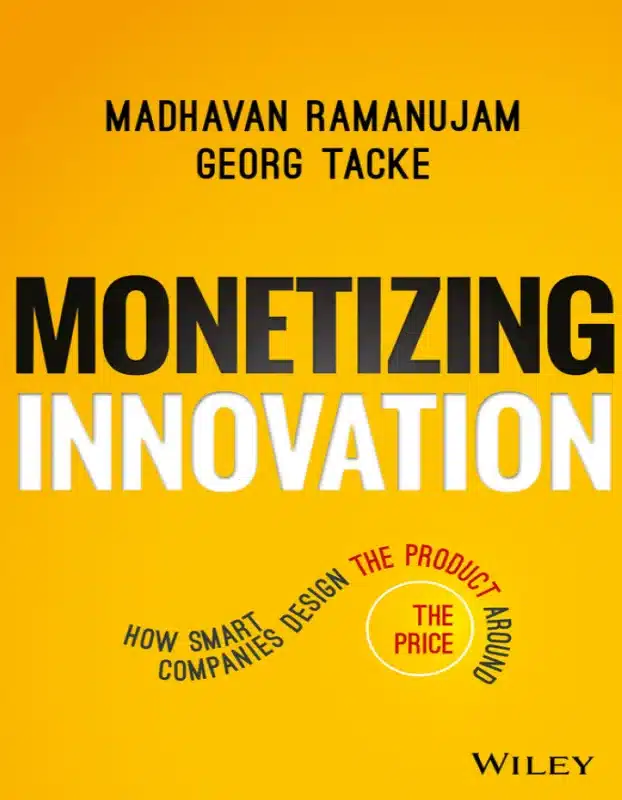
- Author: Madhavan Ramanujam , Georg Tacke
- Publication date : May 2, 2016
- Page Number : 256 pages
Monetizing Innovation: How Smart Companies Design the Product around the Price
Product innovation remains one of the most significant challenges in business, with an alarmingly high failure rate. In “Monetizing Innovation: How Smart Companies Design the Product around the Price,” the authors present a transformative yet practical framework designed to reverse this trend. The book argues that the prevailing “build it and they will come” approach is fundamentally flawed. Instead, it offers a robust methodology centered on a counterintuitive principle: successful innovation begins not with the product, but with a deep understanding of the customer’s willingness to pay.
Table of Contents
Part One: The Monetizing Innovation Problem
Chapter 1: How Innovators Leave Billions on the Table
Chapter 2: Feature Shocks, Minivations, Hidden Gems, and Undeads
Chapter 3: Why Good People Get It Wrong
Part Two: Nine Surprising Rules for Successful Monetization
Part Three: Success Stories and Implementation
Chapter 14: A Roadmap for Implementation
Chapter 13: Learning from the Best
Book Summary
Part One: The Monetizing Innovation Problem
The initial section of the book diagnoses the root causes of product failure, establishing the critical problem that the subsequent chapters aim to solve.
Chapter 1: How Innovators Leave Billions on the Table
The book opens by contrasting two automotive launches: the Porsche Cayenne, a success story built on designing a product to meet pre-identified customer value and price points, and the Dodge Dart, a failure engineered in isolation from market realities. The authors establish a stark statistic—that 72% of new products fail—and pinpoint the primary cause: the failure to integrate pricing and willingness-to-pay considerations into the product design process from the very beginning.
Chapter 2: Feature Shocks, Minivations, Hidden Gems, and Undeads
The authors provide a clear taxonomy, categorizing all innovation failures into four distinct types. This framework helps leaders diagnose their own product development shortcomings:
- Feature Shocks: Over-engineered products loaded with features customers do not value, leading to high costs and a confusing value proposition (e.g., the Amazon Fire Phone).
- Minivations: Good products that are significantly underpriced, leaving substantial profit unrealized.
- Hidden Gems: Potentially transformative products that are never properly commercialized, often due to internal politics or a threat to existing revenue streams (e.g., Kodak’s digital camera).
- Undeads: Products nobody wants but are launched anyway due to a top-down culture that stifles honest feedback (e.g., the Segway).
Chapter 3: Why Good People Get It Wrong
This chapter dissects the flawed mindsets and common myths that perpetuate these failures. The authors challenge deeply ingrained assumptions, such as the belief that a great product automatically commands a fair price or that innovation must occur in isolation from commercial concerns. They advocate for a new paradigm where customer willingness to pay is not an afterthought, but the foundational starting point.
Part Two: Nine Surprising Rules for Successful Monetization
This core section presents the book’s actionable methodology, detailing nine specific rules for designing the product around the price.
- Rule 1: Have the “Willingness-to-Pay” Talk Early: This is the cornerstone of the entire framework. The book insists that innovators must engage with potential customers at the outset to understand what they value and are willing to pay. This conversation provides the essential data needed to validate market potential and prioritize features.
- Rule 2: Don’t Default to a One-Size-Fits-All Solution: The authors argue for a more sophisticated approach to customer segmentation, moving beyond simple demographics. Instead, they guide readers to segment customers based on their needs and willingness to pay, enabling the creation of tailored offerings that resonate with distinct market groups.
- Rule 3: Master Configuration and Bundling: This chapter provides a scientific approach to product design. It introduces the concept of “leader, filler, and killer” features to guide product configuration and advocates for a “Good, Better, Best” tiered offering to maximize customer appeal and profitability.
- Rule 4: Go Beyond the Price Point: The book emphasizes that how you charge is often more critical than what you charge. It provides a practical overview of five powerful monetization models: Subscription, Dynamic Pricing, Market-Based Pricing (Auctions), Alternative Metric Pricing, and Freemium.
- Rule 5: Develop a Pricing Strategy Document: To ensure consistency and strategic alignment, the author recommends creating a formal pricing strategy document. This “living document” should set clear goals (e.g., profit maximization vs. market penetration) and establish principles for competitive reactions, guided by an understanding of the product’s price elasticity.
- Rule 6: Build a Robust, “Outside-In” Business Case: The book calls for a shift from traditional, internal-facing business cases to a model built on real customer willingness-to-pay data. This approach allows for realistic forecasting and scenario planning, transforming speculative hope into data-driven knowledge.
- Rule 7: Communicate Value Effectively: A successful launch requires more than a great product and price; it demands effective value communication. The author introduces the “Matrix of Competitive Advantages” (MOCA) as a tool to help marketing and sales teams craft compelling messages focused on customer benefits, not just product features.
- Rule 8: Use Behavioral Pricing Tactics: Recognizing that purchasing decisions are not always rational, this chapter explores the psychology of pricing. It details six key behavioral pricing tactics, such as the “compromise effect” and “anchoring,” that can be used to persuade customers and drive sales.
- Rule 9: Maintain Your Price Integrity: The final rule addresses the common temptation to cut prices in response to disappointing sales. The book argues that this is almost always a mistake that erodes brand value. Instead, leaders are advised to diagnose the root cause of the problem and explore non-price actions first.
Part Three: Success Stories and Implementation
The final section of the book provides detailed case studies and a practical guide to implementing the methodology.
Chapter 13: Learning from the Best
This chapter presents seven in-depth case studies of companies—including Porsche, LinkedIn, Uber, and Swarovski—that have successfully monetized innovation by designing their products around the price. These real-world examples serve to illustrate the nine rules in action across a variety of industries and business models.
Chapter 14: A Roadmap for Implementation
The book concludes with a practical, two-phase implementation plan:
- Jump-Start and Pilot: Begin by diagnosing current processes and then select a pilot project to apply the nine rules.
- Scale and Stick: After a successful pilot, institutionalize the new process across the organization by creating dedicated monetization teams and establishing clear governance.
The authors also identify nine common implementation pitfalls and provide actionable advice for avoiding them, emphasizing that this shift requires a cultural transformation driven by strong leadership.
Overall Impact and Significance
The primary contribution of “Monetizing Innovation” is its clear, systematic, and data-driven approach to an often chaotic process. The book effectively dismantles the myths surrounding product development and replaces them with a practical, customer-centric methodology. Its focus on front-loading the most critical commercial questions—what customers value and what they will pay—provides a powerful antidote to the over-engineering and market misalignment that cause most new products to fail.
Conclusion and Recommendation
“Monetizing Innovation” is an essential read for product managers, innovators, marketers, and business leaders who are serious about improving their organization’s innovation success rate. By providing a clear, step-by-step framework supported by compelling case studies, the book offers a definitive guide to designing products that customers will not only want but will also willingly pay for. It is highly recommended for any professional committed to transforming their innovation process from a game of chance into a reliable engine for profitable growth.
About the Authors
Madhavan Ramanujam
Partner and board member at Simon-Kucher & Partners, based in Silicon Valley. Widely regarded as a global authority on monetization strategy, Ramanujam has led over 125 projects focused on pricing and product innovation across startups and Fortune 500 companies. His work bridges the gap between technical product development and market-driven pricing, helping companies avoid costly misfires by aligning product features with customer willingness to pay. He holds degrees in engineering from IIT Chennai and in business from Stanford University, where he developed a hybrid approach to value-based pricing. Ramanujam is a sought-after speaker at global conferences, guest lecturer in executive education programs, and co-author of Monetizing Innovation, a seminal book that reframes how companies should think about pricing from the earliest stages of product design.
Georg Tacke
Former CEO and now Senior Advisor at Simon-Kucher & Partners, Tacke brings over 30 years of strategic consulting experience across industries including automotive, financial services, and healthcare. He holds a Master’s and Ph.D. in Business Administration from the University of Bielefeld, and conducted research at Stanford Graduate School of Business, where he deepened his expertise in behavioral pricing and market segmentation. Tacke is internationally recognized for developing structured pricing frameworks that help companies capture value and drive profitability. His advisory work has shaped pricing strategies for multinational corporations, and his thought leadership continues to influence academic and professional discourse. As co-author of Monetizing Innovation, he advocates for integrating pricing into the innovation process—not as an afterthought, but as a core design principle.