


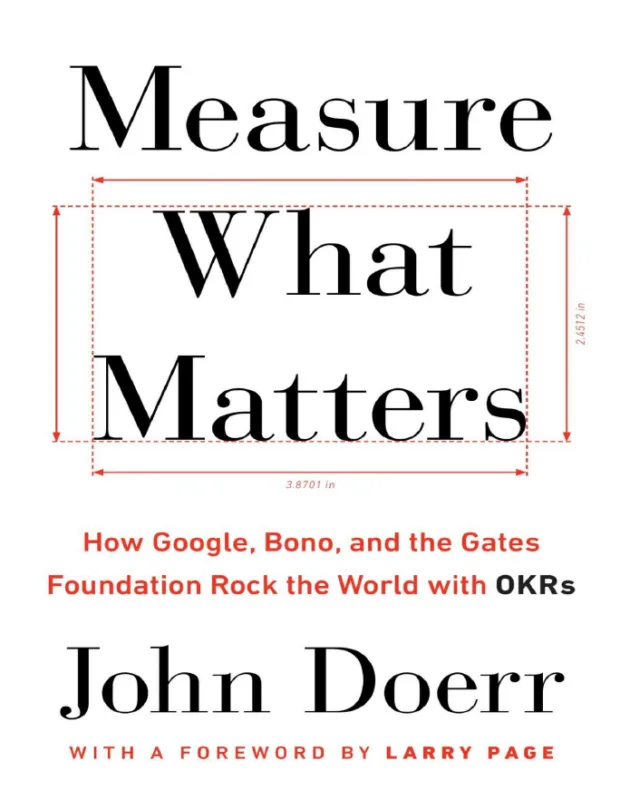
Measure What Matters
Effective execution is a defining challenge for organizations striving for exceptional results. In “Measure What Matters,” John Doerr presents a compelling, practical framework for achieving ambitious goals through the disciplined use of Objectives and Key Results (OKRs). Drawing from his experience implementing this system at Intel and later introducing it to Google, Doerr provides a definitive guide for leaders and teams to enhance focus, alignment, and performance. The book serves as a vital playbook, demonstrating through real-world case studies how this methodology can transform organizations across a multitude of sectors.
Table of Contents
Part One: OKRs in Action
Part Two: The New World of Work
Book Summary
Part One: OKRs in Action
The initial section of the book introduces the core concepts of the OKR framework and illustrates its power through foundational stories and case studies.
Chapter 1: Google, Meet OKRs
The narrative begins with Doerr introducing the OKR methodology to a young Google in 1999. The author defines the system’s two essential components:
- Objectives (O): The WHAT. An Objective is a significant, concrete, action-oriented, and inspirational goal.
- Key Results (KR): The HOW. A Key Result is a specific, time-bound, and measurable metric that verifies the achievement of the Objective.
Doerr establishes his core mantra, “Ideas are easy. Execution is everything,” positioning OKRs as the definitive tool for bridging the gap between vision and results.
Chapter 2: The Father of OKRs
This chapter delves into the origins of OKRs, crediting their invention to the legendary Intel CEO, Andy Grove. The book explains that Grove adapted Peter Drucker’s “Management by Objectives” (MBOs) to create a more agile and transparent system. Grove’s key innovations were to make goals quarterly, visible to the entire company, and, crucially, to decouple them from compensation. This last point is presented as a critical factor in encouraging ambitious, risk-tolerant goal setting.
Chapter 3: Operation Crush: An Intel Story
The book presents its first major case study: Intel’s “Operation Crush” campaign in 1979. Faced with a competitive threat from Motorola, Intel used OKRs to rally the entire company around the single, critical goal of securing 2,000 design wins for its 8086 microprocessor. This story serves as a practical demonstration of the “four OKR superpowers” that form the book’s central framework.
Chapter 4: Superpower #1: Focus and Commit to Priorities
Doerr outlines the first major benefit of OKRs: their ability to instill focus. The system compels leaders to make deliberate choices about what truly matters, typically limiting an organization to 3-5 high-impact objectives per cycle. This requires public commitment from leadership, creating clarity and eliminating ambiguity. The author also introduces the practical concept of pairing Key Results (e.g., pairing a quantity goal with a quality goal) to ensure balanced and sustainable outcomes.
Chapter 5 & 6: Focus and Commit in Practice
The book illustrates the principles of focus and commitment through two case studies. Remind, an education technology company, used OKRs to narrow its priorities and concentrate resources on critical user engagement metrics, making tough but necessary trade-offs. Nuna, a healthcare data analytics company, demonstrates that OKRs only succeed when leadership publicly commits to the process, modeling the accountability they expect from their teams.
Chapter 7: Superpower #2: Align and Connect for Teamwork
The second superpower is the capacity of OKRs to create alignment. The book explains that because OKRs are transparent, they break down organizational silos and foster collaboration. Unlike rigid, top-down MBOs, a healthy OKR system balances strategic goals set by leadership with bottom-up objectives from frontline employees. This networked approach makes interdependencies visible and encourages horizontal connections between teams.
Chapter 8 & 9: Align and Connect in Practice
The book provides two examples of this superpower in action. The health app MyFitnessPal used OKRs to resolve bottlenecks and align its rapidly growing teams around a coherent roadmap. Intuit implemented OKRs to connect its global IT department, creating a shared language that transformed the organization from a “hero culture to a team culture.”
Chapter 10: Superpower #3: Track for Accountability
The third superpower is the discipline of tracking. The author emphasizes that OKRs are living documents that require regular monitoring and scoring. The book details Google’s simple 0.0 to 1.0 scoring system, where a score of 0.7 on an ambitious goal is considered a success. This data-driven tracking creates accountability without a culture of fear; an “at-risk” OKR becomes a trigger for problem-solving, not punishment.
Chapter 11: Tracking in Practice
The Bill & Melinda Gates Foundation serves as the primary case study for tracking. The book shows how Bill Gates uses OKRs to apply rigorous, data-driven accountability to long-term, audacious goals like eradicating malaria. By tracking measurable Key Results, the foundation can effectively assess the performance of its strategies and reallocate capital to the most impactful initiatives.
Chapter 12: Superpower #4: Stretch for Amazing
The final superpower is the ability of OKRs to help organizations stretch beyond their perceived limits. Doerr distinguishes between two types of goals:
- Committed OKRs: Goals that must be achieved and are expected to be scored at 1.0.
- Aspirational (or “Stretch”) OKRs: “Big Hairy Audacious Goals” (BHAGs) that push teams to rethink what is possible, with an expected score of around 0.7.
This concept, exemplified by Google’s “10x thinking,” is presented as a key driver of breakthrough innovation.
Chapter 13 & 14: Stretching in Practice
Two compelling Google case studies illustrate this principle. The development of Google Chrome was driven by a series of stretch OKRs for user adoption that, while initially missed, forced the team to innovate relentlessly. Similarly, YouTube’s audacious goal of reaching one billion hours of daily watch time drove massive improvements in its recommendation algorithms and infrastructure, ultimately leading to the goal’s achievement ahead of schedule.
Part Two: The New World of Work
This section expands the framework to address the human side of performance, arguing that OKRs are most effective when paired with a modern approach to culture and performance management.
Chapter 15: Continuous Performance Management: OKRs and CFRs
Doerr argues that traditional annual performance reviews are obsolete. He introduces a complementary system called CFRs:
- Conversations: Frequent, authentic check-ins between managers and employees.
- Feedback: Real-time, multidirectional peer feedback.
- Recognition: Ongoing appreciation for contributions.
The book strongly advocates for decoupling OKR scores from compensation to encourage the risk-taking essential for stretch goals. OKRs should inform performance discussions, not dictate bonuses.
Chapter 16 & 17: CFRs in Practice
Adobe provides a powerful case study for replacing annual reviews with a system of continuous “Check-ins,” resulting in a sharp drop in voluntary attrition. The robotics-powered startup Zume Pizza illustrates how OKRs and CFRs can be embedded into a company’s DNA from day one to foster discipline, transparency, and deep employee engagement.
Chapter 18: The Link Between Goals and Culture
This chapter explores the symbiotic relationship between goal setting and workplace culture. The author posits that a healthy culture, defined by psychological safety and clarity, is reinforced by the transparency and accountability of OKRs. CFRs, in turn, nourish this culture by fostering human connection. The book concludes that organizations that “out-behave” their competition will ultimately outperform them.
Chapter 19 & 20: Culture Change in Practice
Two final case studies demonstrate how OKRs can drive cultural transformation. The health-tech company Lumeris shows that a dysfunctional culture must be fixed before OKRs can succeed. Conversely, Bono’s ONE Campaign illustrates how implementing OKRs can force a necessary cultural pivot, in their case shifting the organization from a model of “working for Africa” to one of “working with Africa.”
Chapter 21: The Goals to Come
Doerr concludes by reaffirming his belief in the transformative potential of OKRs and CFRs. He presents the system not as a rigid dogma but as an adaptable framework for driving execution and innovation in any sector. His ultimate vision is to empower teams everywhere to achieve the impossible, a mission inspired by his mentors, Andy Grove and Bill Campbell.
Overall Impact and Significance
The primary contribution of “Measure What Matters” is its clear, actionable, and proven methodology for organizational goal setting and execution. The book effectively demystifies a system used by some of the world’s most successful companies, making it accessible to a broad audience. Its emphasis on transparency, alignment, and stretching for amazing results provides a powerful antidote to the ambiguity and inertia that plague many organizations.
Conclusion and Recommendation
“Measure What Matters” is an essential read for leaders, managers, and teams seeking to improve their effectiveness. By providing not only the “what” and “why” of OKRs but also the practical “how” through detailed case studies, the book serves as a comprehensive and compelling guide. It offers a clear path for any organization to enhance its focus, foster a culture of accountability, and ultimately achieve results that once seemed out of reach. It is highly recommended for any professional committed to turning ambitious ideas into reality.
About the Author
John Doerr is an acclaimed American engineer, venture capitalist, and author, best known for his role in shaping Silicon Valley’s innovation landscape. He is the Chairman of Kleiner Perkins, a leading venture capital firm, where he has backed transformative companies including Google, Amazon, Intuit, and Sun Microsystems.
Doerr holds degrees in Electrical Engineering (B.S. and M.E.) from Rice University and an MBA from Harvard Business School. He began his career at Intel, where he contributed to the development of microprocessors and holds several patents in memory technology.
He is the author of two influential books:
- Measure What Matters – a guide to OKRs (Objectives and Key Results), featuring case studies from Google, Bono’s ONE campaign, and others
- Speed & Scale – an action plan for solving the climate crisis through innovation and policy
Beyond investing, Doerr is deeply involved in climate advocacy, education reform, and global health initiatives. In 2022, he and his wife Ann partnered with Stanford University to launch the Stanford Doerr School of Sustainability, the university’s first new school in 70 years2.