


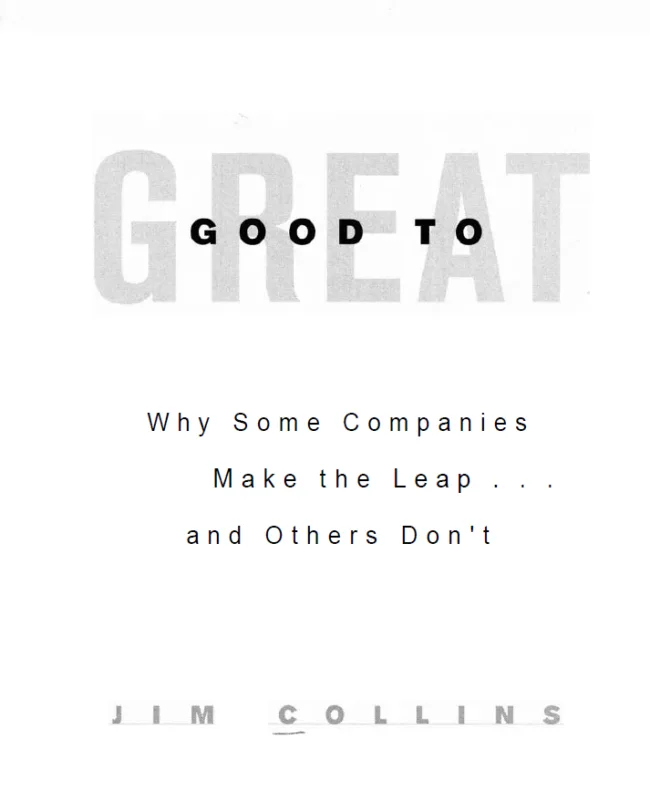
- Author: Jim Collins
- Publication date :October 16, 2001
- Page Number : 300 pages
Good to Great: Why Some Companies Make the Leap... and Others Don't
The transition from being a merely good company to a truly great one is a rare and challenging feat, and one that is often misunderstood. In his seminal work, “Good to Great,” Jim Collins presents a rigorously researched, data-driven framework that identifies the fundamental principles distinguishing companies that achieve enduring greatness from those that do not.
The book is not based on theory, but on a five-year study that systematically analyzed the common characteristics of eleven elite companies that made a quantifiable leap to exceptional, sustained performance. This summary will sequentially explore the core concepts and actionable frameworks presented in each chapter, providing a clear roadmap for leaders aiming to catalyze a similar transformation.
Table of Contents
Chapter 1: Good Is the Enemy of Great
Chapter 2: Level 5 Leadership
Chapter 3: First Who… Then What
Chapter 4: Confront the Brutal Facts (Yet Never Lose Faith)
Chapter 5: The Hedgehog Concept (Simplicity within the Three Circles)
Chapter 6: A Culture of Discipline
Chapter 7: Technology Accelerators
Chapter 8: The Flywheel and the Doom Loop
Chapter 9: From Good to Great to Built to Last
Book Summary
Chapter 1: Good Is the Enemy of Great
The book begins by establishing its central premise: the primary obstacle to achieving greatness is the comfort of being good. Collins argues that most companies fail to make the leap because they lack the ambition and discipline to move beyond satisfactory performance. This chapter outlines the rigorous methodology of the research project, which identified eleven publicly traded companies that transitioned from long-term average or below-average stock performance to sustained greatness, outperforming the general market by a significant margin for at least fifteen years. These “good-to-great” companies were then compared against carefully selected “direct comparison” and “unsustained comparison” companies to isolate the causal factors of their success.
Chapter 2: Level 5 Leadership
The first key differentiator identified by the research is the nature of the leadership that drives the transformation. The book introduces the concept of Level 5 Leadership, a paradoxical blend of profound personal humility and intense professional will.
- Personal Humility: Level 5 leaders are self-effacing, credit others for successes (looking “out the window”), and are driven by a cause larger than themselves.
- Professional Will: They possess an unwavering, stoic resolve to produce the best long-term results, taking full responsibility for poor outcomes (looking “in the mirror”).
This model stands in stark contrast to the high-profile, celebrity CEO archetype often found in the comparison companies, whose ego-driven leadership frequently failed to produce sustainable results.
Chapter 3: First Who… Then What
Contrary to conventional wisdom, the book asserts that good-to-great leaders do not begin with a vision or strategy. Instead, they adhere to the principle of “First Who… Then What.” Their initial focus is on assembling the right team: getting the right people on the bus, getting the wrong people off the bus, and putting the right people in the right seats. The rationale presented is that with the right people, the challenges of motivation and management are minimized, and the organization is better equipped to adapt to unforeseen changes. This people-first approach requires rigorous, not ruthless, decision-making based on character and values over specific skills.
Chapter 4: Confront the Brutal Facts (Yet Never Lose Faith)
This chapter introduces the Stockdale Paradox, named after Admiral Jim Stockdale, who survived years as a prisoner of war. The paradox embodies the psychological duality required for greatness: the ability to maintain unwavering faith in a positive long-term outcome while simultaneously confronting the most brutal, unvarnished facts of the current reality. The book outlines four practical disciplines for creating a climate where truth is heard: (1) lead with questions, not answers; (2) engage in dialogue and debate, not coercion; (3) conduct blameless autopsies; and (4) build “red flag” mechanisms to ensure critical information cannot be ignored.
Chapter 5: The Hedgehog Concept (Simplicity within the Three Circles)
The author uses the parable of the hedgehog and the fox to illustrate a core strategic difference. While the fox knows many things, the hedgehog knows one big thing. Good-to-great companies operate as hedgehogs, developing a simple, profound understanding of their strategic advantage. This Hedgehog Concept is not a goal or strategy but a deep insight derived from the intersection of three circles:
- What you can be the best in the world at.
- What drives your economic engine (understanding a key economic denominator).
- What you are deeply passionate about.
This concept serves as a clarifying lens that guides all subsequent strategic decisions.
Chapter 6: A Culture of Discipline
Greatness, the book argues, is not the result of a single disciplinarian leader but of a pervasive culture of discipline. This culture is built upon a foundation of self-disciplined people who engage in disciplined thought and take disciplined action, all fanatically consistent with the Hedgehog Concept. This approach creates an environment of “freedom and responsibility, within a framework,” where hierarchy, bureaucracy, and excessive controls become unnecessary. A key practical tool introduced is the “stop doing” list, which helps organizations systematically cease activities that fall outside their three circles.
Chapter 7: Technology Accelerators
The research revealed a counterintuitive approach to technology. Good-to-great companies do not use technology as the primary driver of their transformation. Instead, they view technology as an accelerator of momentum, not a creator of it. They avoided technology fads and made deliberate, pioneering investments in technologies that directly supported their established Hedgehog Concept. In contrast, the comparison companies often adopted technology reactively, out of fear, which only hastened their decline.
Chapter 8: The Flywheel and the Doom Loop
This chapter describes the process of transformation itself.
- The Flywheel: The transition from good to great is not a singular, revolutionary event but a cumulative process. It is analogous to pushing a giant, heavy flywheel—each consistent, disciplined push builds momentum, turn after turn, until a breakthrough point is reached.
- The Doom Loop: The comparison companies, lacking the patience for the flywheel effect, consistently fell into a “doom loop.” They would launch dramatic but ultimately misguided programs, make ill-advised acquisitions, or seek silver-bullet solutions, only to see them fail. This would lead to another reactive lurch in a new direction, creating a downward spiral of declining results and morale.
Chapter 9: From Good to Great to Built to Last
In the final chapter, Collins connects the findings of “Good to Great” with his earlier work, “Built to Last.” He positions “Good to Great” as a prequel, providing the framework for achieving sustained great results. To become an enduring, iconic company, one must then apply the principles of “Built to Last,” which focus on preserving a core ideology (core values and purpose) while relentlessly stimulating progress. The Hedgehog Concept from “Good to Great” provides the deep understanding necessary to set a truly effective “Big Hairy Audacious Goal” (BHAG) as described in “Built to Last.”
Overall Impact and Significance
“Good to Great” offers a seminal contribution to the field of management by providing a data-driven, empirical framework for organizational transformation. It moves beyond anecdotal success stories to offer a set of timeless, actionable principles. The book’s primary value lies in its structured, sequential model, which demystifies the process of achieving sustained excellence. Its concepts, such as Level 5 Leadership and the Hedgehog Concept, have become foundational elements of modern strategic thinking.
Conclusion and Recommendation
This book is an essential resource for any leader, executive, or manager seeking to elevate their organization’s performance from mediocrity to sustained greatness. By grounding its analysis in rigorous research and providing clear, practical frameworks, “Good to Great” equips the reader with the necessary tools to confront difficult realities, make disciplined decisions, and build the momentum required for a successful transformation. The authors provide a compelling and evidence-based case that the path to greatness is not a matter of circumstance, but of conscious, disciplined choice.
About the Author
Jim Collins is a renowned author, researcher, and advisor whose work has profoundly shaped modern thinking on business leadership and organizational excellence. With over 25 years of rigorous empirical research, Collins has become a leading voice in understanding what makes companies not just successful—but enduringly great.
He began his academic career at the Stanford Graduate School of Business, where he received the Distinguished Teaching Award in 1992. In 1995, he founded a management laboratory in Boulder, Colorado, dedicated to studying corporate and social sector performance.
Collins is best known for his bestselling books, including:
- Built to Last – exploring the habits of visionary companies
- Good to Great – analyzing why some companies make the leap and others don’t
- How the Mighty Fall – diagnosing the decline of once-great organizations
- Great by Choice – identifying leadership strategies for thriving in uncertainty
- BE 2.0 (Beyond Entrepreneurship 2.0) – a return to his roots in entrepreneurial leadership
His work extends beyond the corporate world, influencing nonprofits, educational institutions, and government agencies, including the United States Military Academy at West Point, where he held the Chair for the Study of Leadership.