















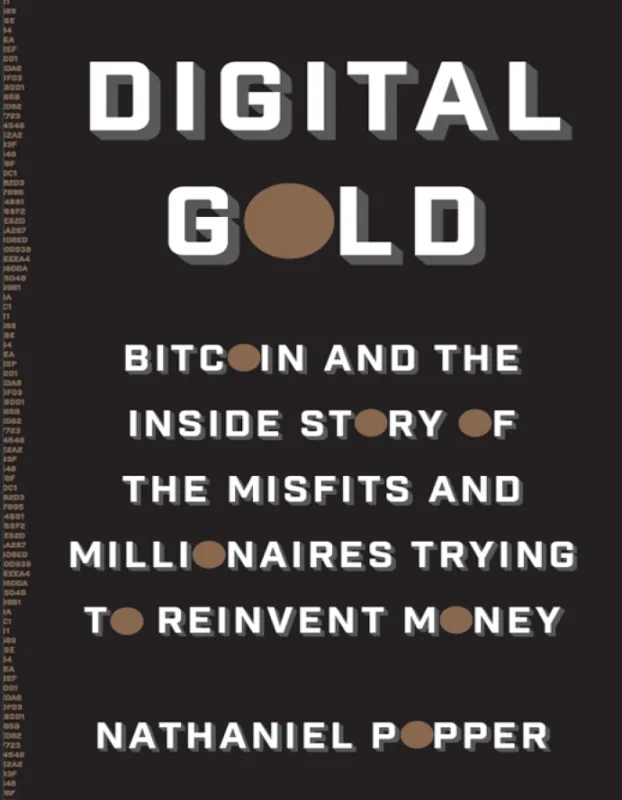
- Author: Nathaniel Popper
- Publication date : May 24, 2016
- Page Number : 432 pages
Digital Gold: Bitcoin and the Inside Story of the Misfits and Millionaires Trying to Reinvent Money
Born from the crucible of the 2008 financial crisis-a moment of profound distrust in traditional banking-a radical and compelling solution emerged in the form of a decentralized, peer-to-peer digital currency. Nathaniel Popper’s “Digital Gold: Bitcoin and the Inside Story of the Misfits and Millionaires Trying to Reinvent Money” serves as the definitive chronicle of this financial and technological revolution. The book provides an indispensable and deeply researched narrative, documenting the turbulent birth of Bitcoin. It moves beyond a simple technical explanation to explore the critical context of why this technology was created, the fundamental economic problems it seeks to solve, and the eclectic cast of characters who championed it.
Table of Contents
- The Ideological Roots and Founding Vision
- The Core Technology: How Bitcoin Works
- Challenges and Crises: The Trial by Fire
- Real-World Application and Maturation
Book Summary
The Ideological Roots and Founding Vision
The author traces Bitcoin’s philosophical origins to the “Cypherpunks,” a movement of programmers and cryptographers active in the 1990s who were fiercely dedicated to using cryptographic tools to protect individual privacy and autonomy from state and corporate overreach.
The book highlights key figures like Hal Finney, who would become one of the first recipients of a Bitcoin transaction, to illustrate the community’s long-held dream of creating a form of digital cash that could operate independently of any central authority.
Popper clarifies that Bitcoin was not an isolated invention but the successful culmination of decades of intellectual effort and failed experiments, citing precursor projects like Adam Back’s “hashcash” and Nick Szabo’s “bit gold.” It was into this fertile intellectual environment that the pseudonymous Satoshi Nakamoto released the seminal nine-page Bitcoin white paper in 2008, presenting an elegant and novel framework that finally solved the long-standing “double-spending” problem and made a secure, decentralized digital currency a reality.
The Core Technology: How Bitcoin Works
“Digital Gold” excels at demystifying the complex, multi-faceted technology that underpins Bitcoin, presenting a clear and accessible model of its core innovations for the non-technical reader:
The Blockchain
The book explains this as a revolutionary public ledger-a globally distributed and immutable database that chronologically records every transaction ever made. Popper emphasizes that its true innovation lies in replacing the need for a trusted third party (like a bank) with cryptographic proof, ensuring that the network’s history cannot be retroactively altered by any single entity.
Peer-to-Peer Network
The author illustrates how Bitcoin’s infrastructure is not housed in a central server but operates on a global network of thousands of computers (nodes). This decentralized architecture makes the system extraordinarily resilient, free from any single point of control or failure, and resistant to censorship.
Mining
The summary details the computational process known as mining, which the book presents as Bitcoin’s ingenious dual-purpose engine. Miners compete to solve complex mathematical problems, and the winner gets to add the next “block” of transactions to the blockchain. The author clarifies that this “proof-of-work” system serves two vital functions: it secures the network by making it computationally expensive to cheat, and it acts as the mechanism for introducing new coins into circulation according to a predictable and finite supply schedule, capping the total at 21 million coins.
Challenges and Crises: The Trial by Fire
The book meticulously documents the series of severe crises that defined Bitcoin’s early years, highlighting the inherent tension between its decentralized ideals and the practical necessity of centralized services. The most significant challenge chronicled is the dramatic rise and ignominious fall of Mt. Gox.
The author explains how the exchange, originally for trading “Magic: The Gathering” cards, was repurposed by Jed McCaleb and later sold to the quirky and disorganized programmer Mark Karpeles. Under Karpeles’s amateur management, Mt. Gox became the dominant global hub for Bitcoin trading but was plagued by technical incompetence, ultimately leading to a catastrophic hack and the loss of hundreds of thousands of bitcoins. Its collapse served as a painful lesson on the profound risks of entrusting a “trustless” currency to fallible human institutions.
Simultaneously, the book confronts the challenge of illicit use through the detailed story of Silk Road. Popper presents this anonymous online marketplace for illegal goods as Bitcoin’s first “killer app”-a platform that, for better or worse, drove significant real-world demand and proved its utility as a censorship-resistant means of payment.
However, the narrative also provides a cautionary tale by following the moral decline of its founder, Ross Ulbricht, from a libertarian idealist into the criminal mastermind “Dread Pirate Roberts,” who allegedly commissioned murders-for-hire to protect his empire. This chapter of Bitcoin’s history attracted intense law enforcement scrutiny and created a significant reputational hurdle for the technology to overcome.
Real-World Application and Maturation
Beyond the crises, “Digital Gold” powerfully highlights Bitcoin’s core value proposition through compelling real-world applications. The author introduces Wences Casares, a respected Argentine tech entrepreneur whose personal experiences with chronic hyperinflation and capital controls in his home country gave him a unique and profound appreciation for Bitcoin as a non-sovereign store of value-a modern form of “digital gold.”
The book uses his influential narrative, along with global events like the 2013 Cyprus banking crisis where citizen savings were confiscated, to illustrate how Bitcoin offers a practical and vital solution for individuals living under unstable economic and political regimes.
This demonstrated utility began to attract a new wave of serious entrepreneurs and investors. The author charts the critical transition from a scattered community of hobbyists to a professionalized industry with the emergence of venture-backed companies. Key among them was Coinbase, founded by Brian Armstrong and Fred Ehrsam, which secured landmark investments from top-tier firms like Andreessen Horowitz.
This shift was further personified by the entry of figures like the Winklevoss twins, who began building regulated financial products, and the formation of Xapo by Wences Casares to provide institutional-grade custody. These developments signaled that Silicon Valley now saw Bitcoin not just as a niche currency but as a foundational protocol for a new “internet of value.”
Overall Impact and Significance
A crucial theme in the book is Bitcoin’s arduous evolution from a fringe obsession into an asset class demanding serious consideration from Wall Street and global regulators. Popper details the sophisticated and proactive lobbying efforts of the Bitcoin Foundation in Washington D.C., which culminated in a surprisingly positive U.S. Senate hearing where officials, including Fed Chairman Ben Bernanke, acknowledged its potential.
This regulatory green light, combined with a tidal wave of speculative demand from China-unleashed when the exchange BTC China integrated with a major payment processor-pushed Bitcoin’s value past $1,000 for the first time in late 2013. The author expertly captures this period of speculative frenzy and the subsequent regulatory crackdown from the Chinese government that tested the market’s resilience.
The narrative concludes by illustrating Bitcoin’s arrival in the mainstream, contrasting the media circus surrounding the misidentification of Dorian Nakamoto as Satoshi with the quiet, serious diligence taking place inside firms like Goldman Sachs, and culminating in Wences Casares successfully pitching the concept to a skeptical Bill Gates.
Conclusion and Recommendation
“Digital Gold” stands as a comprehensive, meticulously reported, and essential reference for understanding the origins, technological underpinnings, and societal significance of Bitcoin. Nathaniel Popper masterfully weaves together the disparate stories of the idealists, cryptographers, entrepreneurs, and criminals who collectively shaped its tumultuous trajectory.
The book successfully moves beyond dense technical jargon to present a deeply human story of innovation, greed, conflict, and the relentless, often messy, effort to reinvent money for the digital age. It is an invaluable and highly recommended resource for any professional in business, finance, or technology seeking to grasp the foundational principles of the digital asset revolution and its profound and ongoing impact on the world.
About the Author
Nathaniel Popper is an American journalist known for his incisive reporting at the intersection of technology and finance. Based in San Francisco, he writes for The New York Times, where he has covered topics ranging from fintech startups to the evolution of digital currencies. He previously worked with The Los Angeles Times, The Forward, and The Boston Globe, and holds a degree in history and literature from Harvard University.
Popper gained prominence in the crypto space after publishing a groundbreaking article on the Winklevoss twins’ Bitcoin holdings, which led him to explore the deeper roots of the cryptocurrency movement. His 2015 book, Digital Gold: Bitcoin and the Inside Story of the Misfits and Millionaires Trying to Reinvent Money, was a finalist for the Financial Times Business Book of the Year Award and remains a foundational narrative in the history of Bitcoin.
He continues to report on major fintech players like Square and Credit Karma, while also tracking developments in Ethereum, blockchain infrastructure, and the broader crypto ecosystem. Popper is currently working on a new book about the rise of WallStreetBets and the retail investor revolution, and is co-producing a documentary titled The Meme Economy, which explores how internet culture is reshaping financial markets.