















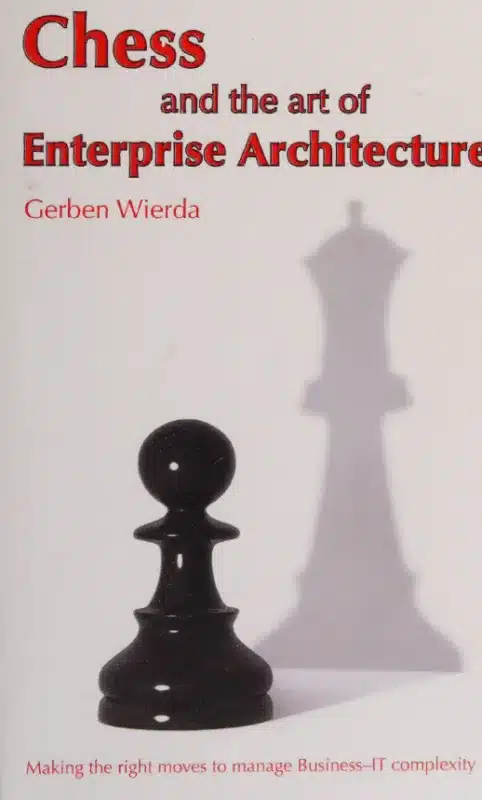
- Author: Gerben Wierda
- Publication date : January 1, 2015
- Page Number : 252 pages
Chess and the Art of Enterprise Architecture
Gerben Wierda’s “Chess and the Art of Enterprise Architecture” confronts a central paradox within information technology: while the discipline of enterprise architecture (EA) was established to bring order, foresight, and alignment to the Business-IT landscape, it has largely failed to deliver on its promises. This book presents a compelling critique of orthodox EA practices and offers a powerful, alternative vision. Its core value lies in providing a new mental model for architects and leaders, one that abandons rigid, predictive planning in favor of a more dynamic, collaborative, and governance-focused approach better suited to managing the inherent complexity of the modern enterprise.
Table of Contents
Chapter 1: An Inconvenient Truth
Chapter 2: The Purpose of Enterprise Architecture
Chapter 3: A Critique of the Orthodoxy
Chapter 4: The Chess Analogy
Chapter 5: A New Model: Playing ‘Enterprise Chess’
Chapter 6: A New Approach to Managing the Future
Chapter 7: Overcoming the Hurdles
Book Summary
Chapter 1: An Inconvenient Truth
The book opens with a provocative thesis: enterprise architecture as a discipline has failed. The author contends that despite decades of practice, the chaos, project failures, and Business-IT misalignment that EA was created to solve still persist. The book points to the frequent reorganization of EA departments and the perception of architects as ivory-tower theorists as clear evidence of this failure. The “inconvenient truth” is that the discipline’s foundational methods are flawed, and a new approach is required.
Chapter 2: The Purpose of Enterprise Architecture
This chapter clarifies the fundamental goals EA is meant to achieve. The author identifies three maturing objectives: preventing chaos by managing the constant stream of changes to the IT landscape; ensuring Business-IT alignment so that technology supports strategic goals; and enabling IT-Business alignment so the business can capitalize on technological innovation. The book emphasizes that all three goals revolve around effectively managing change in the face of an uncertain future.
Chapter 3: A Critique of the Orthodoxy
Here, the author critiques the standard, or “orthodox,” methods of practicing EA. The book argues that the two primary instruments of traditional EA are fundamentally flawed. The Future State Architecture (FSA), which relies on a rigid “IST-Gap-SOLL” (current state-gap-target state) analysis, is too inflexible for a volatile and unpredictable future. Secondly, the use of principles and guidelines often results in a massive, unusable binder of rules or a set of abstract platitudes that are ineffective in guiding real-world design choices.
Chapter 4: The Chess Analogy
This chapter introduces the book’s central and most powerful analogy. The author argues that chess is a far better metaphor for EA than city planning. A chess player does not have a precise end-state in mind but makes the best possible move based on the current board position, guided by descriptive tactical rules (e.g., “control the center”) rather than prescriptive laws. This analogy highlights the need to embrace complexity and unpredictability, treat principles as guiding heuristics, and pay attention to critical details, as even a single “pawn” can determine the outcome.
Chapter 5: A New Model: Playing ‘Enterprise Chess’
This chapter presents the author’s proposed solution: a collaborative, governance-based approach to EA. The goal is to create a “virtual enterprise chess grand master” through effective collaboration among domain experts. The practical “how” of this approach involves several key elements. The central EA function’s role shifts from dictating designs to facilitating a collaborative decision-making process. An Architecture Board serves as a forum for discussion and knowledge sharing among architects and stakeholders. Crucially, projects remain responsible for their own designs, with the central EA function providing review and feedback against long-term landscape goals.
Chapter 6: A New Approach to Managing the Future
The book offers an alternative to the flawed FSA model. Instead of attempting to predict a single future, the author advocates for using scenario planning. The core idea is to identify the most critical uncertainties the organization faces and design a landscape that is robust across multiple possible futures. The practical output is not a detailed blueprint but a board-approved list of uncertainties that all change initiatives must consider in their designs. This shifts the focus from building for a single, fragile future to creating a resilient, adaptable landscape.
Chapter 7: Overcoming the Hurdles
The final chapter addresses the significant challenges to implementing the “enterprise chess” approach, which are primarily cultural and political. The book identifies the single most critical hurdle as a lack of board commitment to the long-term, landscape-wide goals of EA. Other major obstacles include departmental silos, a cultural bias towards overly simplistic models, and cynicism resulting from past EA failures. The author concludes that while difficult, this realistic, move-by-move, collaborative approach is the only viable path to successfully managing enterprise complexity.
Overall Impact and Significance
“Chess and the Art of Enterprise Architecture” makes a significant contribution by challenging the foundational assumptions of the enterprise architecture discipline. Its primary impact is the introduction of a powerful new metaphor that reframes the role of the architect from a top-down planner to a strategic facilitator and governor. By exposing the flaws of rigid, predictive models, the book provides a compelling argument for embracing complexity and adopting a more agile, collaborative, and resilient approach to managing the Business-IT landscape.
Conclusion and Recommendation
Gerben Wierda’s book is a clear, insightful, and highly valuable guide that provides not only a sharp critique of traditional EA but also a practical and actionable alternative. Its main contribution is the “enterprise chess” model, which offers a robust framework for the “how” of practicing architecture in a complex and unpredictable world. The book successfully addresses the persistent failures of the discipline by shifting the focus from creating static blueprints to facilitating a dynamic, intelligent, and collaborative decision-making process.
This book is strongly recommended for enterprise architects, CIOs, IT managers, and business leaders who are struggling with the gap between the promise and the reality of enterprise architecture. It is an essential read for anyone seeking a more effective way to align technology with business strategy and manage the inherent complexity of the modern enterprise.
About the Author
Gerben Wierda is a Dutch enterprise architect, author, and thought leader known for his rigorous and practical approach to modeling complex IT landscapes. He currently serves as Team Coordinator for Architecture & Design at APG, one of the largest fiduciary asset managers in Europe.
With an academic foundation in Physics (M.Sc., University of Groningen) and an MBA from RSM Erasmus University, Wierda blends analytical precision with strategic insight. His career includes pivotal roles such as:
- Lead Architect of the Judiciary of The Netherlands
- Lead Architect at APG Asset Management
He is best known for authoring:
- Chess and the Art of Enterprise Architecture – a metaphor-rich exploration of strategic architecture thinking
- Mastering ArchiMate (multiple editions) – a comprehensive guide to the ArchiMate® modeling language, widely used in enterprise architecture
Wierda is also a regular columnist for the Enterprise Architecture Professional Journal, where his column On Slippery Ice tackles nuanced challenges in IT strategy, AI, and organizational agility.