













- Author: Melanie Mitchell
- Publication date : November 17, 2020
- Page Number : 336 pages
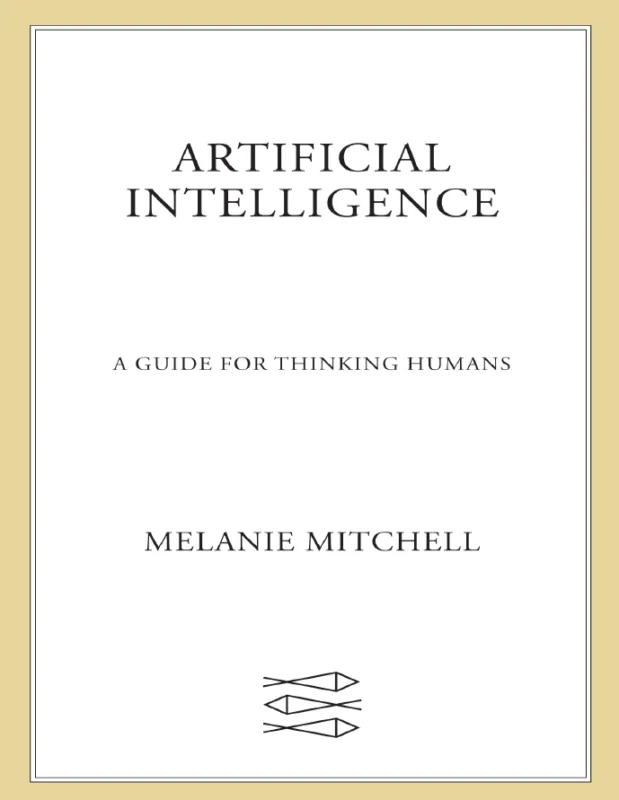
Artificial Intelligence - A Guide for Thinking Humans
As Artificial Intelligence evolves from a niche academic field into a world-shaping force, the public discourse is often clouded by a mixture of hype and anxiety. Melanie Mitchell’s “Artificial Intelligence: A Guide for Thinking Humans” cuts through this noise to serve as an indispensable and clear-eyed guide.
The book’s primary objective is to demystify the field, moving beyond sensationalist headlines to provide a foundational understanding of what modern AI is, what it can actually do, and, most importantly, what it cannot. Its value lies in its role as an expert-led, critical investigation that equips the reader with the knowledge necessary to separate genuine technological progress from the pervasive myths that cloud the public discourse.
Table of Contents
Introduction ……………………………………………… 3
Part 1 Foundational Concepts and the Current AI Landscape …….. 4
Part 2 The Challenge of Computer Vision …………………….. 5
Part 3 The Limits of Learning in Games ……………………… 6
Part 4 The Quest for Natural Language Understanding ………….. 7
Part 5 The Unbreached Barrier of Meaning …………………… 8
Overall Impact and Significance ……………………………. 9
Conclusion and Recommendation ……………………………… 9
About the Author: ……………………………………….. 10
Book Summary
Part I: Foundational Concepts and the Current AI Landscape
This section lays the historical and conceptual groundwork for understanding the current state of AI, tracing its evolution from early theories to the dominant paradigms of today.
Intellectual Origins and Core Dichotomy
The book begins by tracing the intellectual origins of the field to the 1956 Dartmouth Workshop. The author introduces the fundamental schism that defined early research: Symbolic AI, a “top-down” approach focused on encoding human knowledge into explicit logical rules, versus Subsymbolic AI, a “bottom-up,” brain-inspired approach where knowledge is learned from data.
The Ascent of Machine Learning
From there, the author explains the modern ascent of machine learning, detailing the evolution from simple models to complex, multi-layered neural networks. The book presents the back-propagation algorithm as the key technical breakthrough that made these networks practical and effective.
Framing the Current AI Spring
Finally, this part frames the current “AI Spring” by examining the influential predictions of a coming Singularity. This sets the stage for the book’s central inquiry: Is the current wave of AI fundamentally different, or does it represent another cycle of hype that underestimates the profound difficulty of replicating genuine intelligence?
Part II: The Challenge of Computer Vision
This part of the book uses the domain of vision to illustrate the immense gap between AI’s pattern-matching capabilities and the richness of human cognition.
The Richness of Human Cognition
The author masterfully demonstrates that human vision is not mere object recognition but a deeply cognitive process. It involves the inference of actions, emotions, and context to form a holistic understanding that is far beyond any current AI.
The Technology of Machine Vision
The book then demystifies the technology behind modern computer vision: deep convolutional neural networks (ConvNets). It highlights the ImageNet competition as the watershed event that launched the deep learning revolution and established this technology as the industry standard.
Critical Flaws and Ethical Concerns
Crucially, the author provides a critical analysis of the deep flaws in these systems. The book argues that they are brittle, biased, and vulnerable to adversarial examples—tiny, human-imperceptible changes that cause catastrophic failure. This reveals that their “learning” is superficial, leading to a necessary discussion of the ethical consequences of deploying such powerful yet flawed systems.
Part III: The Limits of Learning in Games
This section examines the landmark achievements of AI in complex games, using them to highlight the narrow, hyper-specialized nature of machine intelligence.
Learning Through Reinforcement
The author first introduces Reinforcement Learning (RL), a machine learning paradigm where an “agent” learns a strategy through trial and error by receiving rewards for its actions in a given environment.
Landmark Achievements in Gaming
This sets the context for the celebrated successes of Google’s DeepMind, from mastering Atari video games to the historic victory of AlphaGo over the world’s greatest Go player. These are presented as monumental engineering feats that demonstrate the power of modern AI techniques.
The “Idiot Savant” Problem
However, the author persuasively argues that this superhuman performance does not equate to general intelligence. The book explains that these systems are “idiot savants” that lack transfer learning; skills learned in one game do not transfer to any other task. Their competence is shown to be fragile, proving they have not learned abstract concepts but have only memorized statistical patterns.
Part IV: The Quest for Natural Language Understanding
This part addresses one of the most difficult challenges in AI: getting machines to understand and use human language in a meaningful way.
Representing Language for Machines
The book explains the core technologies that power modern language AI, including recurrent neural networks (RNNs) for processing sequences and word vectors, a technique that represents words in a geometric space to capture semantic relationships.
The Illusion of Translation
The author then demystifies neural machine translation systems like Google Translate, explaining the encoder-decoder architecture. While acknowledging their effectiveness, the book uses a series of revealing examples to show how these systems fail on idioms, sarcasm, and context, proving they operate on patterns without a genuine grasp of meaning.
The Commonsense Gap
This critique extends to question-answering systems. The book shows that while machines excel at “answer extraction,” they consistently fail on tests like Winograd Schemas, which require commonsense reasoning to resolve simple ambiguities.
Part V: The Unbreached Barrier of Meaning
The final section of the book synthesizes the preceding arguments to define the fundamental obstacles that prevent current AI from achieving genuine, human-like understanding.
The Pillars of Human Understanding
Drawing on cognitive science, the author outlines the essential components of human intelligence that AI lacks. The book posits that our intelligence is built upon a foundation of core knowledge and that we make sense of the world by forming abstract concepts through analogy.
Alternative Paths to Intelligence
The book contrasts the dominant deep learning approach with alternative research paths, such as the decades-long Cyc project to manually encode all of human common sense, and research focused on modeling the core cognitive process of analogy-making.
A Sobering Conclusion
In her conclusion, the author asserts that general, human-level AI remains a distant prospect. The book argues that the most pressing near-term danger is not a malevolent superintelligence but the societal risk of deploying brittle, unreliable, and fundamentally uncomprehending systems in critical, high-stakes applications.
Overall Impact and Significance
Melanie Mitchell’s book makes a significant contribution by providing a much-needed dose of intellectual humility and scientific rigor to the public conversation about AI. Its primary impact is its ability to empower the non-expert reader to look past the marketing and hype and ask critical questions about the nature of intelligence. By systematically exposing the limitations and vulnerabilities of today’s most advanced systems, the book reframes the quest for AI not as a race toward superintelligence, but as a scientific endeavor that reveals the profound and still-mysterious complexity of the human mind.
Conclusion and Recommendation
“Artificial Intelligence: A Guide for Thinking Humans” is a uniquely valuable and insightful work that masterfully explains the “what” and “how” of modern AI while relentlessly focusing on the gap between machine computation and human understanding. The book’s most significant contribution is its clear, evidence-based argument that current AI systems lack the common sense, abstraction, and analogy-making abilities that are the hallmarks of true intelligence. It successfully confronts the hype by providing a sober, accessible, and deeply informed analysis of the field’s actual achievements and its most fundamental challenges.
This book is strongly recommended for policymakers, business leaders, students, and any curious reader who wishes to develop a nuanced and realistic understanding of Artificial Intelligence. It is an essential read for anyone who wants to engage thoughtfully in one of the most important conversations of our time.
About the Author
Melanie Mitchell is a distinguished American computer scientist renowned for her work in complex systems, genetic algorithms, and artificial intelligence. She currently serves as a Professor at the Santa Fe Institute, where she also developed the popular online learning platform Complexity Explorer2.
Her academic path began with a deep fascination for AI sparked by reading Gödel, Escher, Bach by Douglas Hofstadter. This led her to pursue a Ph.D. at the University of Michigan under Hofstadter and John Holland, culminating in her influential dissertation on the Copycat cognitive architecture, a model for analogy-making and high-level perception.
Mitchell has authored several widely acclaimed books, including:
- An Introduction to Genetic Algorithms (MIT Press, 1996)
- Complexity: A Guided Tour (Oxford University Press, 2009) – winner of the 2010 Phi Beta Kappa Science Book Award
- Artificial Intelligence: A Guide for Thinking Humans (Farrar, Straus, and Giroux, 2019) – shortlisted for the 2023 Cosmos Prize for Scientific Writing3